
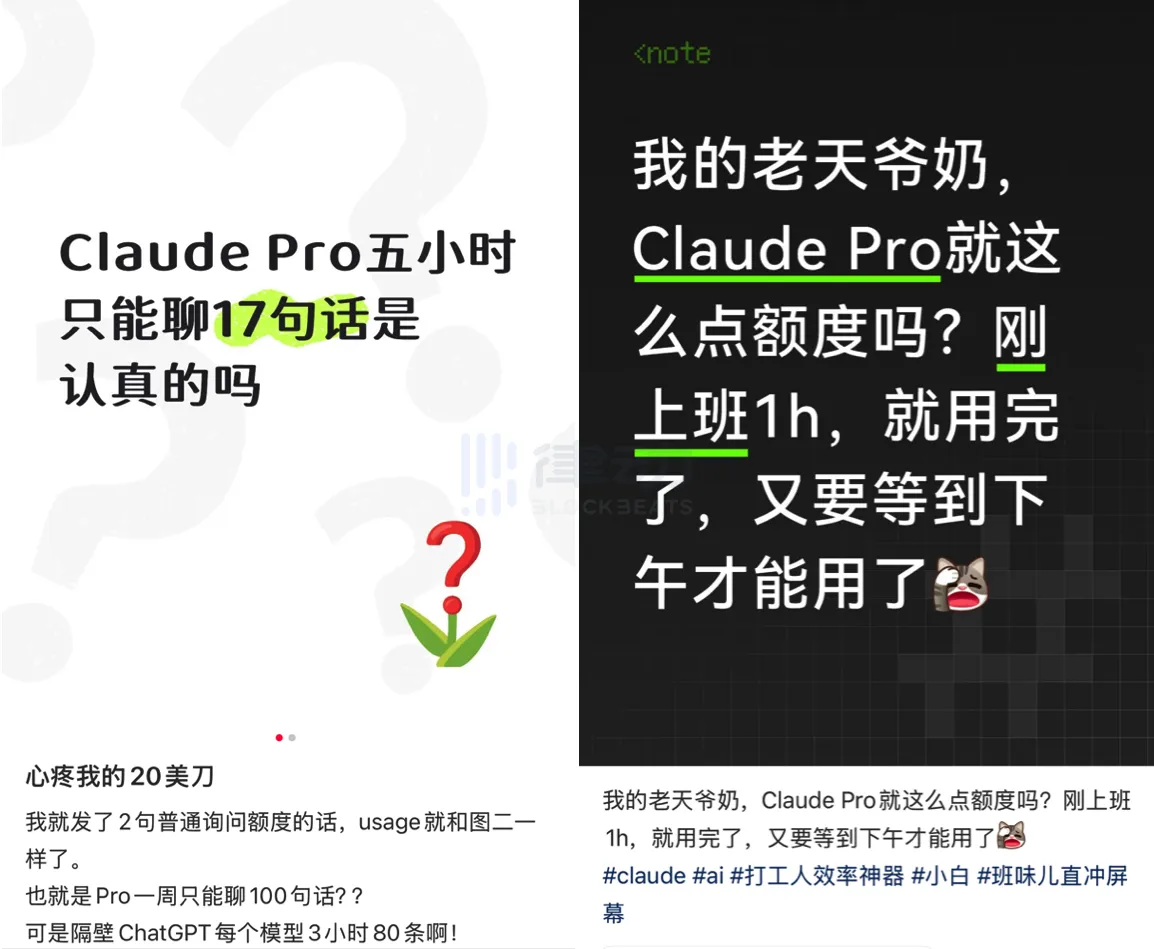
3 hellos limit, where did your Claude Code limit go? A 28-day cache Bug, and an official response that encourages you to "use it sparingly."

4-17%. This is the prompt cache hit rate for Claude Code in the past month. The normal level is 97-99%.
This means that when you resume a previous session, Claude Code does not reuse the previously processed context, but instead processes everything from scratch each time, consuming credits at a rate 10 to 20 times higher than normal. You may think you are continuing a conversation, but in reality, you are starting a completely new, full-priced conversation each time.
This data comes from independent developer ArkNill's proxy monitoring. By setting up a transparent proxy, he recorded every request between Claude Code and the Anthropic API, uncovering at least two client-side caching bugs that caused the API server to be unable to match cached conversation prefixes, forcing a full token rebuild each round.
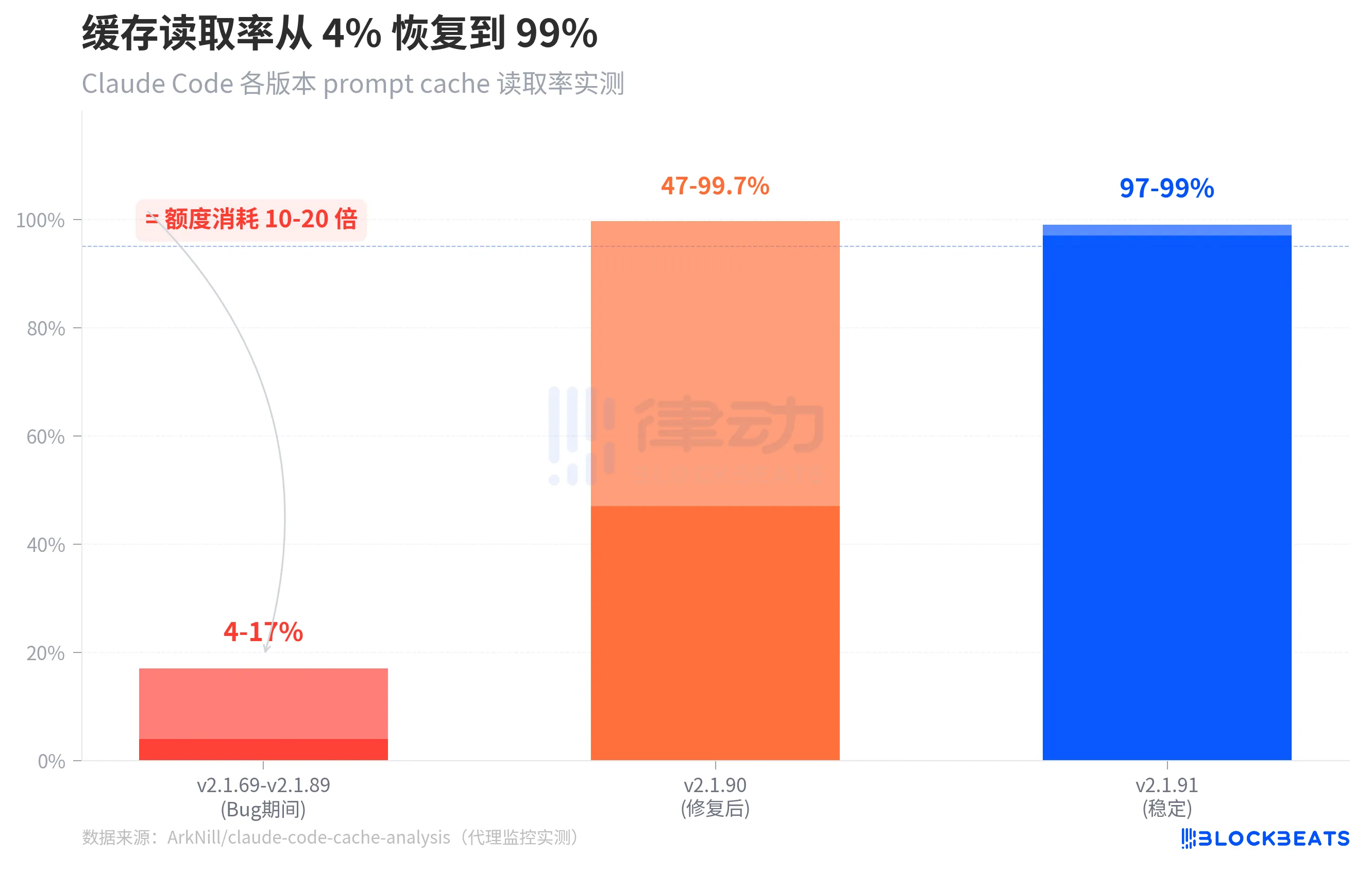
The graph above shows a comparison of cache hit rates across three stages. During versions v2.1.69 to v2.1.89 (the period of the bug), the standalone version's cache hit rate was only 4-17%. After fixing a critical bug in version v2.1.90, the cold start cache hit rate returned to 47-99.7%. By v2.1.91, the stable cache hit rate recovered to 97-99%.
One notable detail from the chart: the range in v2.1.90 is quite wide (47% to 99.7%) because the cache still needs to "warm up" when a session is just resumed, resulting in low hit rates in the first few rounds, but quickly returning to normal. In the bugged version, this warm-up never occurs — the cache hit rate always stays at 14,500 tokens of system prompt, with the full conversation history being fully billed each time.
28 Days, 20 Versions
This bug is not the type introduced in one update and fixed in the next. According to the npm registry release records, the version v2.1.69 that introduced the bug was released on March 4, and the version v2.1.90 that fixed the bug was released on April 1. There were 28 days in between, spanning 20 versions.
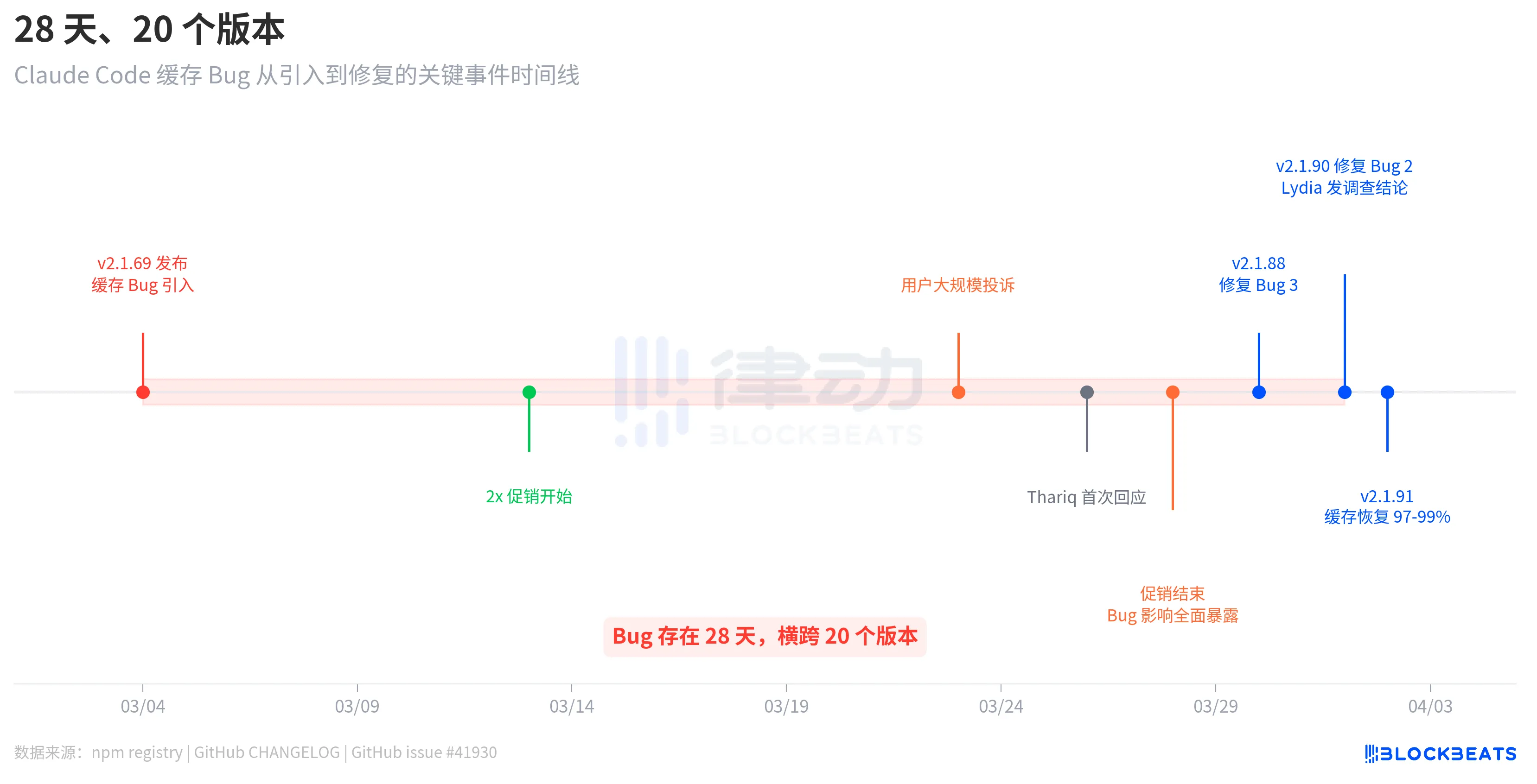
The timeline revealed a tantalizing detail. After the bug was introduced on March 4, users did not immediately complain on a large scale. It wasn't until March 23 that the complaints erupted en masse, almost three weeks later. The reason is that, according to the GitHub issue #41930 analysis, from March 13 to 28, Anthropic had a 2x quota promotion live (doubling during off-peak hours), which objectively masked the impact of the bug. After the promotion ended, the cache bug consumption returned to normal billing baselines, and users' quotas instantly "evaporated."
Anthropic's response was not swift. On March 26, three days after the user complaints erupted, engineer Thariq Shihipar announced on his personal X account that the peak hour limit (weekdays 5am-11am PT) had been tightened. On March 30, Anthropic admitted on Reddit that the "rate at which users hit their quota far exceeded expectations," listing it as the team's top priority. It wasn't until April 1 that team member Lydia Hallie released the official investigation findings.
Throughout the process, Anthropic did not release any blog posts, send email notifications, or update the status page. All official communication was done solely through engineers' personal social media posts and a few Reddit comments.
How Much Did You Pay, and How Long Can You Use It?
GitHub issue #41930 collected hundreds of user reports. The most extreme case was a Max 20x subscription user ($200/month), whose 5-hour rolling window was entirely consumed in 19 minutes. Max 5x users ($100/month) reported their 5-hour window was used up in 90 minutes. According to The Letter Two, some users claimed that a simple "hello" consumed 13% of their session quota. A Pro user ($20/month) on Discord mentioned that his quota "ran out every Monday and only reset on Saturday," with only 12 days of normal usage in 30 days.

Based on ArkNill's benchmark testing, in bug version v2.1.89, the 100% quota of the Max 20x plan would be depleted in about 70 minutes. He also calculated the cost of a single --resume operation for a 500K token context session, which is approximately $0.15, as the system fully replays the entire context.
「You're Holding It Wrong」
Lydia Hallie's investigation confirmed two points: first, there has indeed been a tightening of peak-hour limits, and second, there has been an increase in token consumption within the 1 million token context. She mentioned that the team fixed some bugs but emphasized that "none of the bugs led to overcharging."
She then provided four frugality recommendations:
1. Use Sonnet 4.6 instead of Opus (Opus consumes at about twice the rate);
2. Lower the reasoning depth or turn off extended thinking when deep reasoning is not needed;
3. Do not resume long idle sessions for over an hour; start a new one instead;
4. Set the environment variable CLAUDE_CODE_AUTO_COMPACT_WINDOW=200000 to limit the context window size.
No mention was made of any form of quota reset or compensation.
AI podcast host Alex Volkov summarized this response as "You're holding it wrong," pointing out that Anthropic itself set the 1 million token context as the default, promoted Opus as the flagship model, and highlighted extended thinking as a selling point, but is now advising paying users not to use these features.
The assertion of "no overcharging" also creates tension with Claude Code's own update history. Just the day before Lydia's response, v2.1.90 fixed a cache regression bug that had been present since v2.1.69: when using --resume to resume a session, requests that should have hit the cache would trigger a complete prompt cache miss, resulting in full billing. Lydia's response did not mention this confirmed billing anomaly.
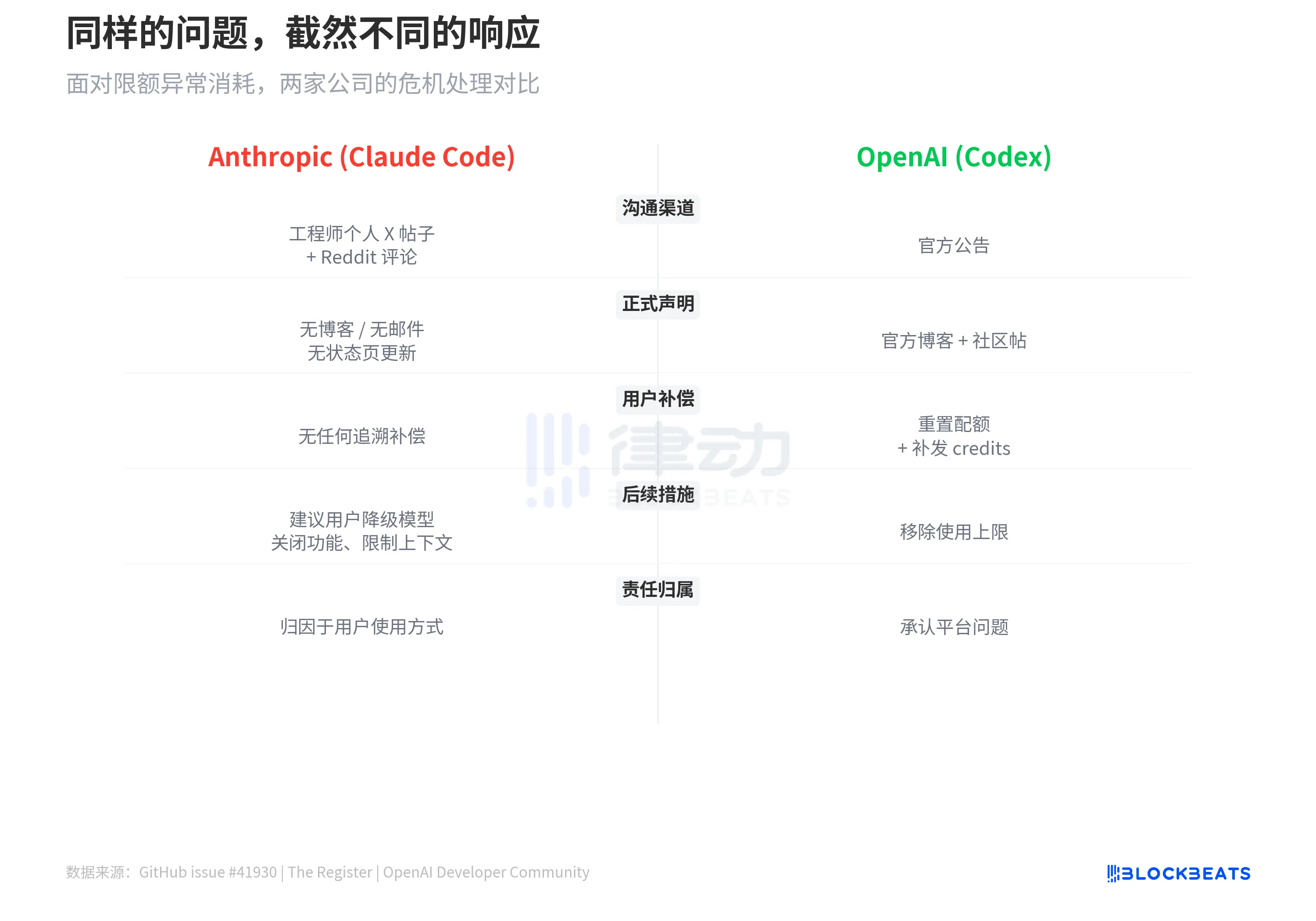
For comparison, OpenAI's Codex had previously experienced similar abnormal quota consumption issues. OpenAI's approach was to reset user quotas, issue credit refunds, and announce the removal of the usage cap on Codex in March. Anthropic's approach is to advise users to downgrade models, disable features, limit context, and attribute responsibility to user usage.
Anthropic sells a subscription for the "strongest model + maximum context + highest reasoning capabilities," charging a fee of $20 to $200 per month. A 28-day caching bug caused the paid users' quotas to deplete at a rate 10-20 times faster, with the official response being to use it sparingly.
You may also like

Morning Report | BitMine increased its holdings by 126,971 ETH last week; trader Eugene announced his exit from the crypto market

Wang Chuan: How can one not feel anxious after the neighbor Old Wang made thirty times profit by investing in storage stocks? (Seven) - A quarter-century cycle

Cryptocurrency CEXs are flocking to sell US stocks, and traditional brokerages are facing an "uninvited guest."

$75 billion in foreign capital has fled, and South Korean retail investors have absorbed it all using leverage

Japan’s Three Megabanks Plan Joint Stablecoin Issuance in Fiscal 2026
MUFG, SMBC, and Mizuho reportedly plan to jointly issue fiat-pegged stablecoins in fiscal 2026, signaling Japan’s growing push into bank-led digital payment infrastructure.

Humanity Discloses H Token Dual-Chain Attack Details, With Losses on Ethereum and BSC Exceeding $36 Million
Humanity said the H token attack across Ethereum and BSC caused more than $36 million in losses after leaked ProxyAdmin keys enabled malicious contract upgrades and token minting.
White House Discusses CLARITY Act With Law Enforcement Ahead of Senate Vote
The White House discussed the CLARITY Act with law enforcement ahead of a Senate vote, focusing on illicit finance risks and developer protections.

Bitcoin Trading Guide 2026: Strategies for Experienced Traders

What Is XAUT and PAXG? Why Tokenized Gold Is Booming in 2026

Will the SpaceX IPO Hurt Bitcoin? Here's What Traders Are Watching

Foreign selling in the South Korean stock market accelerates, with cumulative net sales reportedly reaching $75 billion this year
On June 9, The Kobeissi Letter, citing Goldman Sachs data, reported that global investors are selling South Korean stocks at an unusually rapid pace. In the latest trading session, foreign investors sold about $801 million worth of Kospi constituent stocks again; total foreign outflows last week reached about $10 billion, and the market has been in net foreign selling on nearly every trading day over the past month. According to the data cited in the report, foreign investors have sold about $75 billion worth of South Korean stocks so far this year. Meanwhile, South Korean retail and institutional investors together recorded roughly $69 billion in net buying over the same period, suggesting that the market’s main buying support has come from domestic capital rather than returning overseas funds. The information currently disclosed still mainly comes from The Kobeissi Letter’s retelling and Goldman Sachs data summaries, while public details on the statistical period and the specific definition of “selling” remain relatively limited.

Fortune Warns of Strategy’s Financing Structure Risks as Bitcoin Premium Narrows
Fortune warned that Strategy’s Bitcoin treasury model faces growing financing risks as MSTR’s net asset premium narrows and preferred stock dividend pressure increases.

Ferrari Challenge Le Mans: Carl Moon to Dominate in WEEX Livery

Sahara AI Responds to SAHARA’s Sharp Drop: No Contract or Product Security Issues Found, Internal Investigation Underway
Sahara AI responded to SAHARA’s 60% price drop, saying no token contract or product security issues have been found and an internal investigation is underway.

WEEX Deposit/Withdrawal Dynamic Island: Your Asset Status, Always in Sight
Scaling Crypto Derivatives: The Digital Asset Infrastructure Behind High-Volume Trading
In the fast-moving digital asset ecosystem, derivatives platforms face an extreme architectural test. High-leverage futures markets demand more than just standard security—they require absolute operational precision, zero-latency matching engines, and ironclad structural scalability, all while navigating intense market volatility.
As global platforms scale to meet these demands, the industry is shifting away from rigid, monolithic setups toward a more agile, "decoupled" infrastructure philosophy.
The Blueprint for High-Volume Copy TradingFor elite global exchanges like WEEX (founded in 2018), this architectural choice becomes critical when scaling high-volume retail features like social copy trading. When thousands of users automatically mirror the real-time strategies of elite traders simultaneously, it triggers sudden, monumental spikes in concurrent transactional volume.
To prevent execution latency or settlement bottlenecks during these peak volatility events, a platform's primary engine must remain entirely dedicated to risk management, copy-trade synchronization, and order matching.
The Architectural Rule: New-generation platforms must separate front-end user execution engines from heavy backend infrastructural overhead to eliminate operational friction.
By separating these layers, platforms can maintain complete sovereignty over their trading environments and user experiences while strategically aligning with institutional-grade infrastructure ecosystems. This strategic framework allows modern exchanges to leverage advanced Digital Asset Custody infrastructure such as Cobo’s behind the scenes, ensuring that backend wallet management scales elastically alongside trading spikes.
Capitalizing on Market Momentum and 400× LeverageIn a derivatives arena where platforms offer up to 400× leverage on perpetual contracts, capital efficiency and market agility are core business metrics. To capture market momentum, an exchange needs the ability to rapidly expand its asset offerings, supporting everything from legacy crypto assets to sudden, trending altcoins across a massive library of trading pairs.
Adopting a flexible, scalable Wallet-as-a-Service (WaaS) solution such as Cobo’s could completely rewrite the development timeline for high-growth exchanges. Instead of spending months of engineering capital building out custom backend wallet architectures for every new blockchain network, platforms can deploy localized infrastructure in days.
This agility allows platforms to instantly scale their listings to over a thousand trading pairs without compromising security or delaying time-to-market. It mirrors the exact operational advantages seen during high-velocity market events, similar to how advanced wallet infrastructure empowers platforms during sudden asset surges; allowing exchanges to pass that speed and liquidity directly to their global user base.
A Mature Foundation for GrowthThe synergy between trusted infrastructure ecosystems and global trading platforms represents the natural evolution of a maturing crypto market. As WEEX continues to scale its global spot and derivatives offerings for over 6 million users, adopting robust backend paradigms proves that platforms no longer have to compromise between cutting-edge trading velocity and uncompromised structural security.

Get Paid to Onboard? Try WEEX’s New Homepage with Rewards for Registration, Deposit & Trade
WEEX Custom Layout: Build Your Perfect Trading Workspace in Seconds
Morning Report | BitMine increased its holdings by 126,971 ETH last week; trader Eugene announced his exit from the crypto market
Wang Chuan: How can one not feel anxious after the neighbor Old Wang made thirty times profit by investing in storage stocks? (Seven) - A quarter-century cycle
Cryptocurrency CEXs are flocking to sell US stocks, and traditional brokerages are facing an "uninvited guest."
$75 billion in foreign capital has fled, and South Korean retail investors have absorbed it all using leverage
Japan’s Three Megabanks Plan Joint Stablecoin Issuance in Fiscal 2026
MUFG, SMBC, and Mizuho reportedly plan to jointly issue fiat-pegged stablecoins in fiscal 2026, signaling Japan’s growing push into bank-led digital payment infrastructure.
Humanity Discloses H Token Dual-Chain Attack Details, With Losses on Ethereum and BSC Exceeding $36 Million
Humanity said the H token attack across Ethereum and BSC caused more than $36 million in losses after leaked ProxyAdmin keys enabled malicious contract upgrades and token minting.


