
After 767 days, what does SBF's comeback tweet signify?


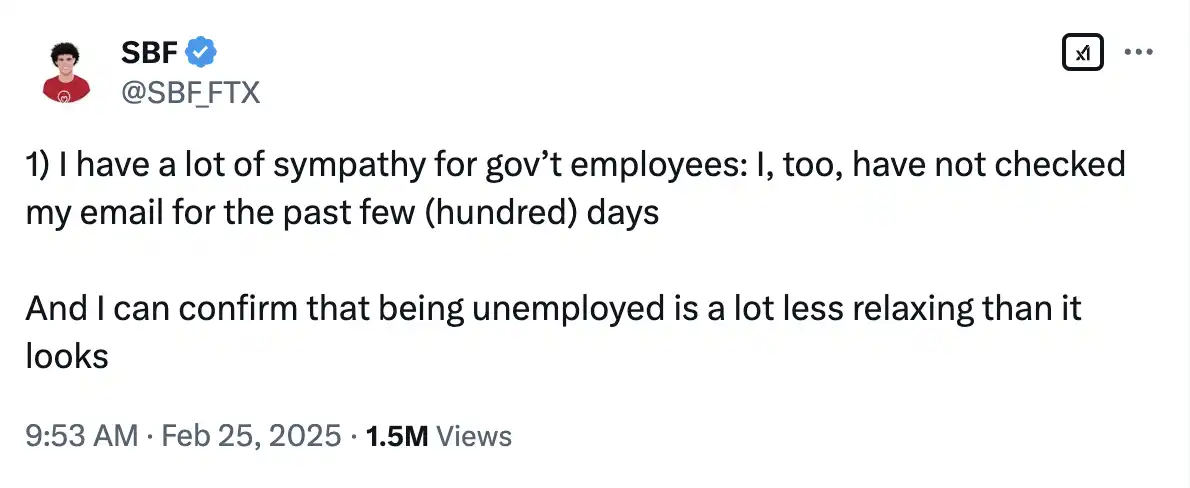
Two years later, SBF tweeted again, discussing the experience of firing employees. He wrote that firing employees is a very difficult and unpleasant thing, but often it is a problem in company management that leads to employees having to be let go, keeping employees in the company who have no value is instead a waste. SBF's lengthy discussion of firing also inevitably evokes recent crazy "layoffs" by the U.S. government.
The market has reignited the expectation that SBF will be pardoned, with FTT briefly breaking through $2.2, now priced at $2.05, a 24-hour increase of 11.8%.
SBF Changes Political Alignment, Clearly "Sides" with Trump to Seek Pardon
It all started when Trump took office.
On January 22, Trump posted on his social media platform Truth Social stating that he had pardoned the Silk Road founder, "Just got off the phone with Ross William Ulbricht's mother, told her, I am honored to have just signed a full and unconditional pardon for her son Ross."
By the end of the month, insiders leaked that SBF's parents, Stanford Law School professor Joseph Bankman and Barbara Fried, had recently met with lawyers and other Trump insiders in an attempt to seek a pardon for SBF, but it is unclear whether they have contacted the White House.
On February 18, like many in the crypto industry hoping to gain political points in Trump's second term, SBF, in an interview with the New York Sun, openly "sided" with Trump: "I have spent a lot of time studying crypto policy, and I am very frustrated and disappointed by what I have seen and heard from the Biden administration and the Democratic Party. The Biden administration is very destructive and difficult to work with, frankly, the Republicans are much more reasonable."
SBF hinted that his right-leaning tendency began in 2022 because he and Trump share a common enemy, namely Judge Lewis Kaplan, who is responsible for the FTX fraud case and the Trump federal defamation case trial.

In 2020, SBF was the second-largest donor to the Biden campaign, but SBF now says, "I used to think of myself as center-left, but now I don't see myself that way anymore. The tech industry has undergone an atmospheric shift, with former outspoken Democrats like Mark Zuckerberg and Marc Andreessen now all supporting Trump."
Bringing DOGE Close, What Does SBF Mean?
In SBF's return tweet, he core-expressed one thing, and that is "Firing employees is one of the hardest things in the world," which inevitably reminds people of Trump's Department of Government Efficiency (DOGE), whose most accomplished act after taking office was to fire government officials. Even SBF's prosecutor resigned due to the "new leader takes office with a bang," as the Justice Department asked her to halt her corruption investigation into New York City Mayor Eric Adams.
According to The Washington Post, in the three weeks since Trump's second term began, a series of actions with advisor Musk has sparked widespread controversy. Musk-led Department of Government Efficiency in the United States has intervened in 18 federal agencies, terminated 199 federal contracts, and attempted to dismiss tens of thousands of federal employees.
On February 16, the local time on the 15th, the Department of Government Efficiency led by Elon Musk (DOGE) sent dismissal notices to over a dozen staff members of the United States Digital Service. The office is an information technology (IT) department of the White House's Executive Office of the President, now under the management of the Department of Government Efficiency (DOGE).
Even the SEC had to make changes. On February 25, according to two sources familiar with the matter, the U.S. Securities and Exchange Commission (SEC) plans to replace top leadership in its regional offices nationwide as part of its cost-cutting proposal to the Trump administration.
Sources said the SEC told directors of its 10 regional offices on Friday that their positions will be eliminated according to the plan to be submitted next month. The SEC oversees over $100 trillion in U.S. capital markets and is currently under pressure from Trump to downsize and cut costs.
SBF's heartfelt and lengthy tweet can be said to hit the nail on the head.
Attached SBF Tweet Full Translation
I sympathize greatly with government employees: I myself have not checked my email in several hundred days. And I can confirm that being unemployed is harder than it looks.
Firing employees is one of the most challenging things in the world and is a terrible thing for all involved parties.
My experience is:
a) Firing employees is usually not their fault.
b) But often, firing them is still the right decision.
A more common issue is that the company simply did not have a position that was the right fit for them.
I tell every person who has been laid off: This is also our fault because we did not find the right position for them, or we did not find the right person to manage them, or we did not provide the right work environment for them.
Perhaps at that time, we did not have the right people to manage them. Maybe they performed best when working remotely, but our company is primarily based on face-to-face communication. Maybe they wanted to be involved in a specific project, but that project happened to not be what the company needed.
Or perhaps the department they were in had issues of its own. This situation happens. We have seen it at our competitors' where they hired an excess of 30,000 employees and had no idea how to allocate them—resulting in the whole team sitting there every day doing nothing.
We have also seen this internally, where when a manager becomes too busy or distracted, half of the department loses direction at the same time. In such situations, the employees are not at fault. If the employer does not know how to allocate them or does not have the right people to manage them effectively, it is not their fault. If internal politics cause the department to lose its way, that is not their fault either. But keeping them in the company, doing nothing, is futile.
You may also like

Japan’s Three Megabanks Plan Joint Stablecoin Issuance in Fiscal 2026
MUFG, SMBC, and Mizuho reportedly plan to jointly issue fiat-pegged stablecoins in fiscal 2026, signaling Japan’s growing push into bank-led digital payment infrastructure.

Humanity Discloses H Token Dual-Chain Attack Details, With Losses on Ethereum and BSC Exceeding $36 Million
Humanity said the H token attack across Ethereum and BSC caused more than $36 million in losses after leaked ProxyAdmin keys enabled malicious contract upgrades and token minting.

White House Discusses CLARITY Act With Law Enforcement Ahead of Senate Vote
The White House discussed the CLARITY Act with law enforcement ahead of a Senate vote, focusing on illicit finance risks and developer protections.

$75 billion in foreign capital has fled, and South Korean retail investors have absorbed it all using leverage

Bitcoin Trading Guide 2026: Strategies for Experienced Traders

What Is XAUT and PAXG? Why Tokenized Gold Is Booming in 2026

Cryptocurrency CEXs are flocking to sell US stocks, and traditional brokerages are facing an "uninvited guest."

Will the SpaceX IPO Hurt Bitcoin? Here's What Traders Are Watching
Foreign selling in the South Korean stock market accelerates, with cumulative net sales reportedly reaching $75 billion this year
On June 9, The Kobeissi Letter, citing Goldman Sachs data, reported that global investors are selling South Korean stocks at an unusually rapid pace. In the latest trading session, foreign investors sold about $801 million worth of Kospi constituent stocks again; total foreign outflows last week reached about $10 billion, and the market has been in net foreign selling on nearly every trading day over the past month. According to the data cited in the report, foreign investors have sold about $75 billion worth of South Korean stocks so far this year. Meanwhile, South Korean retail and institutional investors together recorded roughly $69 billion in net buying over the same period, suggesting that the market’s main buying support has come from domestic capital rather than returning overseas funds. The information currently disclosed still mainly comes from The Kobeissi Letter’s retelling and Goldman Sachs data summaries, while public details on the statistical period and the specific definition of “selling” remain relatively limited.

Fortune Warns of Strategy’s Financing Structure Risks as Bitcoin Premium Narrows
Fortune warned that Strategy’s Bitcoin treasury model faces growing financing risks as MSTR’s net asset premium narrows and preferred stock dividend pressure increases.

Ferrari Challenge Le Mans: Carl Moon to Dominate in WEEX Livery

Sahara AI Responds to SAHARA’s Sharp Drop: No Contract or Product Security Issues Found, Internal Investigation Underway
Sahara AI responded to SAHARA’s 60% price drop, saying no token contract or product security issues have been found and an internal investigation is underway.

WEEX Deposit/Withdrawal Dynamic Island: Your Asset Status, Always in Sight
Scaling Crypto Derivatives: The Digital Asset Infrastructure Behind High-Volume Trading
In the fast-moving digital asset ecosystem, derivatives platforms face an extreme architectural test. High-leverage futures markets demand more than just standard security—they require absolute operational precision, zero-latency matching engines, and ironclad structural scalability, all while navigating intense market volatility.
As global platforms scale to meet these demands, the industry is shifting away from rigid, monolithic setups toward a more agile, "decoupled" infrastructure philosophy.
The Blueprint for High-Volume Copy TradingFor elite global exchanges like WEEX (founded in 2018), this architectural choice becomes critical when scaling high-volume retail features like social copy trading. When thousands of users automatically mirror the real-time strategies of elite traders simultaneously, it triggers sudden, monumental spikes in concurrent transactional volume.
To prevent execution latency or settlement bottlenecks during these peak volatility events, a platform's primary engine must remain entirely dedicated to risk management, copy-trade synchronization, and order matching.
The Architectural Rule: New-generation platforms must separate front-end user execution engines from heavy backend infrastructural overhead to eliminate operational friction.
By separating these layers, platforms can maintain complete sovereignty over their trading environments and user experiences while strategically aligning with institutional-grade infrastructure ecosystems. This strategic framework allows modern exchanges to leverage advanced Digital Asset Custody infrastructure such as Cobo’s behind the scenes, ensuring that backend wallet management scales elastically alongside trading spikes.
Capitalizing on Market Momentum and 400× LeverageIn a derivatives arena where platforms offer up to 400× leverage on perpetual contracts, capital efficiency and market agility are core business metrics. To capture market momentum, an exchange needs the ability to rapidly expand its asset offerings, supporting everything from legacy crypto assets to sudden, trending altcoins across a massive library of trading pairs.
Adopting a flexible, scalable Wallet-as-a-Service (WaaS) solution such as Cobo’s could completely rewrite the development timeline for high-growth exchanges. Instead of spending months of engineering capital building out custom backend wallet architectures for every new blockchain network, platforms can deploy localized infrastructure in days.
This agility allows platforms to instantly scale their listings to over a thousand trading pairs without compromising security or delaying time-to-market. It mirrors the exact operational advantages seen during high-velocity market events, similar to how advanced wallet infrastructure empowers platforms during sudden asset surges; allowing exchanges to pass that speed and liquidity directly to their global user base.
A Mature Foundation for GrowthThe synergy between trusted infrastructure ecosystems and global trading platforms represents the natural evolution of a maturing crypto market. As WEEX continues to scale its global spot and derivatives offerings for over 6 million users, adopting robust backend paradigms proves that platforms no longer have to compromise between cutting-edge trading velocity and uncompromised structural security.

Morning Report | BitMine increased its holdings by 126,971 ETH last week; trader Eugene announced his exit from the crypto market

Wang Chuan: How can one not feel anxious after the neighbor Old Wang made thirty times profit by investing in storage stocks? (Seven) - A quarter-century cycle

Get Paid to Onboard? Try WEEX’s New Homepage with Rewards for Registration, Deposit & Trade
WEEX Custom Layout: Build Your Perfect Trading Workspace in Seconds
Japan’s Three Megabanks Plan Joint Stablecoin Issuance in Fiscal 2026
MUFG, SMBC, and Mizuho reportedly plan to jointly issue fiat-pegged stablecoins in fiscal 2026, signaling Japan’s growing push into bank-led digital payment infrastructure.
Humanity Discloses H Token Dual-Chain Attack Details, With Losses on Ethereum and BSC Exceeding $36 Million
Humanity said the H token attack across Ethereum and BSC caused more than $36 million in losses after leaked ProxyAdmin keys enabled malicious contract upgrades and token minting.
White House Discusses CLARITY Act With Law Enforcement Ahead of Senate Vote
The White House discussed the CLARITY Act with law enforcement ahead of a Senate vote, focusing on illicit finance risks and developer protections.
$75 billion in foreign capital has fled, and South Korean retail investors have absorbed it all using leverage
Bitcoin Trading Guide 2026: Strategies for Experienced Traders
What Is XAUT and PAXG? Why Tokenized Gold Is Booming in 2026


