
Aptos Accuses Monad of Plagiarism: Tech Theft or Traffic Riding?




Perhaps influenced by the official announcement of HyperEVM launching, Monad, a competitor in the L1 space, finally couldn't sit still. Just one day after the launch of HyperEVM, this project which raised a $225 million investment led by Paradigm in April last year finally launched its testnet.
However, amid a wave of community excitement and various airdrop tutorials, another L1 competitor, Aptos, directly posted on the social media platform X, accusing Monad of copying Aptos's technology. Thus, a war of words began.
The Debate
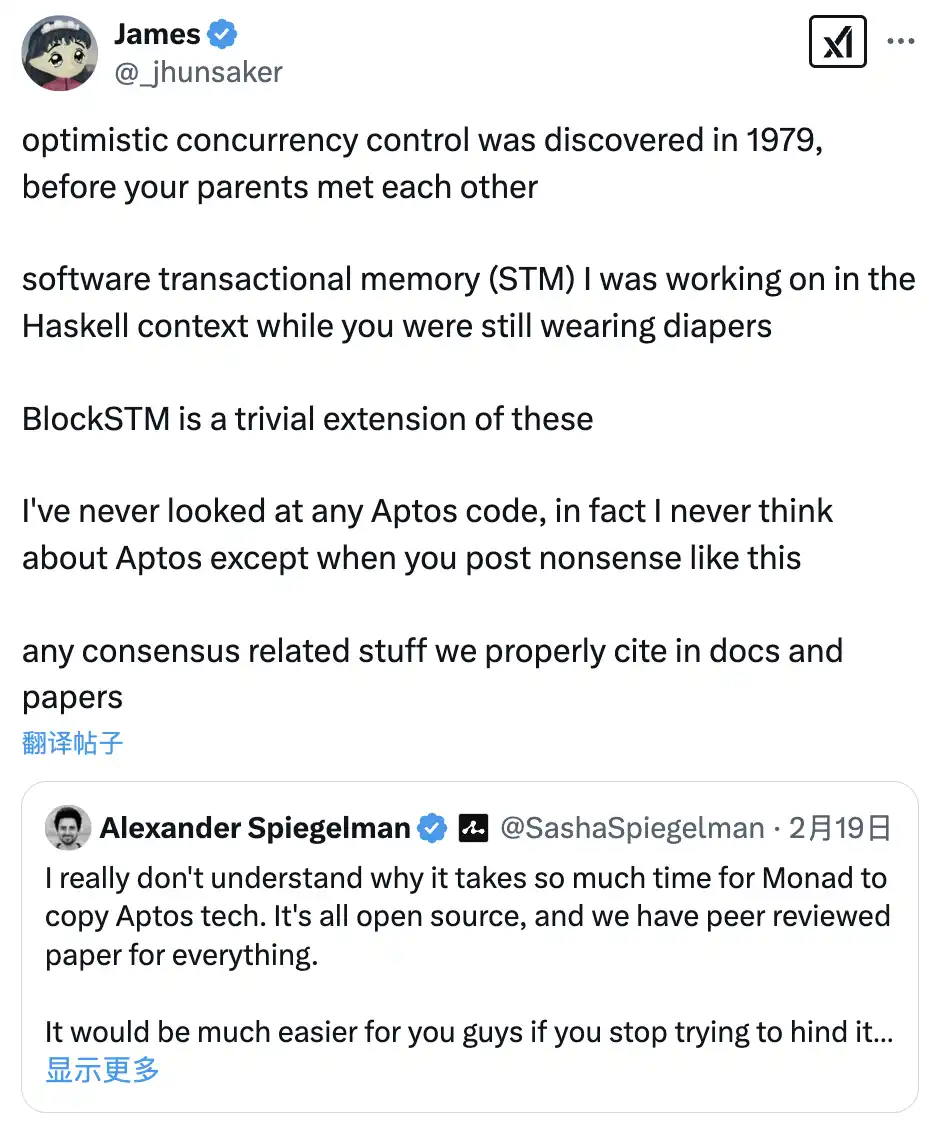
This dispute over technical originality was first sparked by Aptos's Research Director, Alexander Spiegelman: "I don't understand why Monad is spending so much time copying Aptos's technology. Everything is open source, and there have already been many peer-reviewed papers. Instead of being secretive, it's better to shamelessly copy directly."
At a time when Monad was in the spotlight, co-founder James Hunsaker naturally couldn't stand someone ruining the party and directly fired back in the comments: "Optimistic Concurrency Control (OCC) was discovered in 1979 when your parents hadn't even met. I had already been studying Software Transactional Memory (STM) in a Haskell environment long ago, while you were still in diapers. BlockSTM is a simple extension of these things. I have never seen any Aptos code. In fact, if you hadn’t spread this nonsense, I wouldn’t have even thought about Aptos. Anything related to consensus, we will correctly reference in documentation and papers."
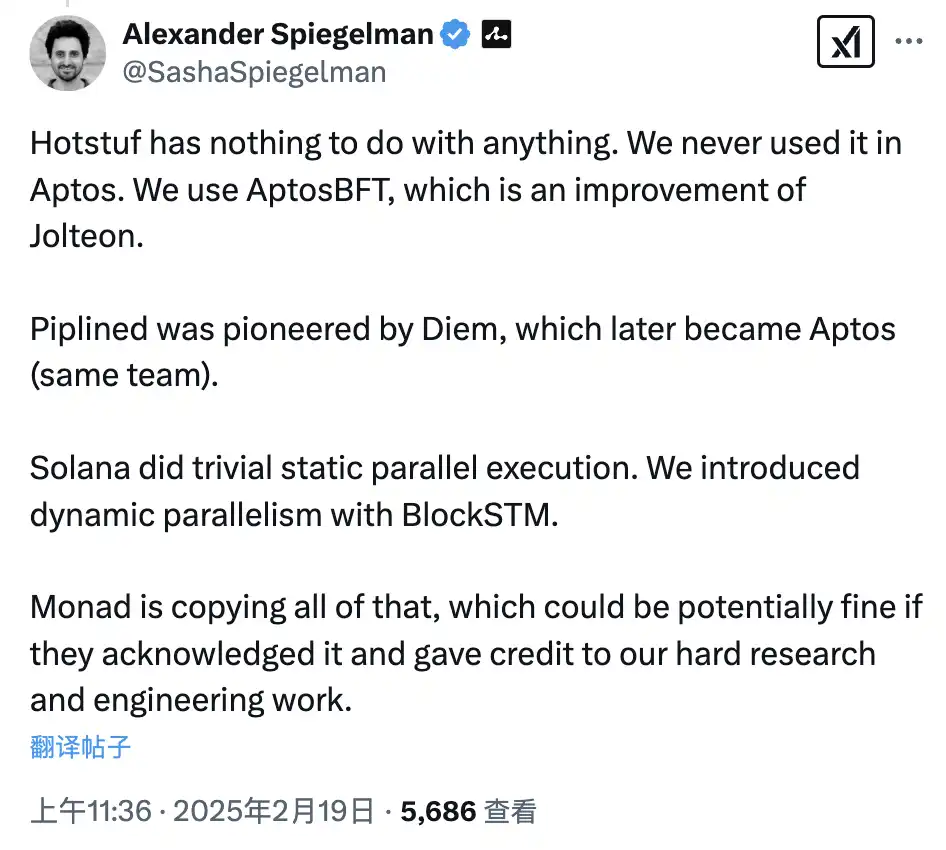
Seeing Hunsaker's denial, Spiegelman once again presented the facts and reasoned: "There's no need to attack individuals instead of addressing the issue. We all know how and why Monad was created. BlockSTM is one of the very few (if not the only one) STM put into production. Before BlockSTM, nothing could really achieve efficiency. With your background, you should know this. Although there are thousands of papers, nothing truly achieves scalability. BlockSTM is a breakthrough, and BlockSTM v2 is the future." Then, he didn't forget to show off his own qualifications: "By the way, I don’t know about you, but when I was a baby, I didn't even wear diapers yet."

The smell of gunpowder grew stronger, Hunsaker directly skipped the technical issue and retorted, "Were you crawling on the ground before?" At this point, Spiegelman was already extremely speechless and helplessly countered, "Do you know the difference between a reader-writer lock and a mutex lock?" This time, Hunsaker on the other side did not reply anymore.

Later, in the comment section, Spiegelman joked, "I think by the time you finally go online in 2029, we will all know the truth." He then muttered, "Monad is replicating our technology. If they can acknowledge and give us due recognition for our hard work in research and engineering, then perhaps it can be accepted."

New Public Chain Plagiarism Incidents: Is It a "Crypto Sector Feature of Open Source Culture"?
Plagiarism controversies surrounding new public chains are not uncommon in the cryptocurrency field. Sonic's high-performance design was once questioned for imitating Solana's PoH and pipeline architecture. Sui and Aptos, sharing the same origin as Diem, saw disputes over the similarities between the Move language and parallel execution, igniting a "brotherly feud." Aleo's zk-SNARKs were accused of directly copying zkSync's ZKP framework. Berachain's modular architecture and IBC function were seen by the Cosmos community as a "luxury fork," while Mantra's RWA tokenization model was believed to have drawn inspiration from Ondo Finance's successful experience.
The crypto industry upholds the spirit of open source, with most projects making their code public. In the current cryptocurrency market where the saying "time is money" is manifested to the extreme, the phenomenon of "fast fish eating slow fish" is common. In such an environment, the open-source culture has fostered some projects that directly Ctrl C+Ctrl V code. Even in non-crypto fields, disputes have arisen in the early development of the Linux kernel over code contributions.
Related reading: "Blast Accused of Copying OP Code: Is There Chaos Behind the "L2 Pipeline"?"
This open-source culture has greatly reduced the barrier to entry for new public chains, allowing new projects to quickly iterate on the shoulders of giants. In the debate between Monad and Aptos, Aptos's BlockSTM open-sourcing has provided a reference for the industry, from which Monad may potentially draw. However, Hunsaker argues that their technology is based on earlier OCC and STM and represents the industry's overall progress, reflecting the common logic of new public chains: open-source achievements are public resources, and borrowing is natural. The open-source culture enables new public chains to launch high-performance solutions in a short period of time, but it has also made it difficult to resolve the issue of originality and ownership.
Airdrop occurring as Testnet Goes Live: Competing for Technology or Traffic?
The timing of this debate is quite coincidental as it coincides with the launch of the Monad testnet, adding a subtle layer of complexity. The testnet is a crucial moment for Monad to attract developers, validate the technology, and build community trust, yet Aptos's accusations have shifted the focus from Monad's technical showcase to the standoff between the two.
As an emerging L1 that has not yet launched its mainnet, Monad, backed by last year's Paradigm's $2.25 billion investment and the narrative of being the "Ethereum High-Performance Evolutionist," has accumulated a significant community expectation. For this testnet, the Monad team was well prepared, triggering a set of combos to maintain community attention and goodwill as soon as it went live. The Monad team announced on social media that they had sent test tokens to over 8.8 million active Ethereum addresses, Backpack Wallet had already supported the Monad testnet, and Wormhole had officially launched on the Monad testnet.
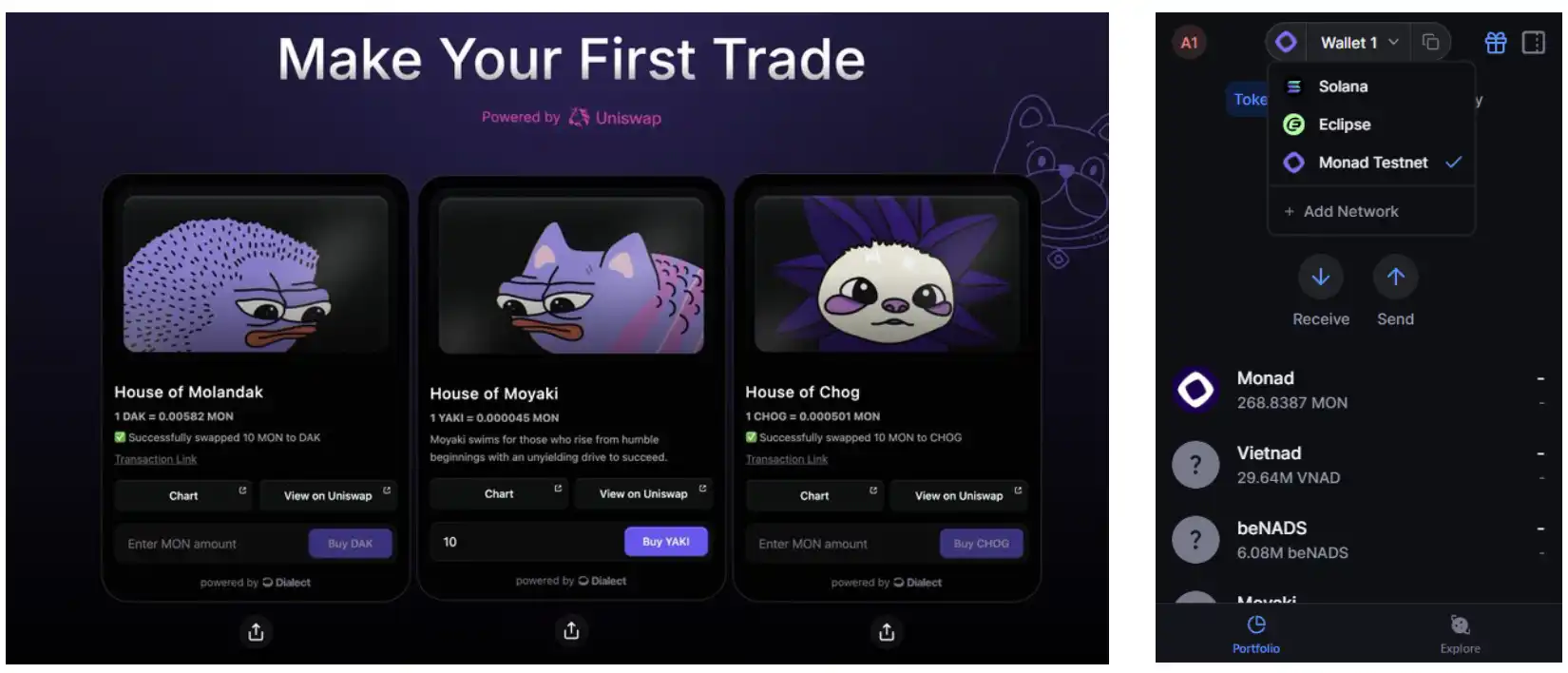
For Monad, the testnet launch is not only an opportunity for technical validation but also a critical window to attract EVM developers and users. If they can deliver on the promise of 10,000 TPS, Monad is poised to establish itself in the L1 race, potentially threatening the market position of high-performance chains like Aptos. On Platform X, the community's high expectations for the testnet have escalated the hype, with users calling it a "scientist's money-making project" and numerous airdrop tutorials popping up. This momentum is the narrative capital that Monad needs to protect and amplify.
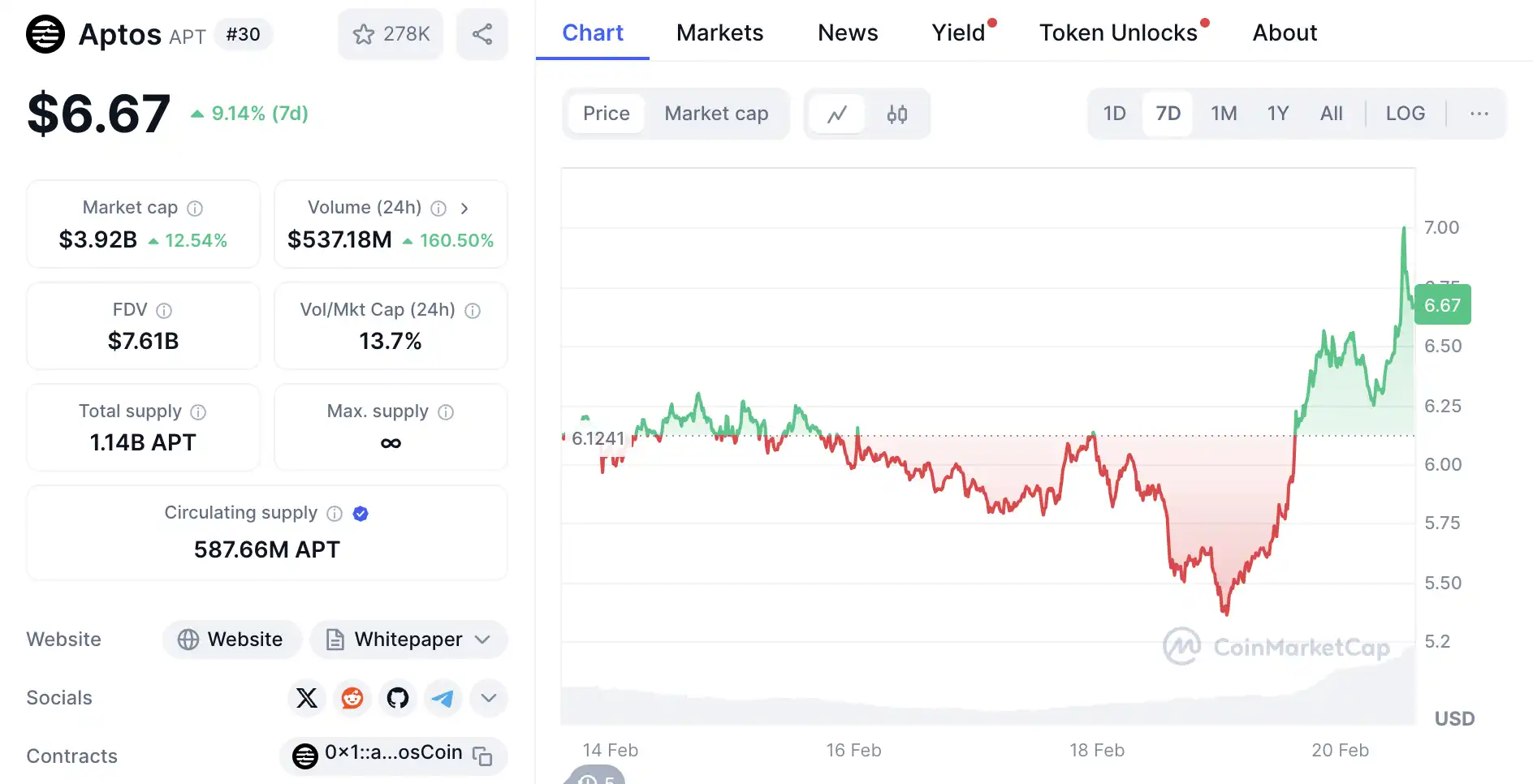
On the other hand, Aptos's research director, Spiegelman, chose to launch the accusations on the day of the testnet, perhaps with considerations of market competition. Although the debate on who the true technology original is remains inconclusive, Aptos's decision to launch an attack when Monad was gaining a wave of traffic has clearly paid off. As the community eagerly watches, Aptos's native token APT has shown a strong price increase. At the time of writing, according to market data, APT has surged by 7% in the past 24 hours, briefly reaching $7.
The recent Aptos move may win more than just a price pump. In the crypto market, attention is a scarce resource. Since January when Coinbase's listing roadmap added Aptos Network's USDC, there hasn't been much news about Aptos this year. This accusation has to some extent redirected the market's attention to Aptos's open-source contributions and technical expertise, throwing some shade on the hot project Monad.
In the face of this controversy, neither Monad nor Aptos's official accounts have made a statement yet. BlockBeats will continue to track the developments of this event.
You may also like

Cryptocurrency CEXs are flocking to sell US stocks, and traditional brokerages are facing an "uninvited guest."

Will the SpaceX IPO Hurt Bitcoin? Here's What Traders Are Watching
Foreign selling in the South Korean stock market accelerates, with cumulative net sales reportedly reaching $75 billion this year
On June 9, The Kobeissi Letter, citing Goldman Sachs data, reported that global investors are selling South Korean stocks at an unusually rapid pace. In the latest trading session, foreign investors sold about $801 million worth of Kospi constituent stocks again; total foreign outflows last week reached about $10 billion, and the market has been in net foreign selling on nearly every trading day over the past month. According to the data cited in the report, foreign investors have sold about $75 billion worth of South Korean stocks so far this year. Meanwhile, South Korean retail and institutional investors together recorded roughly $69 billion in net buying over the same period, suggesting that the market’s main buying support has come from domestic capital rather than returning overseas funds. The information currently disclosed still mainly comes from The Kobeissi Letter’s retelling and Goldman Sachs data summaries, while public details on the statistical period and the specific definition of “selling” remain relatively limited.

Fortune Warns of Strategy’s Financing Structure Risks as Bitcoin Premium Narrows
Fortune warned that Strategy’s Bitcoin treasury model faces growing financing risks as MSTR’s net asset premium narrows and preferred stock dividend pressure increases.

Ferrari Challenge Le Mans: Carl Moon to Dominate in WEEX Livery

Sahara AI Responds to SAHARA’s Sharp Drop: No Contract or Product Security Issues Found, Internal Investigation Underway
Sahara AI responded to SAHARA’s 60% price drop, saying no token contract or product security issues have been found and an internal investigation is underway.

WEEX Deposit/Withdrawal Dynamic Island: Your Asset Status, Always in Sight

Scaling Crypto Derivatives: The Digital Asset Infrastructure Behind High-Volume Trading
In the fast-moving digital asset ecosystem, derivatives platforms face an extreme architectural test. High-leverage futures markets demand more than just standard security—they require absolute operational precision, zero-latency matching engines, and ironclad structural scalability, all while navigating intense market volatility.
As global platforms scale to meet these demands, the industry is shifting away from rigid, monolithic setups toward a more agile, "decoupled" infrastructure philosophy.
The Blueprint for High-Volume Copy TradingFor elite global exchanges like WEEX (founded in 2018), this architectural choice becomes critical when scaling high-volume retail features like social copy trading. When thousands of users automatically mirror the real-time strategies of elite traders simultaneously, it triggers sudden, monumental spikes in concurrent transactional volume.
To prevent execution latency or settlement bottlenecks during these peak volatility events, a platform's primary engine must remain entirely dedicated to risk management, copy-trade synchronization, and order matching.
The Architectural Rule: New-generation platforms must separate front-end user execution engines from heavy backend infrastructural overhead to eliminate operational friction.
By separating these layers, platforms can maintain complete sovereignty over their trading environments and user experiences while strategically aligning with institutional-grade infrastructure ecosystems. This strategic framework allows modern exchanges to leverage advanced Digital Asset Custody infrastructure such as Cobo’s behind the scenes, ensuring that backend wallet management scales elastically alongside trading spikes.
Capitalizing on Market Momentum and 400× LeverageIn a derivatives arena where platforms offer up to 400× leverage on perpetual contracts, capital efficiency and market agility are core business metrics. To capture market momentum, an exchange needs the ability to rapidly expand its asset offerings, supporting everything from legacy crypto assets to sudden, trending altcoins across a massive library of trading pairs.
Adopting a flexible, scalable Wallet-as-a-Service (WaaS) solution such as Cobo’s could completely rewrite the development timeline for high-growth exchanges. Instead of spending months of engineering capital building out custom backend wallet architectures for every new blockchain network, platforms can deploy localized infrastructure in days.
This agility allows platforms to instantly scale their listings to over a thousand trading pairs without compromising security or delaying time-to-market. It mirrors the exact operational advantages seen during high-velocity market events, similar to how advanced wallet infrastructure empowers platforms during sudden asset surges; allowing exchanges to pass that speed and liquidity directly to their global user base.
A Mature Foundation for GrowthThe synergy between trusted infrastructure ecosystems and global trading platforms represents the natural evolution of a maturing crypto market. As WEEX continues to scale its global spot and derivatives offerings for over 6 million users, adopting robust backend paradigms proves that platforms no longer have to compromise between cutting-edge trading velocity and uncompromised structural security.

Morning Report | BitMine increased its holdings by 126,971 ETH last week; trader Eugene announced his exit from the crypto market

Wang Chuan: How can one not feel anxious after the neighbor Old Wang made thirty times profit by investing in storage stocks? (Seven) - A quarter-century cycle

Get Paid to Onboard? Try WEEX’s New Homepage with Rewards for Registration, Deposit & Trade

WEEX Custom Layout: Build Your Perfect Trading Workspace in Seconds

See “Buy Walls” & “Sell Walls” Instantly: WEEX Launches the Depth Chart for Smarter Trades

What Is Quick Trade on WEEX? 2 Ways WEEX Ends Chart-Panel Jumping
Morning News | Five major virtual asset platforms in South Korea have experienced 57 incidents of hacking and system failures in six years; Grayscale submits registration application for Canton ETF

Should we escape the peak? The principle of the tail-end market in the stock market

RootData: May 2026 Cryptocurrency Exchange Transparency Research Report

Founder of Baixing.com: My Experience with Claude Code in Fourteen Points
Cryptocurrency CEXs are flocking to sell US stocks, and traditional brokerages are facing an "uninvited guest."
Will the SpaceX IPO Hurt Bitcoin? Here's What Traders Are Watching
Foreign selling in the South Korean stock market accelerates, with cumulative net sales reportedly reaching $75 billion this year
On June 9, The Kobeissi Letter, citing Goldman Sachs data, reported that global investors are selling South Korean stocks at an unusually rapid pace. In the latest trading session, foreign investors sold about $801 million worth of Kospi constituent stocks again; total foreign outflows last week reached about $10 billion, and the market has been in net foreign selling on nearly every trading day over the past month. According to the data cited in the report, foreign investors have sold about $75 billion worth of South Korean stocks so far this year. Meanwhile, South Korean retail and institutional investors together recorded roughly $69 billion in net buying over the same period, suggesting that the market’s main buying support has come from domestic capital rather than returning overseas funds. The information currently disclosed still mainly comes from The Kobeissi Letter’s retelling and Goldman Sachs data summaries, while public details on the statistical period and the specific definition of “selling” remain relatively limited.
Fortune Warns of Strategy’s Financing Structure Risks as Bitcoin Premium Narrows
Fortune warned that Strategy’s Bitcoin treasury model faces growing financing risks as MSTR’s net asset premium narrows and preferred stock dividend pressure increases.
Ferrari Challenge Le Mans: Carl Moon to Dominate in WEEX Livery
Sahara AI Responds to SAHARA’s Sharp Drop: No Contract or Product Security Issues Found, Internal Investigation Underway
Sahara AI responded to SAHARA’s 60% price drop, saying no token contract or product security issues have been found and an internal investigation is underway.


