
Bitcoin Flash Crashes Overnight, Worst-Case Scenario Could See a Dip to $80,000?




Original Article Title: "Crypto Market Experiences Overnight Flash Crash, Bitcoin Worst-Case Scenario to Drop to $80,000?"
Original Article Author: Lawrence, Mars Finance
At 3:15 a.m. Beijing time on February 19, the price of Bitcoin suddenly flash crashed to $93,300, hitting a new low in nearly two weeks. Although there was a subsequent rebound to $95,400, the significant price volatility caused a major shock to the market.
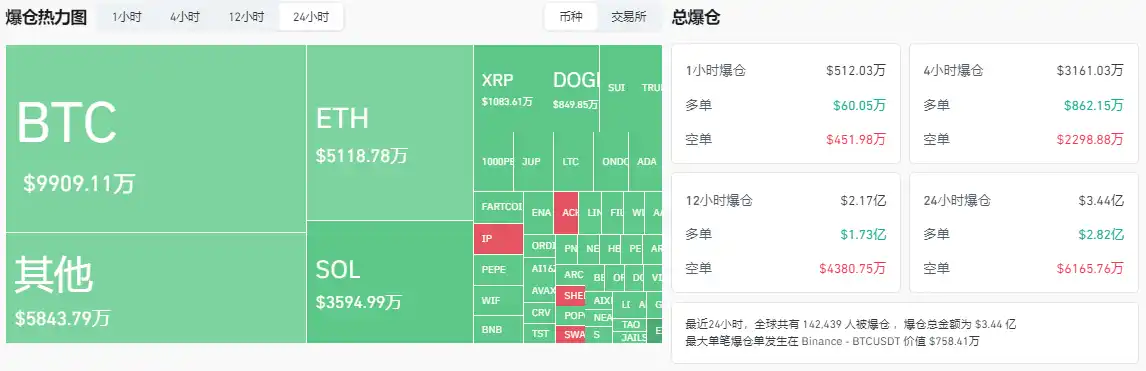
A 14-hour intense fluctuation plunged the derivatives market into chaos. According to Coinglass data, in the past 24 hours, 142,439 investors globally were liquidated, with a total liquidation amount of $344 million. The market's violent oscillation triggered investor panic and exposed the vulnerability of the cryptocurrency market.
Differential Performance of Core Assets
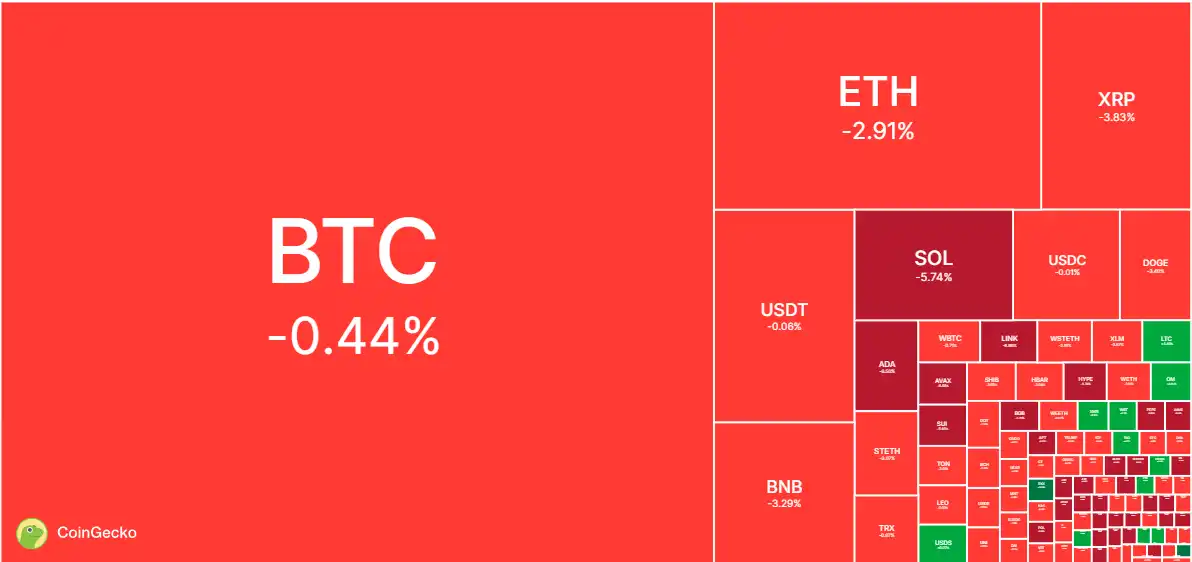
The crypto index shows a significant stratification of the market in this round of adjustment:
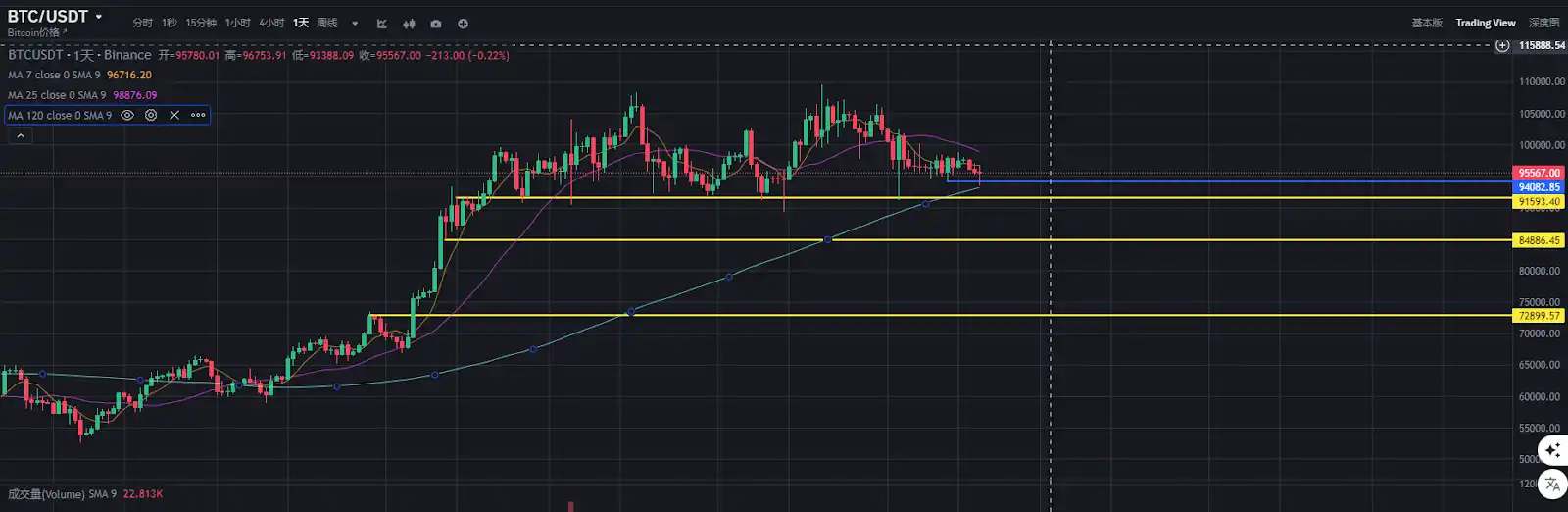
Bitcoin: Despite a 3.2% weekly decline, it remains above the 120-day moving average (around $93,000).
Ethereum: It bottomed out at the key psychological level of $2,600 (a 9.1% drop from the weekly high) and has since rebounded to $2,660, with a 30-day volatility of 47%
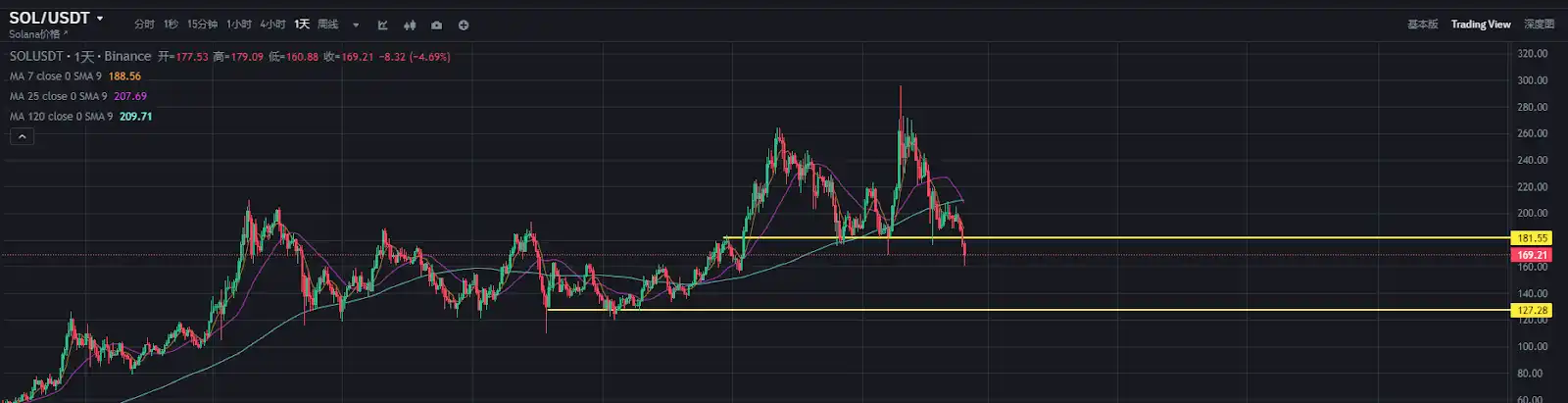
Altcoins in Ruins: Solana (SOL) plummeted by 20%, reaching a low of $160, currently priced at $169, erasing all gains since January 13. Dogecoin (DOGE) fell to $0.24, while XRP struggles to hold support around $2.47.
LIBRA Event Impacting Market Sentiment
The ongoing uncertainty in the macroeconomy continues to affect the cryptocurrency market, and the "scam" incident involving the LIBRA meme coin has exacerbated this downtrend sentiment.
QCP Capital's cryptocurrency options trading desk pointed out in their market analysis: "Due to the weak performance of ETH and other altcoins, Bitcoin's dominance has risen to 60%, its highest level in four years. The recent scandal involving Argentine President Javier Milei and LIBRA has also undermined confidence in altcoins and meme coins."
In addition, Bitcoin's upside has been limited since the Federal Reserve paused its hawkish interest rate policy in January. Federal Reserve Governor Patrick Harker has recently maintained a hawkish stance, stating that interest rates will continue to be stable until inflation is under control. This bearish sentiment has kept the Bitcoin price below $100,000 over the past two weeks, but Bitcoin's market dominance (BTC.D) has risen to over 60%, further suppressing the altcoin rebound.
Analyst Jamie Coutts believes that before Bitcoin may rebound, the market may experience another rally.
Bitcoin Cross-Exchange Flow Pulse Turns Bearish
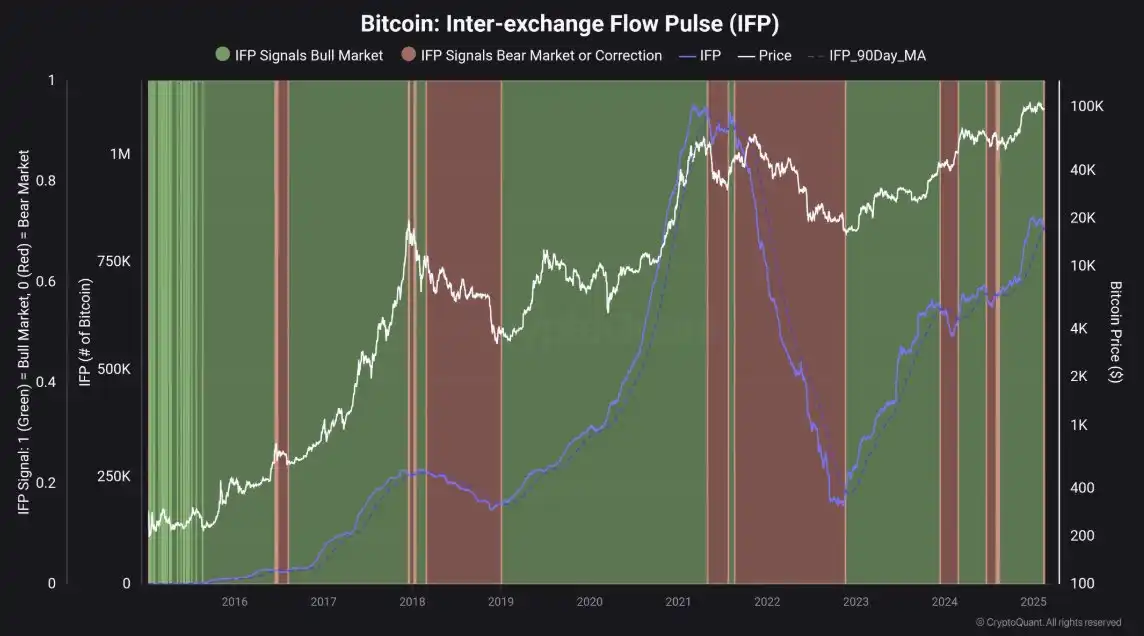
Bitcoin cross-exchange flow pulse chart. Data source: CryptoQuant
According to on-chain analyst Maartunn's analysis, Bitcoin's Inter-Exchange Flow Pulse (IFP) has turned negative, indicating a decrease in potential investors' risk appetite. The IFP metric measures the flow of Bitcoin between the spot and derivatives markets. Historical data shows that when the market is bullish and investor sentiment is high, more Bitcoin moves from spot to derivatives markets. However, when the market weakens, Bitcoin moves out of the futures market and into spot exchanges, showing investors' expectation of a price decline.
On February 16, the IFP metric turned negative for the first time since the third quarter of 2024, indicating a potential shift in market sentiment. Bitcoin researcher Axel Adler Jr also pointed out that Bitcoin futures' long liquidations have reached the highest level in two years. This is similar to the situation in January 2022, when long liquidations marked the beginning of a bear market.
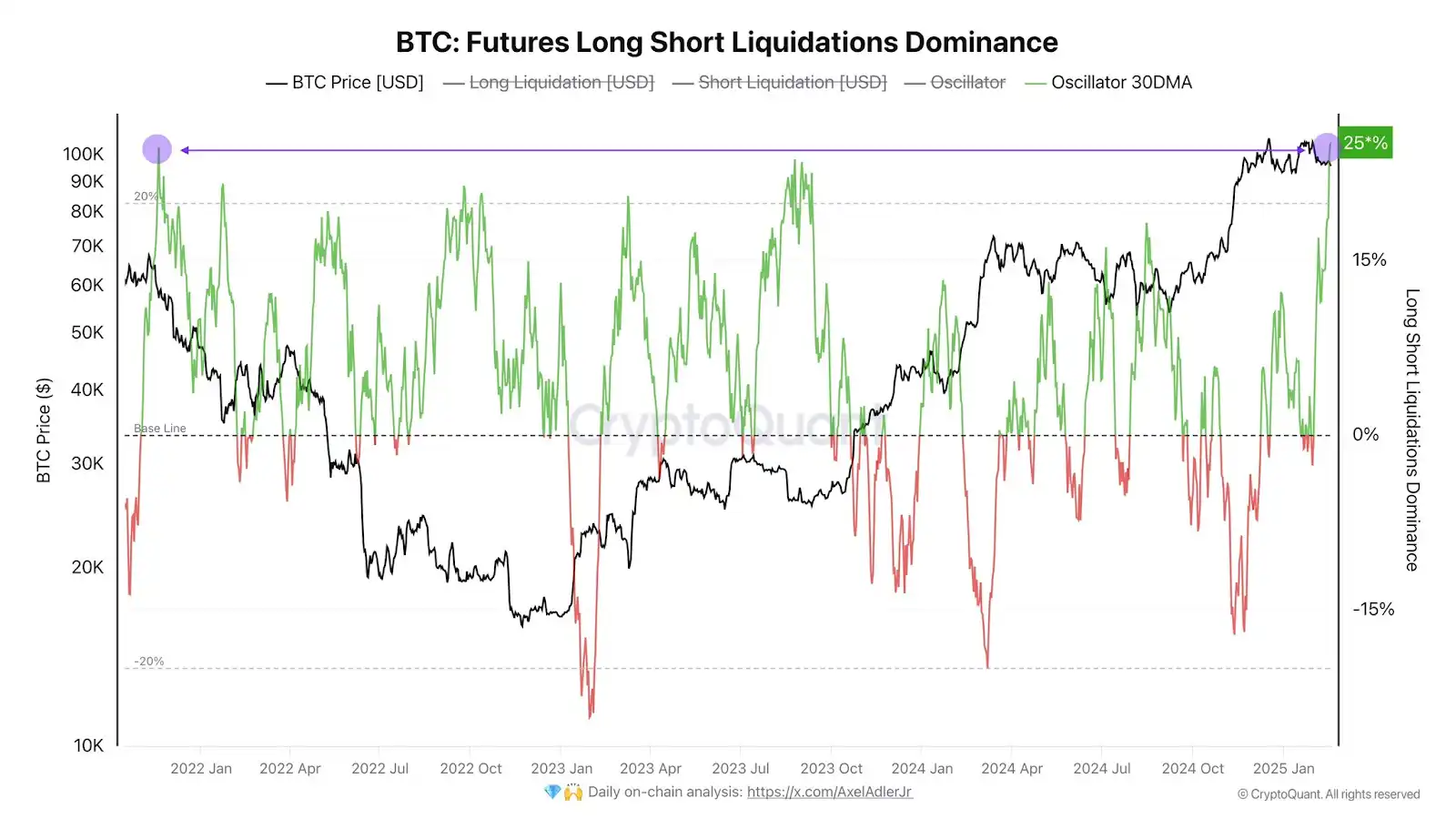
Bitcoin futures long/short liquidation dominance chart. Data source: X.com
Nevertheless, Adler stated that the market has responded to the pressure, indicating that buyers are still active during the adjustment period, engaging in "buying the dip," thereby limiting the extent of Bitcoin's decline.
However, for the bulls, the situation is not completely out of control, as Adler added,
“Currently, the market has responded adequately to this pressure, which actually indicates strong demand during the adjustment period. Buyers are actively 'buying the dip,' limiting the depth of Bitcoin's decline.”
Bitcoin's Worst-Case Scenario Could Drop to Near $80,000
Since February 3, Bitcoin has been consolidating in the range of $95,000 to $99,000. Over the past two weeks, the $95,000 support level has been tested five times. Continued testing of the support level may weaken the effectiveness of this range and increase the risk of breaking below support. Therefore, Bitcoin could close below $95,000 for the first time in the upcoming trades.
If the support level is breached, the price may further decline to a range between $91,130 and $88,909. If the market turns more bearish, the price could retrace to a range between $81,699 and $85,160, which was the price range during Bitcoin's early "Trump Pump" rebound period.
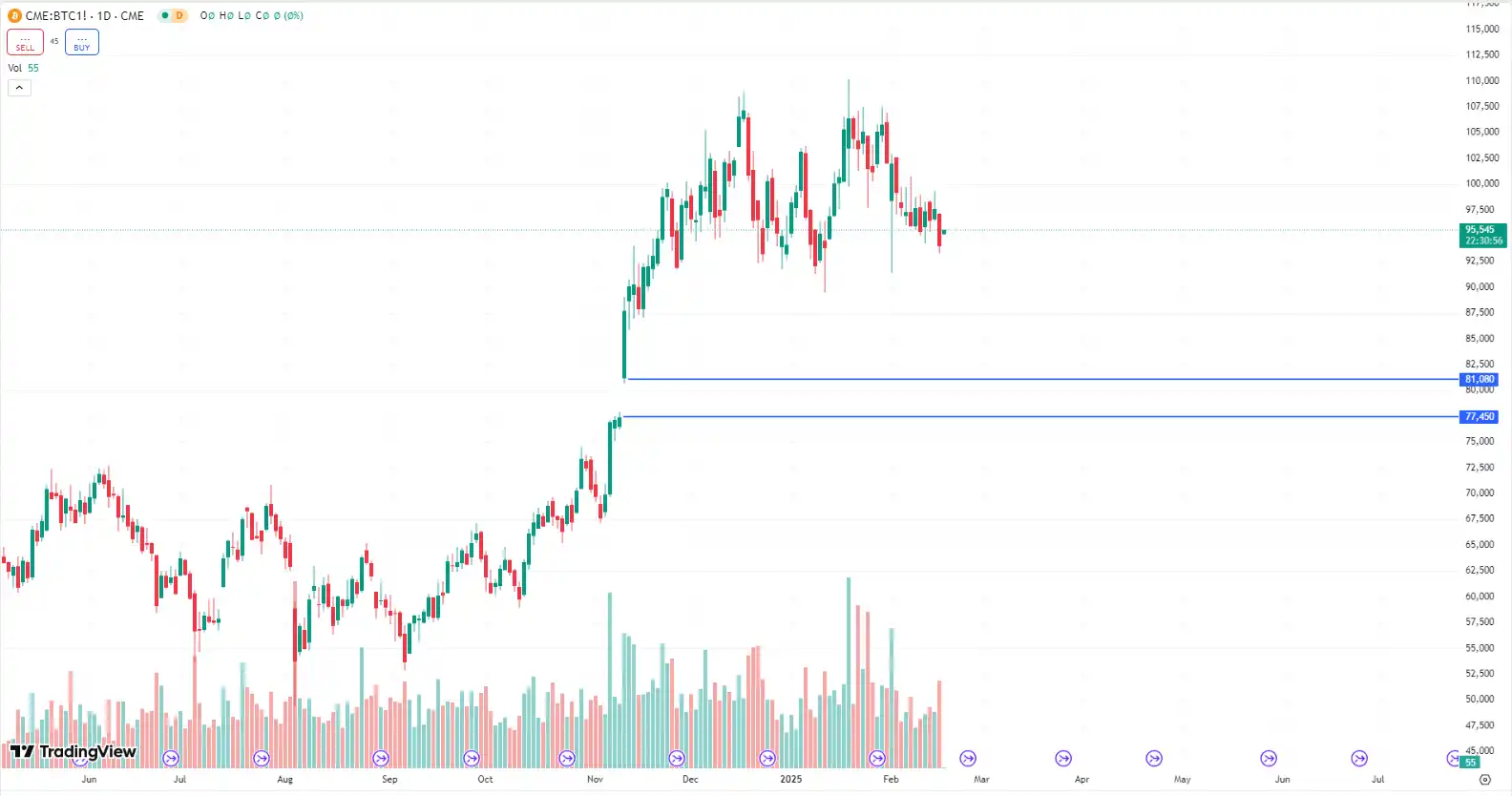
The CME's daily gap still remains between $77,000 and $80,000, which could represent Bitcoin's worst-case scenario, implying a further potential 15% drop in price.
You may also like

WEEX Deposit/Withdrawal Dynamic Island: Your Asset Status, Always in Sight

Scaling Crypto Derivatives: The Digital Asset Infrastructure Behind High-Volume Trading
In the fast-moving digital asset ecosystem, derivatives platforms face an extreme architectural test. High-leverage futures markets demand more than just standard security—they require absolute operational precision, zero-latency matching engines, and ironclad structural scalability, all while navigating intense market volatility.
As global platforms scale to meet these demands, the industry is shifting away from rigid, monolithic setups toward a more agile, "decoupled" infrastructure philosophy.
The Blueprint for High-Volume Copy TradingFor elite global exchanges like WEEX (founded in 2018), this architectural choice becomes critical when scaling high-volume retail features like social copy trading. When thousands of users automatically mirror the real-time strategies of elite traders simultaneously, it triggers sudden, monumental spikes in concurrent transactional volume.
To prevent execution latency or settlement bottlenecks during these peak volatility events, a platform's primary engine must remain entirely dedicated to risk management, copy-trade synchronization, and order matching.
The Architectural Rule: New-generation platforms must separate front-end user execution engines from heavy backend infrastructural overhead to eliminate operational friction.
By separating these layers, platforms can maintain complete sovereignty over their trading environments and user experiences while strategically aligning with institutional-grade infrastructure ecosystems. This strategic framework allows modern exchanges to leverage advanced Digital Asset Custody infrastructure such as Cobo’s behind the scenes, ensuring that backend wallet management scales elastically alongside trading spikes.
Capitalizing on Market Momentum and 400× LeverageIn a derivatives arena where platforms offer up to 400× leverage on perpetual contracts, capital efficiency and market agility are core business metrics. To capture market momentum, an exchange needs the ability to rapidly expand its asset offerings, supporting everything from legacy crypto assets to sudden, trending altcoins across a massive library of trading pairs.
Adopting a flexible, scalable Wallet-as-a-Service (WaaS) solution such as Cobo’s could completely rewrite the development timeline for high-growth exchanges. Instead of spending months of engineering capital building out custom backend wallet architectures for every new blockchain network, platforms can deploy localized infrastructure in days.
This agility allows platforms to instantly scale their listings to over a thousand trading pairs without compromising security or delaying time-to-market. It mirrors the exact operational advantages seen during high-velocity market events, similar to how advanced wallet infrastructure empowers platforms during sudden asset surges; allowing exchanges to pass that speed and liquidity directly to their global user base.
A Mature Foundation for GrowthThe synergy between trusted infrastructure ecosystems and global trading platforms represents the natural evolution of a maturing crypto market. As WEEX continues to scale its global spot and derivatives offerings for over 6 million users, adopting robust backend paradigms proves that platforms no longer have to compromise between cutting-edge trading velocity and uncompromised structural security.

Morning Report | BitMine increased its holdings by 126,971 ETH last week; trader Eugene announced his exit from the crypto market

Wang Chuan: How can one not feel anxious after the neighbor Old Wang made thirty times profit by investing in storage stocks? (Seven) - A quarter-century cycle

Get Paid to Onboard? Try WEEX’s New Homepage with Rewards for Registration, Deposit & Trade

WEEX Custom Layout: Build Your Perfect Trading Workspace in Seconds

See “Buy Walls” & “Sell Walls” Instantly: WEEX Launches the Depth Chart for Smarter Trades

What Is Quick Trade on WEEX? 2 Ways WEEX Ends Chart-Panel Jumping
Morning News | Five major virtual asset platforms in South Korea have experienced 57 incidents of hacking and system failures in six years; Grayscale submits registration application for Canton ETF

Should we escape the peak? The principle of the tail-end market in the stock market

RootData: May 2026 Cryptocurrency Exchange Transparency Research Report

Founder of Baixing.com: My Experience with Claude Code in Fourteen Points

Yang Ge Gary: Agent Economics and AI Microeconomics
When reasoning becomes a scarce resource, who captures its value?

Jensen Huang dramatically "rescues" the South Korean stock market

Stablecoins vs Deposit Tokens: On the surface, they seem like opposing sides, but in reality, they are interconnected

Bitcoin Crash to $50,000 or Bear Trap Before $100,000? Deep Dive for WEEX Traders
How Could the SpaceX IPO Affect Bitcoin, Altcoins season, and Crypto Liquidity?
WEEX Deposit/Withdrawal Dynamic Island: Your Asset Status, Always in Sight
Scaling Crypto Derivatives: The Digital Asset Infrastructure Behind High-Volume Trading
In the fast-moving digital asset ecosystem, derivatives platforms face an extreme architectural test. High-leverage futures markets demand more than just standard security—they require absolute operational precision, zero-latency matching engines, and ironclad structural scalability, all while navigating intense market volatility.
As global platforms scale to meet these demands, the industry is shifting away from rigid, monolithic setups toward a more agile, "decoupled" infrastructure philosophy.
The Blueprint for High-Volume Copy TradingFor elite global exchanges like WEEX (founded in 2018), this architectural choice becomes critical when scaling high-volume retail features like social copy trading. When thousands of users automatically mirror the real-time strategies of elite traders simultaneously, it triggers sudden, monumental spikes in concurrent transactional volume.
To prevent execution latency or settlement bottlenecks during these peak volatility events, a platform's primary engine must remain entirely dedicated to risk management, copy-trade synchronization, and order matching.
The Architectural Rule: New-generation platforms must separate front-end user execution engines from heavy backend infrastructural overhead to eliminate operational friction.
By separating these layers, platforms can maintain complete sovereignty over their trading environments and user experiences while strategically aligning with institutional-grade infrastructure ecosystems. This strategic framework allows modern exchanges to leverage advanced Digital Asset Custody infrastructure such as Cobo’s behind the scenes, ensuring that backend wallet management scales elastically alongside trading spikes.
Capitalizing on Market Momentum and 400× LeverageIn a derivatives arena where platforms offer up to 400× leverage on perpetual contracts, capital efficiency and market agility are core business metrics. To capture market momentum, an exchange needs the ability to rapidly expand its asset offerings, supporting everything from legacy crypto assets to sudden, trending altcoins across a massive library of trading pairs.
Adopting a flexible, scalable Wallet-as-a-Service (WaaS) solution such as Cobo’s could completely rewrite the development timeline for high-growth exchanges. Instead of spending months of engineering capital building out custom backend wallet architectures for every new blockchain network, platforms can deploy localized infrastructure in days.
This agility allows platforms to instantly scale their listings to over a thousand trading pairs without compromising security or delaying time-to-market. It mirrors the exact operational advantages seen during high-velocity market events, similar to how advanced wallet infrastructure empowers platforms during sudden asset surges; allowing exchanges to pass that speed and liquidity directly to their global user base.
A Mature Foundation for GrowthThe synergy between trusted infrastructure ecosystems and global trading platforms represents the natural evolution of a maturing crypto market. As WEEX continues to scale its global spot and derivatives offerings for over 6 million users, adopting robust backend paradigms proves that platforms no longer have to compromise between cutting-edge trading velocity and uncompromised structural security.
Morning Report | BitMine increased its holdings by 126,971 ETH last week; trader Eugene announced his exit from the crypto market
Wang Chuan: How can one not feel anxious after the neighbor Old Wang made thirty times profit by investing in storage stocks? (Seven) - A quarter-century cycle
Get Paid to Onboard? Try WEEX’s New Homepage with Rewards for Registration, Deposit & Trade
WEEX Custom Layout: Build Your Perfect Trading Workspace in Seconds


