
CoinDesk Interview with OKX CEO Hong: Sharing Global Expansion Plan


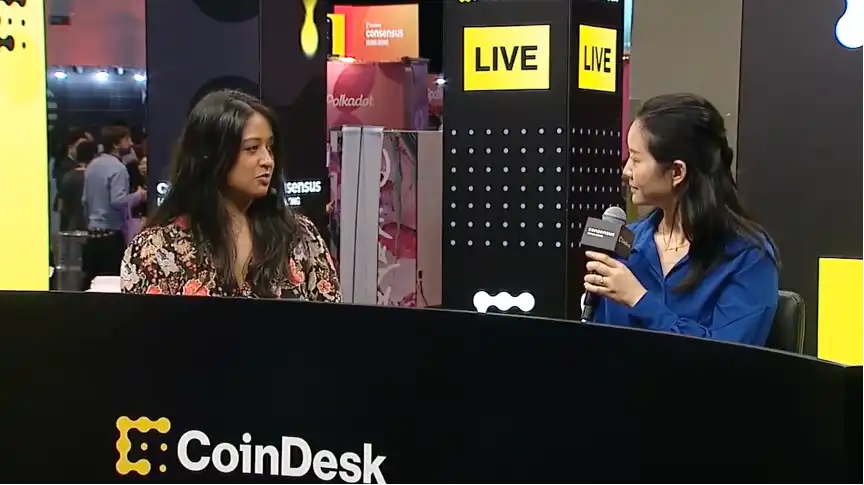
Amid the accelerated evolution of the global cryptocurrency ecosystem, OKX is advancing its globalization efforts at an unprecedented pace. Recently, OKX President Hong was interviewed by CoinDesk at the "Consensus Hong Kong 2025" conference, where she discussed OKX's pioneering role in Dubai and the global retail and institutional markets, and shared her observations on the thriving Asian cryptocurrency community. Additionally, she elaborated on OKX's future global expansion plans, demonstrating a steadfast belief in the industry's long-term development.
According to Hong, "In Dubai, we are the first and possibly the only trading platform that can simultaneously provide derivative trading services to both retail and institutional users. Similarly, in Australia, we also have the capability to operate in compliance and provide services to users. This is the direction we are constantly striving towards—to provide a more comprehensive, compliant, and reliable product offering to a broader group of institutional users, and we are confident in this endeavor."
Below is the full interview:
CoinDesk: Our guest today is Hong, President of OKX. Hello! Just now, Andy and I were talking about New York, and the three of us also met in Dubai. Let's shift the conversation to Hong Kong. What is the significance of OKX's presence at the Consensus conference for you today?
Hong: We have always attached great importance to the Asian market, which is a key region in our strategic layout and has a unique community ecosystem. We have established a strong team in Hong Kong and are committed to driving the development of the local crypto ecosystem. Being able to exchange ideas with industry partners here and feel the vibrant atmosphere of the conference is truly inspiring.
CoinDesk: Currently, the retail market's enthusiasm for cryptocurrency remains high. The crypto market has evolved from a mere hobby to a massive financial system worth trillions of dollars. Just in November and December of last year, trading volume exceeded 100 trillion USD, which is quite remarkable. Compared to investing, the crypto market tends to favor trading, which undoubtedly benefits trading platforms like OKX. So, in the past 12 to 18 months, what changes have you observed in the behavior patterns of your primary user group—retail users?
Hong: Globally, cryptocurrency users in different regions exhibit different behavior patterns. Trading activity in the Asian market is indeed relatively more active. However, at the same time, there are also a significant number of long-term traders among Asian retail users seeking trading opportunities. For example, Bitcoin, Ethereum, and other Layer 1 assets are choices they hold for the long term. In addition, there is a healthy interest in yield-generating products in the market, whether they are on-chain yield or other forms of yield products. This demand may not be as prominent as the trading market, but it is always present.
CoinDesk: It is very inspiring to hear about such a trend. After all, those who were passionate about trading in their 20s, now in their 30s, may have settled down and established their careers, so naturally their trading strategies would be more inclined towards long-term planning, right?
Hong: Indeed. Over the past 12 months, we have also observed some new trends in our products. In addition to the compliant products offered by OKX on centralized exchange platforms, the usage of Web3 self-custody wallets has also seen significant growth. The self-custody wallet feature we have introduced is powerful and can meet users' needs in a one-stop manner. It is worth noting that this product has quickly gained popularity in our community and has gained strong momentum.
CoinDesk: So now the number of people using self-custody wallets has even exceeded that of centralized exchange platforms' users, is that correct?
Hong: If you look at the total asset value of both, then yes.
CoinDesk: Does this phenomenon surprise you?
Hong: To be honest, 12 months ago, we did not anticipate this situation. But we have been continuously investing in product development and infrastructure, whether in the CEX or DeFi field, and we have always been market-demand-driven. At the same time, we also attach great importance to community building, whether it is in local community events in the compliant market or in communication within various Web3 vertical communities and protocols, we have put in a lot of effort. Most importantly, we listen to user feedback and turn it into the driving force for product optimization. These efforts have ultimately paid off.
CoinDesk: When we talk about "community," we often think of Web3 gaming projects or active groups on Telegram and Discord. In contrast, trading platforms seem to rarely emphasize community. So, how do you define "community"? And how have you built the OKX community globally?
Hong: Community building is one of the core values of our trading platform's existence. We do not just provide trading products; more importantly, we create value for users. This is our sole reason for existence. Therefore, we place great emphasis on localized operation, allowing users to truly feel our service. For example, in the CEX business, over the past year, we have made significant progress in the compliance process—having obtained licenses in Singapore and Australia, and in the European Economic Area (EEA), we have successfully obtained business licenses in 28 countries. This is a significant step towards localized service, providing users with a compliant and reliable trading experience. In the Web3 field, we focus on the needs of the crypto-native community, such as interest in different public chains and assets. Our goal is to integrate liquidity through technological means, meet user needs, and help them achieve trading goals in a responsible manner. That is our mission.
CoinDesk: Indeed, now users can spend more time in wallets and trading platforms, engaging with more products, which will bring about new liquidity trends, attracting institutional traders. So, in terms of institutional services, how is OKX expanding its business, especially in the face of restrictions in areas such as lending, and how is it attracting hedge funds and professional traders?
Hong: The institutional market has always been one of our core businesses, and we serve numerous institutional users globally, including in Asia, Europe, and Latin America. OKX's competitive advantage lies in providing high liquidity and innovative institutional-grade trading products. In the next 12 to 24 months, we will continue to allocate resources to further expand compliant business based on the existing CEX infrastructure. For example, we have obtained relevant licenses in Dubai and Australia and have expanded to 28 countries in the European Economic Area. Many institutional traders not only want to use offshore trading products but are also looking for compliant, regulated crypto products. OKX is uniquely competitive in this area. For instance, in Dubai, we are the first and currently the only trading platform to offer both retail and institutional derivative trading; in Australia, we can also serve high-net-worth and institutional users. Our goal is to provide more comprehensive, compliant, and reliable products that cover a wider range of institutional users.
CoinDesk: You mentioned derivatives, and perpetual contracts seem to be sweeping the entire market. They are not only fun but also an efficient and powerful financial tool. At the same time, your options products are also receiving attention. How does OKX ensure that users can correctly use these complex products and avoid unnecessary risks?
Hong: For regulated markets, we always ensure strict compliance processes to verify the identity of eligible traders. In unregulated markets, we collaborate with partners to provide trader education, help users conduct due diligence, and protect their interests. Our goal is to nurture responsible traders so they can benefit from long-term trading. OKX does not pursue short-term profits; we do not engage in user vs. platform betting and do not want them to suffer significant losses in market volatility. Therefore, user education will be a key focus of our continued investment.
CoinDesk: OKX is accelerating global expansion, what are the next steps in your plan?
Hong: We are advancing our presence in multiple markets, including the United States, where we aim to complete a brand overhaul this year and officially enter the market as 'OKX'. The European market is a long-term challenge as we have obtained the EEA license, but each country has different regulatory requirements that need further localization. Additionally, we are also launching localized products for the Singapore, Australia, and Dubai markets, such as fiat recharge, trading bots, etc., to provide more diverse trading tools in a compliant manner.
CoinDesk: Finally, what are you most looking forward to at the Consensus conference today? Will you be attending the horse race?
Hong: Let's see if I can make it through the whole day, haha. I'm really excited about it.
CoinDesk: Thank you very much for your insights today.
Disclaimer
This content is for informational purposes only and should not be construed as (i) investment advice or recommendation, (ii) an offer or solicitation to buy, sell, or hold digital assets, or (iii) financial, accounting, legal, or tax advice. We do not guarantee the accuracy, completeness, or usefulness of such information. Digital assets (including stablecoins and NFTs) are subject to market fluctuations, involve high risk, may depreciate, or even become worthless. You should carefully consider whether trading or holding digital assets is suitable for you based on your financial condition and risk tolerance. For your specific circumstances, please consult your legal/tax/investment professionals. Not all products are available in all regions. For more details, please refer to the OKX Terms of Service and Risk Disclosure & Disclaimer. The OKX Web3 mobile wallet and its derivative services are governed by separate terms of service. It is your responsibility to understand and comply with local applicable laws and regulations.
This article is a contributed submission and does not represent the views of BlockBeats.
You may also like

Bitcoin Trading Guide 2026: Strategies for Experienced Traders

What Is XAUT and PAXG? Why Tokenized Gold Is Booming in 2026

Cryptocurrency CEXs are flocking to sell US stocks, and traditional brokerages are facing an "uninvited guest."

Will the SpaceX IPO Hurt Bitcoin? Here's What Traders Are Watching
Foreign selling in the South Korean stock market accelerates, with cumulative net sales reportedly reaching $75 billion this year
On June 9, The Kobeissi Letter, citing Goldman Sachs data, reported that global investors are selling South Korean stocks at an unusually rapid pace. In the latest trading session, foreign investors sold about $801 million worth of Kospi constituent stocks again; total foreign outflows last week reached about $10 billion, and the market has been in net foreign selling on nearly every trading day over the past month. According to the data cited in the report, foreign investors have sold about $75 billion worth of South Korean stocks so far this year. Meanwhile, South Korean retail and institutional investors together recorded roughly $69 billion in net buying over the same period, suggesting that the market’s main buying support has come from domestic capital rather than returning overseas funds. The information currently disclosed still mainly comes from The Kobeissi Letter’s retelling and Goldman Sachs data summaries, while public details on the statistical period and the specific definition of “selling” remain relatively limited.

Fortune Warns of Strategy’s Financing Structure Risks as Bitcoin Premium Narrows
Fortune warned that Strategy’s Bitcoin treasury model faces growing financing risks as MSTR’s net asset premium narrows and preferred stock dividend pressure increases.

Ferrari Challenge Le Mans: Carl Moon to Dominate in WEEX Livery

Sahara AI Responds to SAHARA’s Sharp Drop: No Contract or Product Security Issues Found, Internal Investigation Underway
Sahara AI responded to SAHARA’s 60% price drop, saying no token contract or product security issues have been found and an internal investigation is underway.

WEEX Deposit/Withdrawal Dynamic Island: Your Asset Status, Always in Sight

Scaling Crypto Derivatives: The Digital Asset Infrastructure Behind High-Volume Trading
In the fast-moving digital asset ecosystem, derivatives platforms face an extreme architectural test. High-leverage futures markets demand more than just standard security—they require absolute operational precision, zero-latency matching engines, and ironclad structural scalability, all while navigating intense market volatility.
As global platforms scale to meet these demands, the industry is shifting away from rigid, monolithic setups toward a more agile, "decoupled" infrastructure philosophy.
The Blueprint for High-Volume Copy TradingFor elite global exchanges like WEEX (founded in 2018), this architectural choice becomes critical when scaling high-volume retail features like social copy trading. When thousands of users automatically mirror the real-time strategies of elite traders simultaneously, it triggers sudden, monumental spikes in concurrent transactional volume.
To prevent execution latency or settlement bottlenecks during these peak volatility events, a platform's primary engine must remain entirely dedicated to risk management, copy-trade synchronization, and order matching.
The Architectural Rule: New-generation platforms must separate front-end user execution engines from heavy backend infrastructural overhead to eliminate operational friction.
By separating these layers, platforms can maintain complete sovereignty over their trading environments and user experiences while strategically aligning with institutional-grade infrastructure ecosystems. This strategic framework allows modern exchanges to leverage advanced Digital Asset Custody infrastructure such as Cobo’s behind the scenes, ensuring that backend wallet management scales elastically alongside trading spikes.
Capitalizing on Market Momentum and 400× LeverageIn a derivatives arena where platforms offer up to 400× leverage on perpetual contracts, capital efficiency and market agility are core business metrics. To capture market momentum, an exchange needs the ability to rapidly expand its asset offerings, supporting everything from legacy crypto assets to sudden, trending altcoins across a massive library of trading pairs.
Adopting a flexible, scalable Wallet-as-a-Service (WaaS) solution such as Cobo’s could completely rewrite the development timeline for high-growth exchanges. Instead of spending months of engineering capital building out custom backend wallet architectures for every new blockchain network, platforms can deploy localized infrastructure in days.
This agility allows platforms to instantly scale their listings to over a thousand trading pairs without compromising security or delaying time-to-market. It mirrors the exact operational advantages seen during high-velocity market events, similar to how advanced wallet infrastructure empowers platforms during sudden asset surges; allowing exchanges to pass that speed and liquidity directly to their global user base.
A Mature Foundation for GrowthThe synergy between trusted infrastructure ecosystems and global trading platforms represents the natural evolution of a maturing crypto market. As WEEX continues to scale its global spot and derivatives offerings for over 6 million users, adopting robust backend paradigms proves that platforms no longer have to compromise between cutting-edge trading velocity and uncompromised structural security.

Morning Report | BitMine increased its holdings by 126,971 ETH last week; trader Eugene announced his exit from the crypto market

Wang Chuan: How can one not feel anxious after the neighbor Old Wang made thirty times profit by investing in storage stocks? (Seven) - A quarter-century cycle

Get Paid to Onboard? Try WEEX’s New Homepage with Rewards for Registration, Deposit & Trade

WEEX Custom Layout: Build Your Perfect Trading Workspace in Seconds

See “Buy Walls” & “Sell Walls” Instantly: WEEX Launches the Depth Chart for Smarter Trades

What Is Quick Trade on WEEX? 2 Ways WEEX Ends Chart-Panel Jumping
Morning News | Five major virtual asset platforms in South Korea have experienced 57 incidents of hacking and system failures in six years; Grayscale submits registration application for Canton ETF
Should we escape the peak? The principle of the tail-end market in the stock market
Bitcoin Trading Guide 2026: Strategies for Experienced Traders
What Is XAUT and PAXG? Why Tokenized Gold Is Booming in 2026
Cryptocurrency CEXs are flocking to sell US stocks, and traditional brokerages are facing an "uninvited guest."
Will the SpaceX IPO Hurt Bitcoin? Here's What Traders Are Watching
Foreign selling in the South Korean stock market accelerates, with cumulative net sales reportedly reaching $75 billion this year
On June 9, The Kobeissi Letter, citing Goldman Sachs data, reported that global investors are selling South Korean stocks at an unusually rapid pace. In the latest trading session, foreign investors sold about $801 million worth of Kospi constituent stocks again; total foreign outflows last week reached about $10 billion, and the market has been in net foreign selling on nearly every trading day over the past month. According to the data cited in the report, foreign investors have sold about $75 billion worth of South Korean stocks so far this year. Meanwhile, South Korean retail and institutional investors together recorded roughly $69 billion in net buying over the same period, suggesting that the market’s main buying support has come from domestic capital rather than returning overseas funds. The information currently disclosed still mainly comes from The Kobeissi Letter’s retelling and Goldman Sachs data summaries, while public details on the statistical period and the specific definition of “selling” remain relatively limited.
Fortune Warns of Strategy’s Financing Structure Risks as Bitcoin Premium Narrows
Fortune warned that Strategy’s Bitcoin treasury model faces growing financing risks as MSTR’s net asset premium narrows and preferred stock dividend pressure increases.


