
FTX's First Funding Round Unwinding: Unlocking 11.2 Million SOL Triggers Selling Pressure Anxiety


Original Title: "FTX First Round of Payouts Commences, Unlocking of 11.2 Million SOL Tokens Causes Market Sell Pressure Anxiety, an Overblown 'Crying Wolf'?"
Original Author: Frank, PANews
On February 18, 2025, the FTX first-round creditors' payouts officially started, marking a crucial phase in this two-year-long bankruptcy liquidation. However, market attention is now focused on another potential risk: on March 1, 11.2 million SOL tokens from the FTX bankruptcy auction are set to unlock, valued at up to $1.9 billion. Despite the payouts appearing "mild" with fiat settlement, the expected large circulation of SOL has raised market concerns. The aftershocks of FTX's asset sell-off are poised to once again impact the crypto ecosystem. Is the spreading panic an overreaction, or has the risk not been fully priced in yet?
Over 50 Billion Still Outstanding in First Round
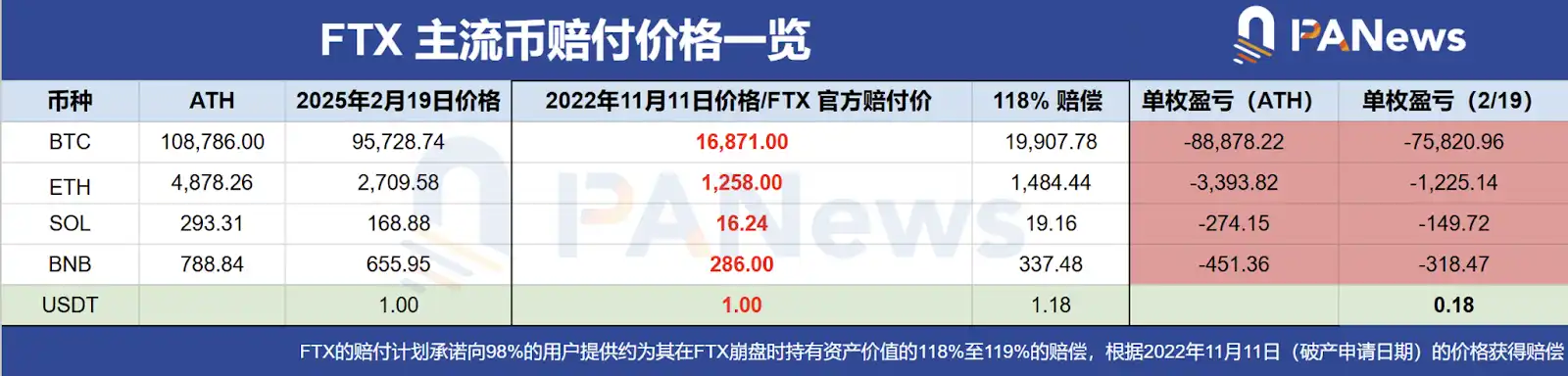
Public information indicates that the creditors in this round receiving payouts are initial beneficiaries, referring to small creditors with claims of $50,000 or less. According to FTX's restructuring plan, they will receive full repayment and enjoy a 9% annual interest. These users may ultimately receive a 119% fiat-denominated repayment.
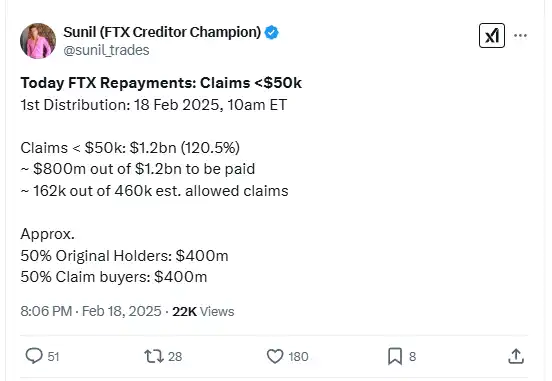
According to FTX creditor Sunil, the current payout in this round has already disbursed around $800 million, covering 162,000 accounts, which represent 35% of the estimated 460,000 eligible claim accounts. Moreover, payouts exceeding $50,000 will have to wait until after May 30.
Previous reports indicated that the overall payout amount for the first phase ranged from $65 to $70 billion. It is expected that this round of payouts will continue until March 4. However, FTX has not yet disclosed the actual payout amount from the first round.
From a payout perspective alone, since FTX has opted for fiat payouts, the commencement of payouts may not cause significant turbulence in the crypto market. It might even bring in some new entry funds into the market.
Nearly $2 Billion Worth of OTC SOL Token Unlocking
The market's anxiety about FTX primarily stems from the auction of crypto assets like Solana. Documents as of 2023 showed that FTX's asset total was only $47.7 billion, creating a $68 billion gap compared to the estimated $115 billion payout at the time. As the crypto market ushered in a bull run in 2024, the crypto assets held by FTX saw a significant surge.
FTX's largest blood transfusion recipient is Solana, with the SOL token seeing a surge of over 28 times its value since December 2022. As one of Solana's key investors, FTX holds a significant amount of locked SOL tokens. According to monitoring data from @ai_9684xtpa, FTX has already conducted three auctions, selling a total of 41 million SOL as of February 17. Among these, 11.2 million SOL will unlock on March 1.

Reportedly, the 41 million tokens were not sold directly on the secondary market but were sold to Galaxy (purchased 25.52 million tokens at $64), Pantera and other buyers (purchased 13.67 million tokens at $95), Figure and other buyers (purchased 1.8 million tokens at $102). Overall, these tokens brought FTX $2.932 billion in revenue, becoming its largest category of liquidation income in the crypto asset class.
Regarding the unlocked SOL tokens, this transaction likely took place through previous auctions, and the unlocking now signifies the actual delivery. Regardless of the ultimate beneficiary, these tokens will enter circulation, with the known buyers' costs significantly below market price. Therefore, there is indeed a risk of profit-taking selloff, but the upcoming unlocked SOL tokens represent only 2.3% of the current circulating supply.
Sui Has Repurchased Equity, Disposal Methods for APT, AVAX, and Other Assets Unknown
In March 2024, FTX announced the sale of its investment in Mysten Labs to Sui Network for $95 million. Mysten Labs is the development company behind the Sui network. By the end of 2024, the value of these sold equity and tokens reached a peak of $4.6 billion. For the market, if FTX retains these tokens, the SUI market could face increased pressure.
Aside from Solana and Sui, Aptos was also one of FTX's initial key investments in public blockchains. According to media reports, in 2022, FTX Ventures and Jump Crypto led a $150 million investment in Aptos. However, the final disposition of this equity has not been disclosed by Aptos to date. According to data provided by FTX in March 2023, they held 5 million APT tokens at that time. However, in ARKM's FTX on-chain address, there is currently no information available about APT tokens. Based on the price as of February 19, the value of this APT portion is approximately $31.65 million.
As of February 19, in the FTX on-chain address, the largest holding token is FTT, with a total of 257 million tokens, worth about 505 million US dollars. The total market value of FTT is only 657 million US dollars. If the holding is sold off, a price impact could pose the greatest risk. FTX once asked users to fill in the purchase price of FTT, but in the fiat valuation compensation, FTT is temporarily counted as 0. It is still uncertain how FTT holders will be compensated.
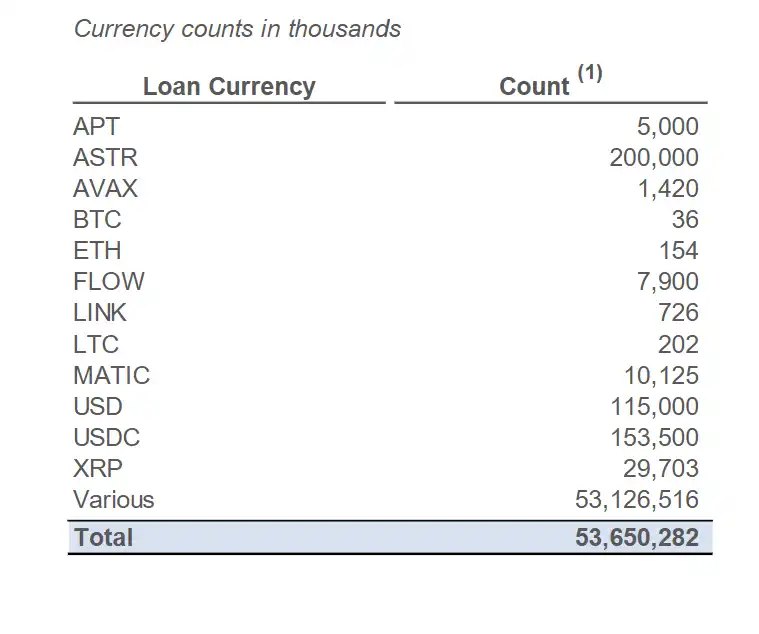
In the document disclosed in 2023, it is shown that FTX also holds 1.42 million AVAX tokens (worth 33.76 million US dollars), 36,000 BTC (worth 346 million US dollars), 154,000 ETH (worth 410 million US dollars), 29.7 million XRP (worth 76.32 million US dollars), and other major crypto assets. However, as of February 19, these assets are no longer visible in FTX's public wallet address as they have been sold off during the liquidation period. As of February 19, the on-chain address holding value of FTX is about 1.269 billion US dollars.
With the commencement of FTX's settlement, the FTX bankruptcy event is finally nearing its end. After more than two years of transformation, the entire crypto industry has begun a new pattern, and the impact of FTX on the industry has gradually become a part of history. The recent market downturn allegedly triggered by FTX seems more like a storm in a teacup or the panic sentiment of the current market turbulence period.
You may also like

Cryptocurrency CEXs are flocking to sell US stocks, and traditional brokerages are facing an "uninvited guest."

Will the SpaceX IPO Hurt Bitcoin? Here's What Traders Are Watching
Foreign selling in the South Korean stock market accelerates, with cumulative net sales reportedly reaching $75 billion this year
On June 9, The Kobeissi Letter, citing Goldman Sachs data, reported that global investors are selling South Korean stocks at an unusually rapid pace. In the latest trading session, foreign investors sold about $801 million worth of Kospi constituent stocks again; total foreign outflows last week reached about $10 billion, and the market has been in net foreign selling on nearly every trading day over the past month. According to the data cited in the report, foreign investors have sold about $75 billion worth of South Korean stocks so far this year. Meanwhile, South Korean retail and institutional investors together recorded roughly $69 billion in net buying over the same period, suggesting that the market’s main buying support has come from domestic capital rather than returning overseas funds. The information currently disclosed still mainly comes from The Kobeissi Letter’s retelling and Goldman Sachs data summaries, while public details on the statistical period and the specific definition of “selling” remain relatively limited.

Fortune Warns of Strategy’s Financing Structure Risks as Bitcoin Premium Narrows
Fortune warned that Strategy’s Bitcoin treasury model faces growing financing risks as MSTR’s net asset premium narrows and preferred stock dividend pressure increases.

Ferrari Challenge Le Mans: Carl Moon to Dominate in WEEX Livery

Sahara AI Responds to SAHARA’s Sharp Drop: No Contract or Product Security Issues Found, Internal Investigation Underway
Sahara AI responded to SAHARA’s 60% price drop, saying no token contract or product security issues have been found and an internal investigation is underway.

WEEX Deposit/Withdrawal Dynamic Island: Your Asset Status, Always in Sight

Scaling Crypto Derivatives: The Digital Asset Infrastructure Behind High-Volume Trading
In the fast-moving digital asset ecosystem, derivatives platforms face an extreme architectural test. High-leverage futures markets demand more than just standard security—they require absolute operational precision, zero-latency matching engines, and ironclad structural scalability, all while navigating intense market volatility.
As global platforms scale to meet these demands, the industry is shifting away from rigid, monolithic setups toward a more agile, "decoupled" infrastructure philosophy.
The Blueprint for High-Volume Copy TradingFor elite global exchanges like WEEX (founded in 2018), this architectural choice becomes critical when scaling high-volume retail features like social copy trading. When thousands of users automatically mirror the real-time strategies of elite traders simultaneously, it triggers sudden, monumental spikes in concurrent transactional volume.
To prevent execution latency or settlement bottlenecks during these peak volatility events, a platform's primary engine must remain entirely dedicated to risk management, copy-trade synchronization, and order matching.
The Architectural Rule: New-generation platforms must separate front-end user execution engines from heavy backend infrastructural overhead to eliminate operational friction.
By separating these layers, platforms can maintain complete sovereignty over their trading environments and user experiences while strategically aligning with institutional-grade infrastructure ecosystems. This strategic framework allows modern exchanges to leverage advanced Digital Asset Custody infrastructure such as Cobo’s behind the scenes, ensuring that backend wallet management scales elastically alongside trading spikes.
Capitalizing on Market Momentum and 400× LeverageIn a derivatives arena where platforms offer up to 400× leverage on perpetual contracts, capital efficiency and market agility are core business metrics. To capture market momentum, an exchange needs the ability to rapidly expand its asset offerings, supporting everything from legacy crypto assets to sudden, trending altcoins across a massive library of trading pairs.
Adopting a flexible, scalable Wallet-as-a-Service (WaaS) solution such as Cobo’s could completely rewrite the development timeline for high-growth exchanges. Instead of spending months of engineering capital building out custom backend wallet architectures for every new blockchain network, platforms can deploy localized infrastructure in days.
This agility allows platforms to instantly scale their listings to over a thousand trading pairs without compromising security or delaying time-to-market. It mirrors the exact operational advantages seen during high-velocity market events, similar to how advanced wallet infrastructure empowers platforms during sudden asset surges; allowing exchanges to pass that speed and liquidity directly to their global user base.
A Mature Foundation for GrowthThe synergy between trusted infrastructure ecosystems and global trading platforms represents the natural evolution of a maturing crypto market. As WEEX continues to scale its global spot and derivatives offerings for over 6 million users, adopting robust backend paradigms proves that platforms no longer have to compromise between cutting-edge trading velocity and uncompromised structural security.

Morning Report | BitMine increased its holdings by 126,971 ETH last week; trader Eugene announced his exit from the crypto market

Wang Chuan: How can one not feel anxious after the neighbor Old Wang made thirty times profit by investing in storage stocks? (Seven) - A quarter-century cycle

Get Paid to Onboard? Try WEEX’s New Homepage with Rewards for Registration, Deposit & Trade

WEEX Custom Layout: Build Your Perfect Trading Workspace in Seconds

See “Buy Walls” & “Sell Walls” Instantly: WEEX Launches the Depth Chart for Smarter Trades

What Is Quick Trade on WEEX? 2 Ways WEEX Ends Chart-Panel Jumping
Morning News | Five major virtual asset platforms in South Korea have experienced 57 incidents of hacking and system failures in six years; Grayscale submits registration application for Canton ETF

Should we escape the peak? The principle of the tail-end market in the stock market

RootData: May 2026 Cryptocurrency Exchange Transparency Research Report

Founder of Baixing.com: My Experience with Claude Code in Fourteen Points
Cryptocurrency CEXs are flocking to sell US stocks, and traditional brokerages are facing an "uninvited guest."
Will the SpaceX IPO Hurt Bitcoin? Here's What Traders Are Watching
Foreign selling in the South Korean stock market accelerates, with cumulative net sales reportedly reaching $75 billion this year
On June 9, The Kobeissi Letter, citing Goldman Sachs data, reported that global investors are selling South Korean stocks at an unusually rapid pace. In the latest trading session, foreign investors sold about $801 million worth of Kospi constituent stocks again; total foreign outflows last week reached about $10 billion, and the market has been in net foreign selling on nearly every trading day over the past month. According to the data cited in the report, foreign investors have sold about $75 billion worth of South Korean stocks so far this year. Meanwhile, South Korean retail and institutional investors together recorded roughly $69 billion in net buying over the same period, suggesting that the market’s main buying support has come from domestic capital rather than returning overseas funds. The information currently disclosed still mainly comes from The Kobeissi Letter’s retelling and Goldman Sachs data summaries, while public details on the statistical period and the specific definition of “selling” remain relatively limited.
Fortune Warns of Strategy’s Financing Structure Risks as Bitcoin Premium Narrows
Fortune warned that Strategy’s Bitcoin treasury model faces growing financing risks as MSTR’s net asset premium narrows and preferred stock dividend pressure increases.
Ferrari Challenge Le Mans: Carl Moon to Dominate in WEEX Livery
Sahara AI Responds to SAHARA’s Sharp Drop: No Contract or Product Security Issues Found, Internal Investigation Underway
Sahara AI responded to SAHARA’s 60% price drop, saying no token contract or product security issues have been found and an internal investigation is underway.


