
How to Automate Your Workflow with AI (No Code Required)

Original Title: how non-developers automate work like engineers (without writing code)...
Original Author: Damian Player
Translation: Peggy, BlockBeats
Editor's Note: While most people still see AI as a "more efficient search tool," Perplexity is starting to get work done.
This article revolves around a repeatedly overlooked difference—why do some people only get an answer when using AI, while others receive a deliverable outcome directly? The key is not in the model's capability, but in its usage: whether the tool is treated as a conversational window or as an executable system that can be commanded and scheduled.
Represented by Perplexity Computer, a new class of tools replaces "asking questions" with "tasks" as the core interaction method. From contract review, competitive analysis, to data cleansing and report generation, users no longer describe problems but directly define the final deliverable. Coupled with integration with enterprise tools, personal background hardening, and style examples, this capability further evolves from one-time output to a reusable, automatically executable workflow.
More importantly, the boundary of automation is being redefined. It is no longer just assisting in completing a step but can sustainably run, execute across tools, and even proactively propose additional tasks. This means that the relationship between humans and tools is shifting from "usage" to "management and delegation."
In this shift, the real watershed is no longer whether to use AI but whether you have already started using it to "deliver results."
The following is the original article:
Those who figure this out will gain an asymmetric advantage. Soon, everyone will learn how to do it. But before everything becomes obvious, here's how you can get ahead start.
Over the past year, developers have been running autonomous AI agents in the background (such as Claude Code, OpenClaw, etc.) that can conduct research, build products, and deliver complete results directly without requiring constant supervision or reminders. Yet, you've never been able to use this setup—unless you know how to use the terminal and write code.
Perplexity Computer changes that. This is the first time non-developers can access the same capabilities. All you need is a browser and a task to hand over to it for completion.
Most people open Perplexity, enter a question, get an answer, and then close the page. They miss the point. Perplexity Computer is not meant to answer questions; it is meant to perform tasks.
Stop asking questions and start delegating real work to it.

Why Most People Fail
Chief Financial Officers, Lawyers, Consultants... They open the tool, type in a question, get a decent answer, and think to themselves, "Oh, a fancier Google." Then they proceed to spend another 90 minutes cleaning up a spreadsheet they already cleaned up last Monday.
The issue is not with the tool but with the usage. They treat it like a chatbot.
Asking: "What risks are in this contract?"
Tasking: "Review this contract. Validate each statement against publicly available sources; highlight any vague wording, missing terms, or potentially litigious sections; list the top 5 key risk points with specific clause references; output a redline Word document."
Same contract. One approach gives you a list to read through yourself; the other approach directly gives you a client-ready deliverable.
Set Up This System in Just 10 Minutes
First, connect the tool. Click on the connectors in the sidebar. Perplexity can integrate with over 400 applications: Gmail, Google Drive, Slack, Salesforce, Notion, SharePoint... Connect the ones you actually use.
Then let it know who you are. Input once: "I am in a certain role, working in a specific type of company. I regularly produce X, Y, Z content. Please keep this background in mind for each session." It will retain this information long-term.
Tell it what "good" looks like. Find 2–3 of your most satisfactory outcomes, upload them, and input: "These are my best work examples. Please learn from their format and tone to use as a reference for future content generation."
This way, it's not guessing your style; it's reverse-engineering a successful path you have already validated.
10 minutes, start with this.
A Real Example: The 90-Minute Monday No More
Every Monday, a financial analyst would receive a data export: 150 rows of messy data with duplicate entries, three date formats, ratings in text instead of numeric form. She used to spend 90 minutes cleaning the data before she could even begin her analysis. The same issue, every week.
She entered just one command: clean the file, deduplicate, standardize date formats, convert text ratings to numbers; perform analysis on the cleaned data; generate an interactive dashboard with filtering capabilities and provide a sharing link; output a PDF report comparing pre- and post-cleaned data; save all files to the "Monday Report" folder on Drive.
4 minutes later: clean dataset, interactive dashboard, sharing link, PDF report—all appeared in her Drive.
Then she asked, "What improvement have I not yet asked for that would make this even more useful?"
The system suggested two things: first, automate this task to run every Monday morning at 7 a.m.; second, add a task to generate a Tuesday executive summary based on underperforming sectors.
She set up both tasks and closed the page.
Every Monday thereafter, it ran automatically—whether her computer was on or not.
This is the same set of capabilities developers have been using for the past year. Now, it's in your browser.
What People Have Been Using It For
@gregisenberg did a live test on @startupideaspod podcast.
He gave just one task: find companies advertising on competitive podcasts, identify the actual person responsible for sponsorship, and write a personalized email to each.
The system found Ramp's VP of Growth, grabbed a recent episode he was featured in, composed a cold email referencing his specific remarks on the show, and sent it off. Greg didn't say "send"; the system determined the task was complete and executed it on its own.
Then it proactively suggested: monitor competitive podcasts, immediately alert when a new brand starts advertising, and provide the corresponding contact—"reach out as soon as the budget starts rolling."
In the end, this process concurrently conducted research on 96 potential clients and scheduled follow-up emails on the 3rd and 7th days.
In the Marketing Against the Grain program, the team used Perplexity to audit the entire HubSpot product page: automatically crawling the entire site, scoring against custom criteria, sorting issues, and generating a shareable website report. What would have taken the team a week to accomplish was completed during the recording of the episode.
All of this was done live, not a demo, and not a scripted setup.
Specific Use Cases
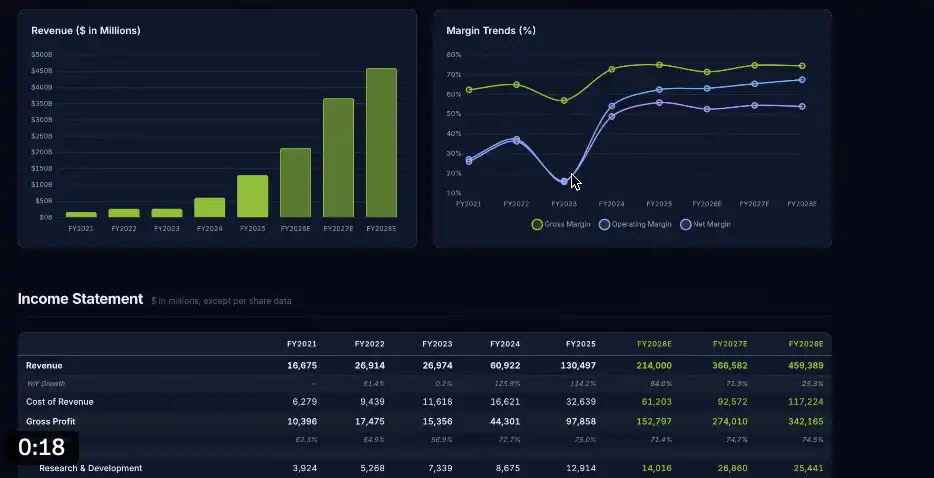
In the financial field, an investment portfolio analyst issued only one task before NVIDIA's earnings report.
The outcome was: a real-time interactive dashboard featuring $130.5 billion in revenue, 75% gross margin, 114.2% growth rate, full income statement, and profit margin trends forecasted from FY 2021 to FY 2028, all supporting filtering and sharing links.
No Excel, no manual data hunting, done in 5 minutes.
Perplexity can directly query SEC filings, FactSet, S&P Global, PitchBook, and other data sources—no API key needed, no additional authorization required, all built into the system.
Legal Scenario:
“Audit this contract. Review each provision for public reference support; highlight vague wording, missing standard clauses, and content that may create legal liability under [specific state] contract law; list the top 5 key risk points with specific clause references; output a Word document with tracked changes.”
An auditor once uploaded a proposal claiming a 43% year-over-year market growth. Perplexity Computer discovered the actual data was only 4%, flagging the issue before signing.
Marketing Scenario:
“Analyze the top-performing content of [Competitor 1], [Competitor 2], [Competitor 3] in the last 30 days; identify the most interactive content formats and topics; pinpoint content gaps; generate a 30-day content calendar based on these gaps and save it as a Google Doc.”
Set it as a recurring task. Auto-generate the latest competitor analysis every Monday without manual research.
Operations Scenario:
“Here is our Q1 CSV data. Please clean the data; analyze revenue by region and product line; identify the top three issues; create a one-page action plan; prepare a one-page presentation-ready PPT; save all files to the project folder.”
Five artifacts, one directive. It's done by the time you're in the meeting.
Model Council: Three judgments in 60 seconds
When faced with a decision that has real consequences, simply input your question once. Perplexity will simultaneously invoke Claude, ChatGPT, and Gemini, and a "Synthesizer" will summarize their consensus and discrepancies.
· Consistent Opinion: High-confidence conclusion
· Points of Divergence: Requires further judgment
Someone asked whether the product should be priced at $297 or $497. The three models provided different answers, but the Synthesizer found the only unanimous conclusion: do not go below $297. The decision is made.
Many companies spend money hiring consulting firms to lock analysts in a conference room to reach a conclusion.
Here, only one directive is needed.
The True Core Competency
To extract real value from the Perplexity Computer, 80% depends on one thing: can you clearly describe the "final output"?
Not the technical configuration. It's whether you are clear on what you are delivering. Do not describe the steps, describe the outcome.
After each task is completed, remember to ask, "Is there something I haven't asked that could make this output more useful?"
It almost always identifies blind spots. Every time, use it.
Start Here
Open Perplexity (pro version $20/month). Go to the Computer page, click on connectors, and first connect Gmail and Google Drive.
Input your three-sentence background (just once). Upload 2-3 of your best work samples to let it learn your style. Then select a task that took you over 2 hours last week and had similar outputs each time: describe it in terms of the "final deliverable," send it. Observe the execution process. If it's a recurring task, set it to run automatically before closing the page.
Developers have been using this system for a year. The gap between their output and others is real.
This is the way to bridge the gap.
You may also like

Japan’s Three Megabanks Plan Joint Stablecoin Issuance in Fiscal 2026
MUFG, SMBC, and Mizuho reportedly plan to jointly issue fiat-pegged stablecoins in fiscal 2026, signaling Japan’s growing push into bank-led digital payment infrastructure.

Humanity Discloses H Token Dual-Chain Attack Details, With Losses on Ethereum and BSC Exceeding $36 Million
Humanity said the H token attack across Ethereum and BSC caused more than $36 million in losses after leaked ProxyAdmin keys enabled malicious contract upgrades and token minting.

White House Discusses CLARITY Act With Law Enforcement Ahead of Senate Vote
The White House discussed the CLARITY Act with law enforcement ahead of a Senate vote, focusing on illicit finance risks and developer protections.

$75 billion in foreign capital has fled, and South Korean retail investors have absorbed it all using leverage

Bitcoin Trading Guide 2026: Strategies for Experienced Traders

What Is XAUT and PAXG? Why Tokenized Gold Is Booming in 2026

Cryptocurrency CEXs are flocking to sell US stocks, and traditional brokerages are facing an "uninvited guest."

Will the SpaceX IPO Hurt Bitcoin? Here's What Traders Are Watching
Foreign selling in the South Korean stock market accelerates, with cumulative net sales reportedly reaching $75 billion this year
On June 9, The Kobeissi Letter, citing Goldman Sachs data, reported that global investors are selling South Korean stocks at an unusually rapid pace. In the latest trading session, foreign investors sold about $801 million worth of Kospi constituent stocks again; total foreign outflows last week reached about $10 billion, and the market has been in net foreign selling on nearly every trading day over the past month. According to the data cited in the report, foreign investors have sold about $75 billion worth of South Korean stocks so far this year. Meanwhile, South Korean retail and institutional investors together recorded roughly $69 billion in net buying over the same period, suggesting that the market’s main buying support has come from domestic capital rather than returning overseas funds. The information currently disclosed still mainly comes from The Kobeissi Letter’s retelling and Goldman Sachs data summaries, while public details on the statistical period and the specific definition of “selling” remain relatively limited.

Fortune Warns of Strategy’s Financing Structure Risks as Bitcoin Premium Narrows
Fortune warned that Strategy’s Bitcoin treasury model faces growing financing risks as MSTR’s net asset premium narrows and preferred stock dividend pressure increases.

Ferrari Challenge Le Mans: Carl Moon to Dominate in WEEX Livery

Sahara AI Responds to SAHARA’s Sharp Drop: No Contract or Product Security Issues Found, Internal Investigation Underway
Sahara AI responded to SAHARA’s 60% price drop, saying no token contract or product security issues have been found and an internal investigation is underway.

WEEX Deposit/Withdrawal Dynamic Island: Your Asset Status, Always in Sight
Scaling Crypto Derivatives: The Digital Asset Infrastructure Behind High-Volume Trading
In the fast-moving digital asset ecosystem, derivatives platforms face an extreme architectural test. High-leverage futures markets demand more than just standard security—they require absolute operational precision, zero-latency matching engines, and ironclad structural scalability, all while navigating intense market volatility.
As global platforms scale to meet these demands, the industry is shifting away from rigid, monolithic setups toward a more agile, "decoupled" infrastructure philosophy.
The Blueprint for High-Volume Copy TradingFor elite global exchanges like WEEX (founded in 2018), this architectural choice becomes critical when scaling high-volume retail features like social copy trading. When thousands of users automatically mirror the real-time strategies of elite traders simultaneously, it triggers sudden, monumental spikes in concurrent transactional volume.
To prevent execution latency or settlement bottlenecks during these peak volatility events, a platform's primary engine must remain entirely dedicated to risk management, copy-trade synchronization, and order matching.
The Architectural Rule: New-generation platforms must separate front-end user execution engines from heavy backend infrastructural overhead to eliminate operational friction.
By separating these layers, platforms can maintain complete sovereignty over their trading environments and user experiences while strategically aligning with institutional-grade infrastructure ecosystems. This strategic framework allows modern exchanges to leverage advanced Digital Asset Custody infrastructure such as Cobo’s behind the scenes, ensuring that backend wallet management scales elastically alongside trading spikes.
Capitalizing on Market Momentum and 400× LeverageIn a derivatives arena where platforms offer up to 400× leverage on perpetual contracts, capital efficiency and market agility are core business metrics. To capture market momentum, an exchange needs the ability to rapidly expand its asset offerings, supporting everything from legacy crypto assets to sudden, trending altcoins across a massive library of trading pairs.
Adopting a flexible, scalable Wallet-as-a-Service (WaaS) solution such as Cobo’s could completely rewrite the development timeline for high-growth exchanges. Instead of spending months of engineering capital building out custom backend wallet architectures for every new blockchain network, platforms can deploy localized infrastructure in days.
This agility allows platforms to instantly scale their listings to over a thousand trading pairs without compromising security or delaying time-to-market. It mirrors the exact operational advantages seen during high-velocity market events, similar to how advanced wallet infrastructure empowers platforms during sudden asset surges; allowing exchanges to pass that speed and liquidity directly to their global user base.
A Mature Foundation for GrowthThe synergy between trusted infrastructure ecosystems and global trading platforms represents the natural evolution of a maturing crypto market. As WEEX continues to scale its global spot and derivatives offerings for over 6 million users, adopting robust backend paradigms proves that platforms no longer have to compromise between cutting-edge trading velocity and uncompromised structural security.

Morning Report | BitMine increased its holdings by 126,971 ETH last week; trader Eugene announced his exit from the crypto market

Wang Chuan: How can one not feel anxious after the neighbor Old Wang made thirty times profit by investing in storage stocks? (Seven) - A quarter-century cycle

Get Paid to Onboard? Try WEEX’s New Homepage with Rewards for Registration, Deposit & Trade
WEEX Custom Layout: Build Your Perfect Trading Workspace in Seconds
Japan’s Three Megabanks Plan Joint Stablecoin Issuance in Fiscal 2026
MUFG, SMBC, and Mizuho reportedly plan to jointly issue fiat-pegged stablecoins in fiscal 2026, signaling Japan’s growing push into bank-led digital payment infrastructure.
Humanity Discloses H Token Dual-Chain Attack Details, With Losses on Ethereum and BSC Exceeding $36 Million
Humanity said the H token attack across Ethereum and BSC caused more than $36 million in losses after leaked ProxyAdmin keys enabled malicious contract upgrades and token minting.
White House Discusses CLARITY Act With Law Enforcement Ahead of Senate Vote
The White House discussed the CLARITY Act with law enforcement ahead of a Senate vote, focusing on illicit finance risks and developer protections.
$75 billion in foreign capital has fled, and South Korean retail investors have absorbed it all using leverage
Bitcoin Trading Guide 2026: Strategies for Experienced Traders
What Is XAUT and PAXG? Why Tokenized Gold Is Booming in 2026


