
How to Make Money on Polymarket Using AI?


Original Title: How Perplexity + Claude Replace an Entire Analyst Team on Polymarket
Original Author: @0xwhrrari
Translation: Peggy, BlockBeats
Editor's Note: This article introduces a method to identify arbitrage opportunities on Polymarket and systematically execute them: using Perplexity for research to pinpoint discrepancies between data and market pricing; using Claude to build trading logic, manage risk, and automate execution; ultimately completing trades and realizing gains on Polymarket.
The author's key insight is that profits come from "structured information asymmetry." Market prices more so reflect group intuition, while data (such as weather forecasts) provides a probability distribution. When these two are misaligned and continually captured by a system, they can be transformed into stable trading opportunities. Claude is the brain, Polymarket is the wallet, and Perplexity is the eye, all working together to form a complete arbitrage loop.
This model not only lowers the barrier to entry, allowing individuals to possess close to a "team-level" capability, but also raises the competitive standard. With research, analysis, and execution compressed into a single continuous chain, relying solely on experience or manual operation will increasingly struggle to compete with systematic strategies.
For the average participant, a more realistic path is to first find certainty through research and then leverage systems to amplify gains. Those who can validate this method earlier are more likely to consistently earn stable returns in these seemingly straightforward markets.
The following is the original text:
Among the top 20 traders on Polymarket, 14 of them are actually bots. One AI-powered entity based on Claude turned $1,000 into $14,216 within 48 hours; while another AI entity based on OpenClaw was liquidated to zero on the same platform in the same timeframe.
The difference lies not in code quality but in preparedness.
One AI was simply fed a generic prompt to "trade on Polymarket," while behind the other was a complete research apparatus: which niche track to trade in, who's already profiting, where the data is coming from, and how the underlying math checks out.
Perplexity AI handles research, Claude handles coding, and Polymarket handles payout.
This is the full breakdown, recommended for bookmarking.
You can try:
· Perplexity: perplexity.ai
· Strategy View: polymarket.com
· Copy Trading Bot: t.me/PolyGunSniperBot
· Telegram Channel: rari lr
Research Layer: From Zero to Strategy in 10 Minutes
There are dozens of trading categories on Polymarket: politics, crypto, sports, weather. Most people choose based on intuition, which is the beginning of losses.
With just one in-depth research query, Perplexity can scan over 47 information sources in less than 3 minutes: including Polymarket's API documentation, traders' profit and loss screenshot-sharing posts on Reddit, and Twitter analyses breaking down wallet behavior.
Most importantly, each conclusion comes with citations and source links—not unverifiable raw text, but clickable, verifiable "data-backed evidence."
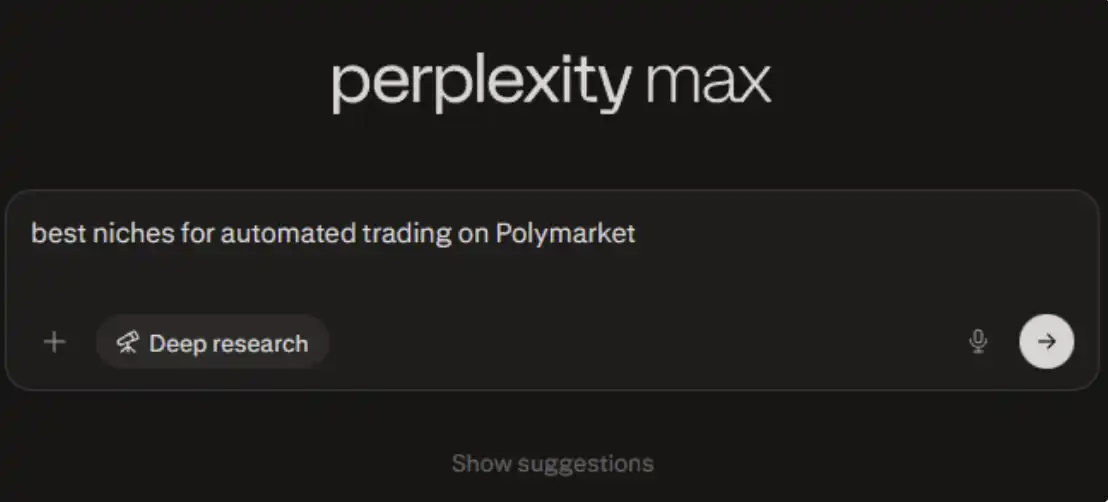
The breakdown is almost immediate:
BTC 5-Minute Market: Arbitrage window is only 2.7 seconds, entering the realm of High-Frequency Trading (HFT). You need co-located servers and a budget of at least six figures.
Sports Arbitrage: Profit margins typically range from 1-3%, requiring a capital of at least $5,000 to justify execution risk.
Weather Market: Profit margins are over 3-4 times, with an entry of $100. Most participants are retail traders pricing based on intuition.
After the initial response, Perplexity AI will also proactively suggest follow-up research questions:
"Should you compare NOAA and other weather forecast providers?"—Yes
“Should we take a look at Polymarket's fee structure?” — Yes
“How does the historical accuracy of weather forecasts vary across different time spans?” — Yes
It further unearthed multiple transaction wallet profiles. The system even automatically extracted data not present in the API: entry timing patterns, average position sizes, trade frequency distribution. Such analysis, if done manually tracking wallets one by one, would probably take a junior analyst a whole day.
And the common traits among these wallets are very clear: fully automated, running 24/7 all year round, making emotionless decisions. No one is sitting in front of the computer clicking the mouse — these bots are mathematically trading.
The third query then delved deeper: What is the best data source for the U.S. weather market?
Perplexity compared NOAA, OpenWeatherMap, and AccuWeather, conducting a systematic evaluation from multiple dimensions such as accuracy, cost, update frequency, and API availability.
NOAA excelled in all truly critical metrics. Free, 24–48-hour forecast accuracy of 94%, based on decades of satellite data and supercomputer modeling, updated hourly, open API, with almost no rate limits within reasonable usage.
With just three queries and ten minutes, a comprehensive strategy map was obtained: which niche market to focus on, who is already profitable, and where the data sources are located.
Without Perplexity, the same research would often take 4 to 5 hours, flipping back and forth between Twitter, Reddit, various documentation pages, and academic papers, with no guarantee of finding the right sources.
The Mathematical Logic Behind the Advantage
Polymarket's temperature market is a binary market: “Will the temperature in New York be above 72°F this Saturday?” The answer is only two: yes or no. The final settlement is either $1 or $0.
But who prices these markets? Retail traders. They will check the weather app on their phones, maybe glance at the 7-day weather forecast. They won't delve into NOAA's probability distribution data.
The result is this: while NOAA gives a 94% confidence interval for a temperature range, the market only prices it at 11 cents.
This is the result shown by the data, indicating a structural disconnect with the market's collective perception.
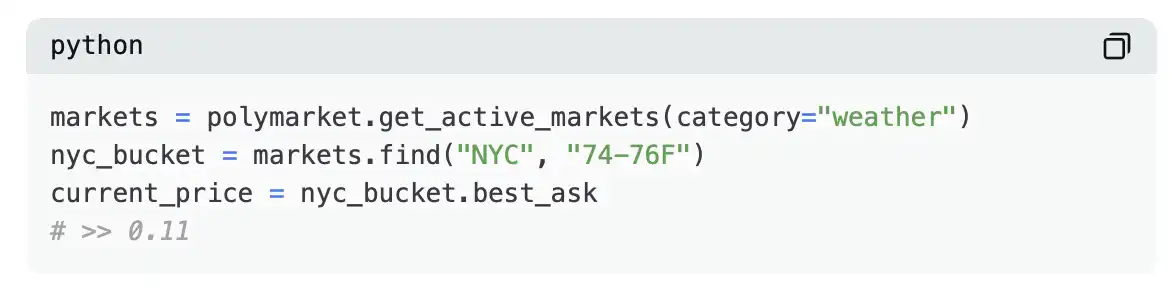
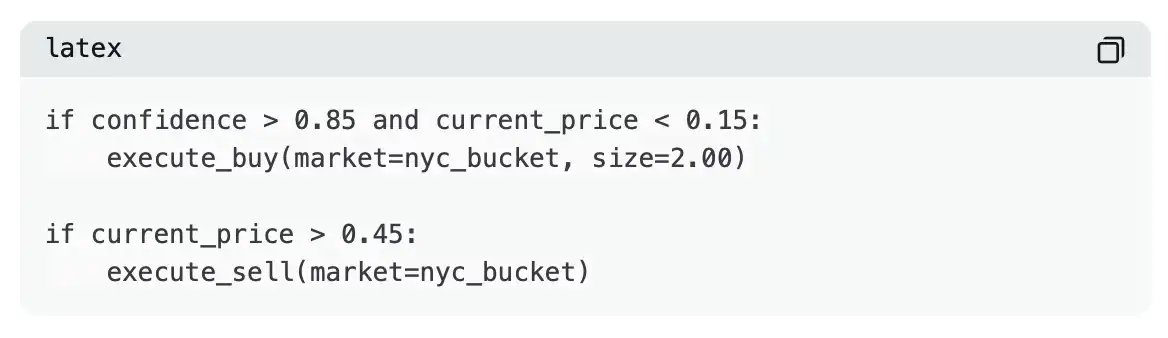
For example, NOAA believes there is a 94% probability that New York will experience temperatures between 74–76°F on Saturday, but on Polymarket, the price for this range is only 11 cents. So, the bot buys in at 11 cents. As more information is gradually absorbed by the market in the following hours, the price rises to 45–60 cents. The bot sells at 47 cents. Profit per share: +36 cents.
If operating on a $2 position, the gain is +$6.50. Running 10 trades like this a day results in $65.
A single trade may not seem remarkable. What truly excites is the outcome at scale.
This is also why the model council of Perplexity is crucial. The query regarding "optimal position size" is not handled by a single model—it is run concurrently by Claude, GPT, and Gemini.
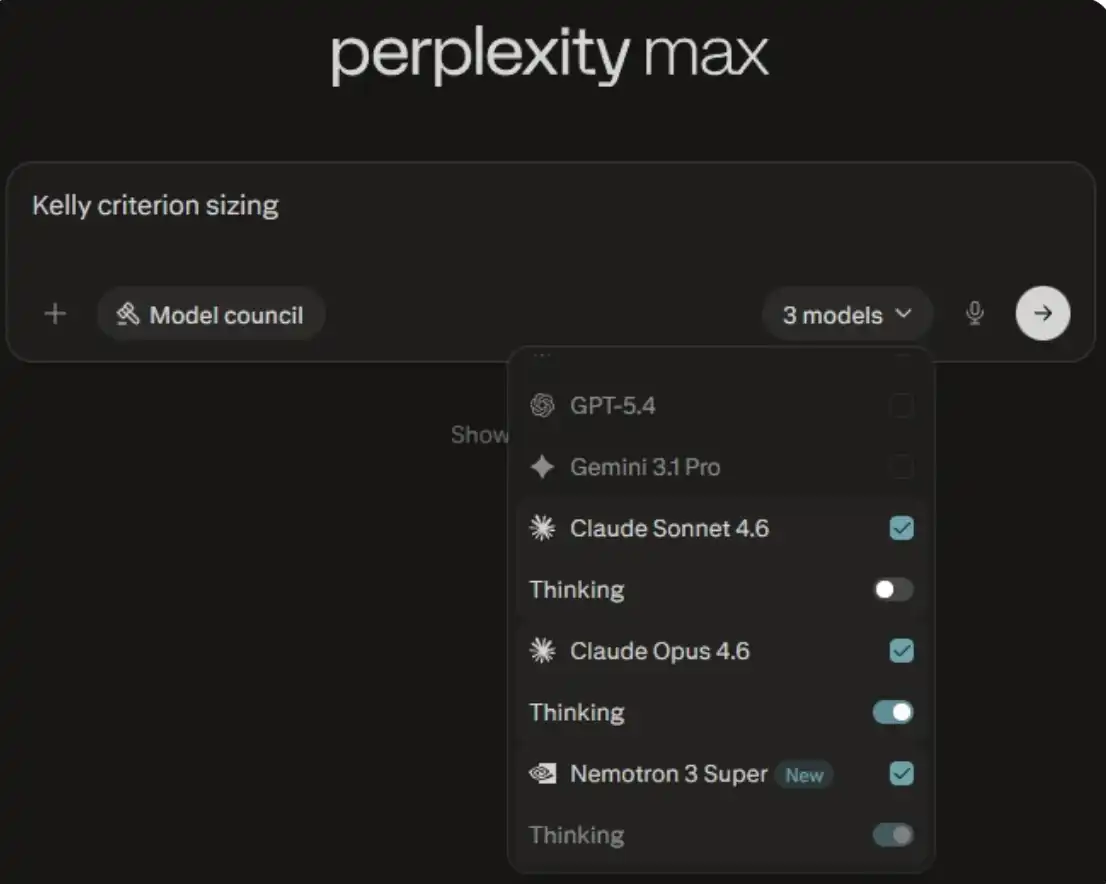
The ultimate answer provided is not the "view" of a single model, but the result of convergence from the three major models.
When Claude, GPT, and Gemini independently calculate and reach a unanimous conclusion on the same Kelly position ratio, it is no longer a possible "illusionary output" but a cross-validated result.
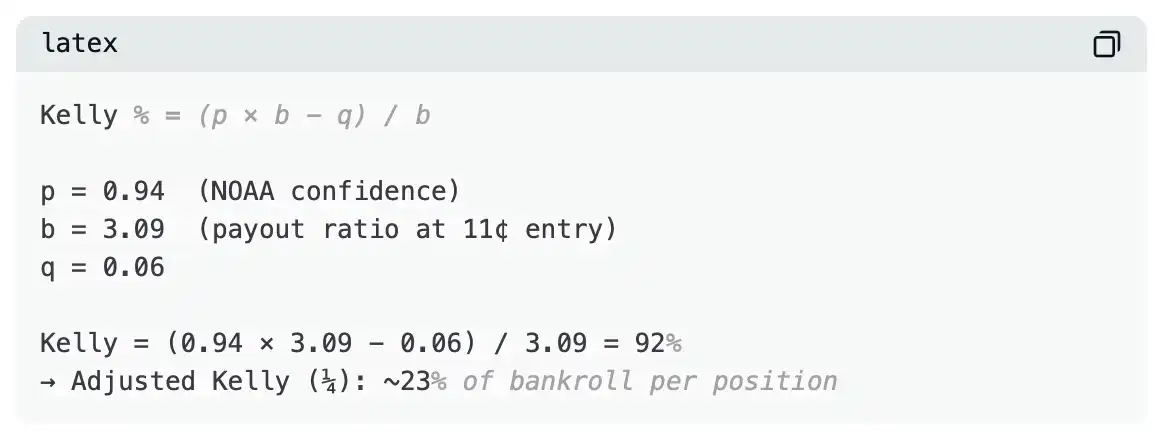
In practical operation, if the capital is only $100, each position should not exceed $2.
Is this conservative? Certainly. However, NOAA still has an error rate of about 6%. Without proper position control, one erroneous trade is enough to wipe out all the day's profits. With 6 cities, each with over 10 temperature ranges—this means there are over 60 markets to scan every day.
Perplexity's multisource analysis further consolidates three independent meteorological studies, confirming that NOAA's 94% forecast accuracy within 24 hours is actually a conservative estimate—especially for core metropolitan areas with denser weather station coverage, the accuracy is often higher.
And this bot scans the market every 2 minutes. By this calculation, it completes 720 scans across over 60 markets each day. This coverage intensity is simply unsustainable for humans.
Claude as the "Brain"
The entire system is divided into three modules: Scanner, Parser, Executor.
NOAA Scanner:
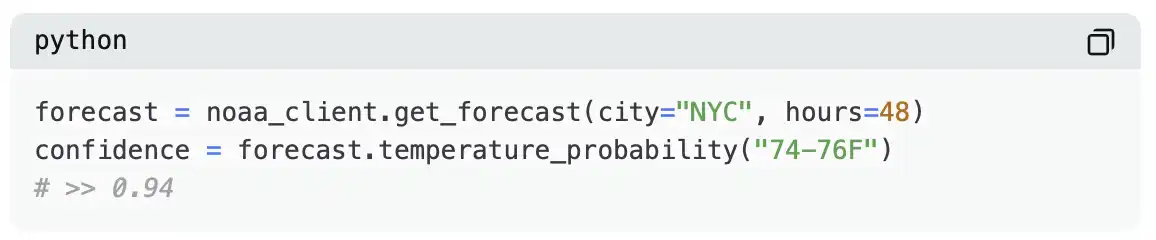
Polymarket Parser:
Decision Logic:
Telegram Reporting Module:

A regular script would only execute if/then logic: condition met → buy. It's that simple. Whereas an agent based on Claude would read the "context."
For example, if a hurricane is approaching? The NOAA data, originally updated hourly, is now updated every 30 minutes. The agent will recognize the increasing forecast instability and automatically reduce position size. It will also read news flows, monitor sentiment on Twitter, cross-validate multiple data sources—adjusting its confidence dynamically before actually placing an order.
That's the difference between a calculator and an analyst.
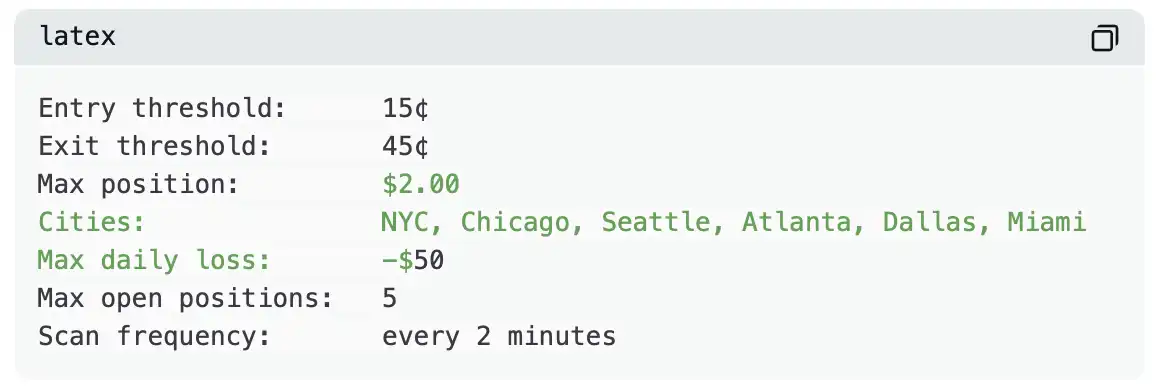
Entering at 15 cents with NOAA confidence above 85% means there is at least a 5.6x discrepancy between true probability and market pricing.
Exiting at 45 cents would allow locking in 3x gains on each successful trade.
Setting the daily loss limit at $50 means the worst-case scenario for a day is losing half the principal—at which point the bot automatically shuts down, resuming the next day.
The Stack
Perplexity AI addresses the research layer gap: niche market selection, data source identification, mathematical validation, risk assessment—all based on verifiable references and sources.
Claude addresses the execution layer gap: code generation, logic implementation, and real-time adaptive decision-making.
Polymarket represents the monetization layer.
Why Perplexity is an Asymmetric Advantage
Most people underestimate the "research" step. They jump straight to writing code, directly executing strategies—and then are puzzled why the bot starts losing money on day one.
Perplexity is not a search engine disguised as a chat interface; it is fundamentally a research infrastructure.
Multi-Model Consensus Mechanism
Your query is not handed to just one model but simultaneously run on Claude, GPT, and Gemini. When the three models independently converge on an answer, you are no longer facing a "potential illusion" but a cross-validated signal.
All Conclusions Are Sourced
Every judgment can be traced back to its origin. It's not "I think NOAA's accuracy is 94%," it's: here are research papers, API documentation, and Reddit discussions where traders have verified real P&L. You can fact-check every single point.
The Depth of Deep Research
Analyzing over 47 information sources in less than 3 minutes: academic papers, API documentation, trading forums, Twitter data analysis. The output is not a bunch of links but actionable strategies.
Auto-Generation of Follow-Up Questions
It doesn't just answer questions; it also tells you what to ask next: "Should you compare different forecast sources?" "Should you break down the cost structure?" It constructs a complete research path for you.
Compound Effect of Speed
10 minutes of research replacing 4–5 hours of manual retrieval. This is not just a convenience improvement but a structural advantage. While others are still scrolling Reddit, your bot has already started running and generating returns.
Claude is the brain; Polymarket is the wallet; and Perplexity is the eye.
Without it, you are trading blindly; with it, before placing a bet, you have already seen the entire chessboard.
Research Layer → Strategy Layer → Execution Layer → Returns, Perplexity is the first step. And the first step is precisely where 90% of traders fail.
Do not skip it.
Most people read through these, nod, and then go back to manual trading. The ones who take real action, however, have already opened Perplexity in another tab and launched the first Deep Research query: Market Segmentation, Profitable Wallets, Data Sources, Kelly Criterion Position Sizing...
The distance from 'knowing' to 'doing' is just a prompt.
Wait until you make your first $6.50 in some Weather market, then come back and read this again—your understanding will be completely different.
You may also like

Morning Report | BitMine increased its holdings by 126,971 ETH last week; trader Eugene announced his exit from the crypto market

Wang Chuan: How can one not feel anxious after the neighbor Old Wang made thirty times profit by investing in storage stocks? (Seven) - A quarter-century cycle

Cryptocurrency CEXs are flocking to sell US stocks, and traditional brokerages are facing an "uninvited guest."

$75 billion in foreign capital has fled, and South Korean retail investors have absorbed it all using leverage

Japan’s Three Megabanks Plan Joint Stablecoin Issuance in Fiscal 2026
MUFG, SMBC, and Mizuho reportedly plan to jointly issue fiat-pegged stablecoins in fiscal 2026, signaling Japan’s growing push into bank-led digital payment infrastructure.

Humanity Discloses H Token Dual-Chain Attack Details, With Losses on Ethereum and BSC Exceeding $36 Million
Humanity said the H token attack across Ethereum and BSC caused more than $36 million in losses after leaked ProxyAdmin keys enabled malicious contract upgrades and token minting.
White House Discusses CLARITY Act With Law Enforcement Ahead of Senate Vote
The White House discussed the CLARITY Act with law enforcement ahead of a Senate vote, focusing on illicit finance risks and developer protections.

Bitcoin Trading Guide 2026: Strategies for Experienced Traders

What Is XAUT and PAXG? Why Tokenized Gold Is Booming in 2026

Will the SpaceX IPO Hurt Bitcoin? Here's What Traders Are Watching

Foreign selling in the South Korean stock market accelerates, with cumulative net sales reportedly reaching $75 billion this year
On June 9, The Kobeissi Letter, citing Goldman Sachs data, reported that global investors are selling South Korean stocks at an unusually rapid pace. In the latest trading session, foreign investors sold about $801 million worth of Kospi constituent stocks again; total foreign outflows last week reached about $10 billion, and the market has been in net foreign selling on nearly every trading day over the past month. According to the data cited in the report, foreign investors have sold about $75 billion worth of South Korean stocks so far this year. Meanwhile, South Korean retail and institutional investors together recorded roughly $69 billion in net buying over the same period, suggesting that the market’s main buying support has come from domestic capital rather than returning overseas funds. The information currently disclosed still mainly comes from The Kobeissi Letter’s retelling and Goldman Sachs data summaries, while public details on the statistical period and the specific definition of “selling” remain relatively limited.

Fortune Warns of Strategy’s Financing Structure Risks as Bitcoin Premium Narrows
Fortune warned that Strategy’s Bitcoin treasury model faces growing financing risks as MSTR’s net asset premium narrows and preferred stock dividend pressure increases.

Ferrari Challenge Le Mans: Carl Moon to Dominate in WEEX Livery

Sahara AI Responds to SAHARA’s Sharp Drop: No Contract or Product Security Issues Found, Internal Investigation Underway
Sahara AI responded to SAHARA’s 60% price drop, saying no token contract or product security issues have been found and an internal investigation is underway.

WEEX Deposit/Withdrawal Dynamic Island: Your Asset Status, Always in Sight
Scaling Crypto Derivatives: The Digital Asset Infrastructure Behind High-Volume Trading
In the fast-moving digital asset ecosystem, derivatives platforms face an extreme architectural test. High-leverage futures markets demand more than just standard security—they require absolute operational precision, zero-latency matching engines, and ironclad structural scalability, all while navigating intense market volatility.
As global platforms scale to meet these demands, the industry is shifting away from rigid, monolithic setups toward a more agile, "decoupled" infrastructure philosophy.
The Blueprint for High-Volume Copy TradingFor elite global exchanges like WEEX (founded in 2018), this architectural choice becomes critical when scaling high-volume retail features like social copy trading. When thousands of users automatically mirror the real-time strategies of elite traders simultaneously, it triggers sudden, monumental spikes in concurrent transactional volume.
To prevent execution latency or settlement bottlenecks during these peak volatility events, a platform's primary engine must remain entirely dedicated to risk management, copy-trade synchronization, and order matching.
The Architectural Rule: New-generation platforms must separate front-end user execution engines from heavy backend infrastructural overhead to eliminate operational friction.
By separating these layers, platforms can maintain complete sovereignty over their trading environments and user experiences while strategically aligning with institutional-grade infrastructure ecosystems. This strategic framework allows modern exchanges to leverage advanced Digital Asset Custody infrastructure such as Cobo’s behind the scenes, ensuring that backend wallet management scales elastically alongside trading spikes.
Capitalizing on Market Momentum and 400× LeverageIn a derivatives arena where platforms offer up to 400× leverage on perpetual contracts, capital efficiency and market agility are core business metrics. To capture market momentum, an exchange needs the ability to rapidly expand its asset offerings, supporting everything from legacy crypto assets to sudden, trending altcoins across a massive library of trading pairs.
Adopting a flexible, scalable Wallet-as-a-Service (WaaS) solution such as Cobo’s could completely rewrite the development timeline for high-growth exchanges. Instead of spending months of engineering capital building out custom backend wallet architectures for every new blockchain network, platforms can deploy localized infrastructure in days.
This agility allows platforms to instantly scale their listings to over a thousand trading pairs without compromising security or delaying time-to-market. It mirrors the exact operational advantages seen during high-velocity market events, similar to how advanced wallet infrastructure empowers platforms during sudden asset surges; allowing exchanges to pass that speed and liquidity directly to their global user base.
A Mature Foundation for GrowthThe synergy between trusted infrastructure ecosystems and global trading platforms represents the natural evolution of a maturing crypto market. As WEEX continues to scale its global spot and derivatives offerings for over 6 million users, adopting robust backend paradigms proves that platforms no longer have to compromise between cutting-edge trading velocity and uncompromised structural security.

Get Paid to Onboard? Try WEEX’s New Homepage with Rewards for Registration, Deposit & Trade
WEEX Custom Layout: Build Your Perfect Trading Workspace in Seconds
Morning Report | BitMine increased its holdings by 126,971 ETH last week; trader Eugene announced his exit from the crypto market
Wang Chuan: How can one not feel anxious after the neighbor Old Wang made thirty times profit by investing in storage stocks? (Seven) - A quarter-century cycle
Cryptocurrency CEXs are flocking to sell US stocks, and traditional brokerages are facing an "uninvited guest."
$75 billion in foreign capital has fled, and South Korean retail investors have absorbed it all using leverage
Japan’s Three Megabanks Plan Joint Stablecoin Issuance in Fiscal 2026
MUFG, SMBC, and Mizuho reportedly plan to jointly issue fiat-pegged stablecoins in fiscal 2026, signaling Japan’s growing push into bank-led digital payment infrastructure.
Humanity Discloses H Token Dual-Chain Attack Details, With Losses on Ethereum and BSC Exceeding $36 Million
Humanity said the H token attack across Ethereum and BSC caused more than $36 million in losses after leaked ProxyAdmin keys enabled malicious contract upgrades and token minting.


