
Hyperbeat, to launch a "bank" on Hyperliquid




Original Title: "Hyperbeat: The Person Behind the 'Bank' on Hyperliquid"
Original Author: Sanqing, Foresight News
On April 8, the Hyperliquid native protocol Hyperbeat launched Liquid Banking, deploying a self-managed "bank" on HyperEVM, integrating stablecoin deposits, VISA card spending, perpetual contract trading, and multi-currency fiat transactions into a single on-chain smart wallet.
Image Source: Hyperbeat Tweet
The Hyperbeat team transitioned from the Hyperliquid testnet's initial validators, starting with only 5 members and self-raising around $200,000 to kick off. The two co-founders, Kilian Boshoff (@Fundi_Crypto) and 800.HL (@degennQuant), have kept a low profile, with the former having a background from Stellenbosch University in South Africa, and the company registered in the Cayman Islands.
In August 2025, they completed a $5.2 million seed round, led by ether.fi Ventures and Electric Capital, with participation from Coinbase Ventures, Maelstrom, Anchorage Digital, among others, valuing the company at around $40 million.
Morpho Powers the Engine, Creating a 'Bank' in Ten Months
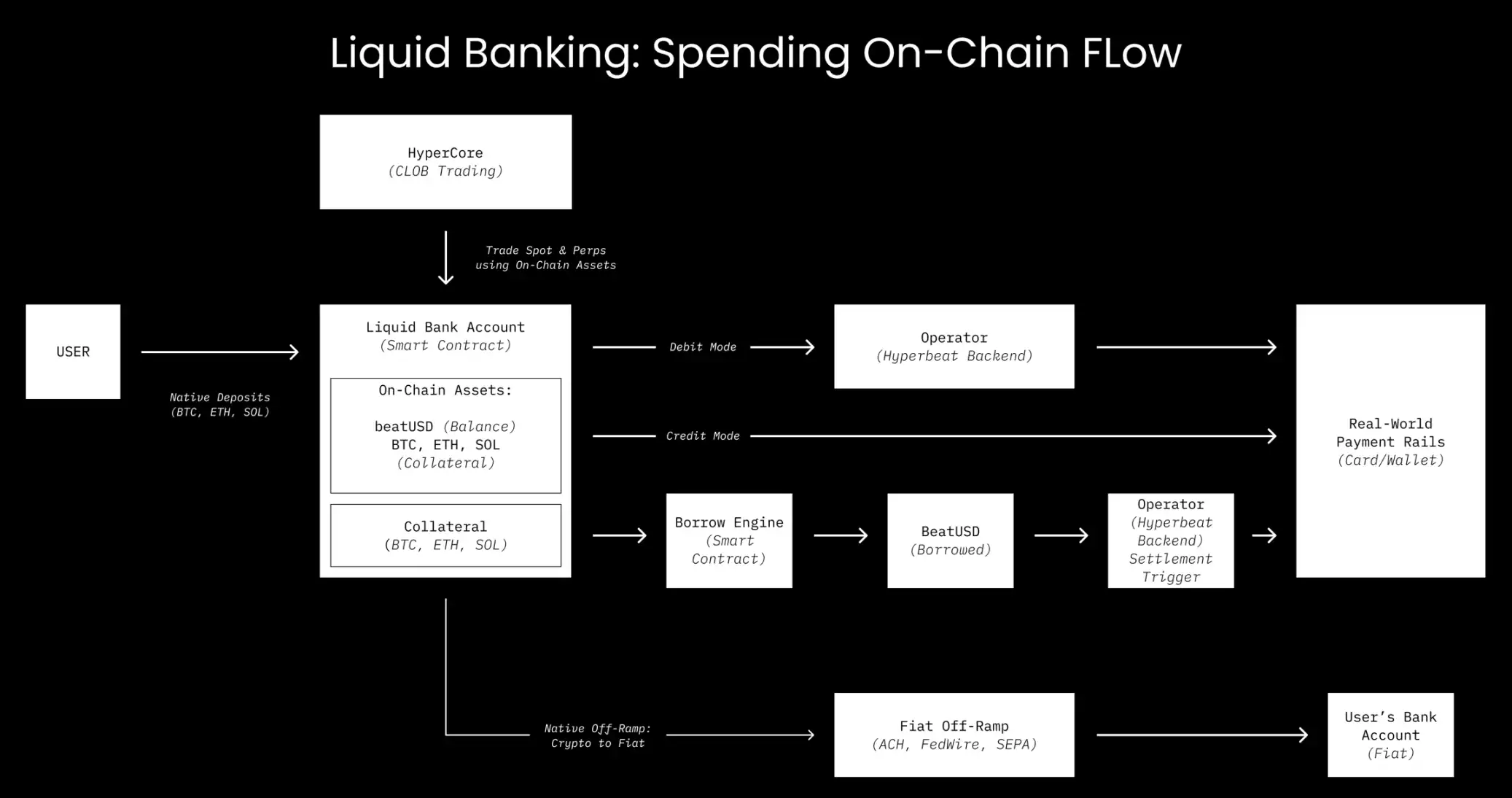
The core selling point of Liquid Banking is Credit Mode.
CREDIT Mode | Image Source: Hyperbeat Docs
Users deposit assets such as BTC, ETH, HYPE as collateral, and when they swipe their VISA card, the system instantly borrows stablecoins through the Morpho Blue market to complete the payment, while the collateral remains on-chain to continue earning rewards. Users never interact with a lending interface throughout the process, as the act of swiping the card itself constitutes an on-chain loan.
The underlying lending engine comes from Morpho. Hyperbeat integrates Morpho into users' smart wallets through an on-chain whitelist mechanism. Currently, Credit Mode is running on six isolated markets, with collateral including HYPE, UBTC, UETH, USOL, and even the gold token XAUT.
Hyperbeat does not touch the core lending logic, and Morpho does not touch the user interface. The former creates the "bank frontend," while the latter provides the "credit engine."
The stablecoin deposits in Liquid Banking are centered around the native stablecoin beatUSD issued in collaboration with Paxos Labs. Paxos provides the stablecoin infrastructure (based on USDG0), with reserve earnings flowing directly back into Hyperbeat's reward program and ultimately distributed to users, rather than remaining with the issuer.
The USD+ Treasury on the deposit side automatically allocates user funds to Morpho and protocols like Hypuur, Hyperlend, Felix, offering an annual percentage yield of 3%-8%.
The earnings come from real lending interest from Credit Mode consumers. The more the consumption, the higher the deposit yield. However, whether this cycle can be sustained depends on the actual consumption volume.
Non-selling coin consumption, but card swiping accrues interest
The fiat deposits and withdrawals in Liquid Banking are provided by Noah, supporting USD (ACH, FedWire) and Euro (SEPA) deposits, with each account linked to a unique IBAN.
Liquid Banking Architecture | Source: Hyperbeat Docs
In March 2026, direct deposits and withdrawals for the Vietnamese Dong and Malaysian Ringgit will be further enabled, with withdrawals also covering currencies like Pound Sterling, Dirham, Baht, among a dozen others.
The VISA card is issued by Third National, with the underlying infrastructure provided by Rain, a Visa Principal Member. By early January 2026, its funding valuation had reached $1.95 billion, with an annualized processing volume exceeding $30 billion, covering over a hundred countries.
The card is classified as Visa Signature, with benefits such as airport lounge access. Foreign exchange transactions incur a 1% FX fee (based on Visa's official rate), no annual fee, no swipe fees; ATM withdrawals cost $1 + 0.65%; default monthly spending limit of $100,000.
The Credit Mode's lending interest rate fluctuates with the Morpho market utilization rate, but there is no interest-free period; interest on each "HODL & Borrow" transaction starts accruing from the moment of the transaction.
The Hyperbeat official "no hidden fees" refers to the transparency of the yield strategy, not the card fee pricing. The Credit Mode lending interest rate is dynamically determined by the Morpho market, without an interest-free period, meaning that the real-time cost of "HODL & Borrow" convenience exists and is not low.
Self-Custody Comes with a One-Day Cooling-Off Period
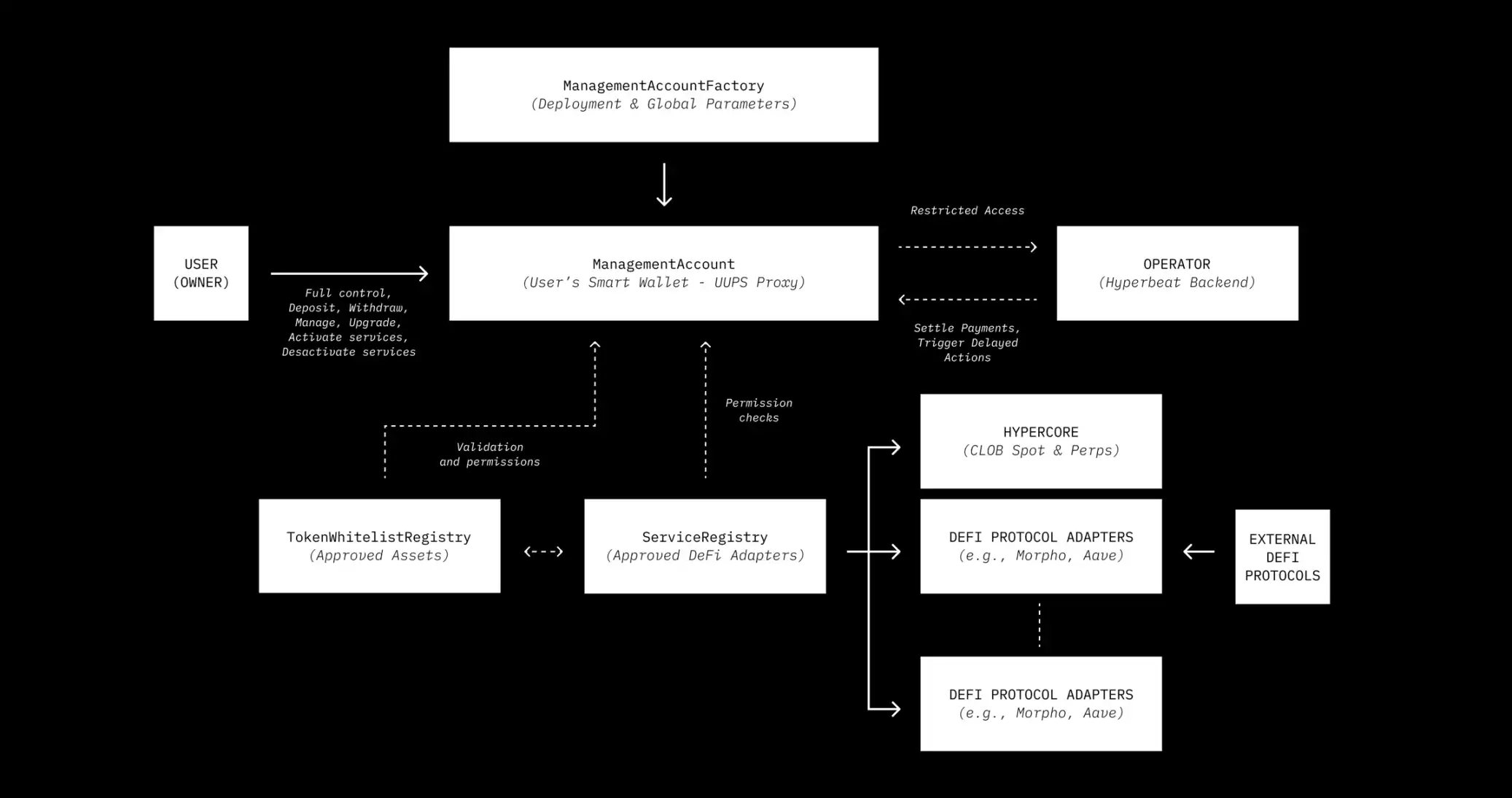
Unlike all centralized crypto cards, user assets always stay in their self-controlled ManagementAccount smart wallet. The Hyperbeat backend only has a limited Operator role, which can only settle within the user-set limits and cannot transfer assets to unauthorized addresses.
However, self-custody must address one issue: what if users front-run withdrawals after swiping their card? Hyperbeat has introduced an on-chain time-lock mechanism.
Settlement token withdrawals require a cooling-off period and confirmation process, collateral withdrawals require Operator approval to prevent defaults, and mode switches also have delays. The contract has been audited by Zellic and Nethermind, and key management is provided by Turnkey.
These frictions are not bugs but features. It acknowledges the speed difference between on-chain settlement and offline consumption, filling the gap with contract rules instead of "trust us." However, users must monitor their health factor themselves, as there is no customer service to help undo operational errors.
You may also like

When reasoning becomes a scarce resource, who captures its value?

Jensen Huang dramatically "rescues" the South Korean stock market
Stablecoins vs Deposit Tokens: On the surface, they seem like opposing sides, but in reality, they are interconnected

Bitcoin Crash to $50,000 or Bear Trap Before $100,000? Deep Dive for WEEX Traders

Yang Ge Gary: Agent Economics and AI Microeconomics

Founder of Baixing.com: My Experience with Claude Code in Fourteen Points

How Could the SpaceX IPO Affect Bitcoin, Altcoins season, and Crypto Liquidity?

RootData: May 2026 Cryptocurrency Exchange Transparency Research Report

Should we escape the peak? The principle of the tail-end market in the stock market

Morning News | Five major virtual asset platforms in South Korea have experienced 57 incidents of hacking and system failures in six years; Grayscale submits registration application for Canton ETF

The ambitions of Kalshi, MTS, and a16z

The AI bubble is bursting

Real withdrawal is to release water: When crypto VCs position themselves in the Agent network effect

Has the narrative of BTC as "digital gold" failed?
A Perspective on the Indian Cryptocurrency Market: Descending into Silence or Moving Towards Maturity?

It took me a year to see the painful truth about Agent payments

Morning News | Bitmine issues preferred shares to raise $300 million; Polymarket accuses Kalshi of industrial espionage
Privacy coin trust crisis! ZEC plummets over 56% in a single day
When reasoning becomes a scarce resource, who captures its value?
Jensen Huang dramatically "rescues" the South Korean stock market
Stablecoins vs Deposit Tokens: On the surface, they seem like opposing sides, but in reality, they are interconnected
Bitcoin Crash to $50,000 or Bear Trap Before $100,000? Deep Dive for WEEX Traders
Yang Ge Gary: Agent Economics and AI Microeconomics
Founder of Baixing.com: My Experience with Claude Code in Fourteen Points


