
Industry Security Mega Test, Self-Custody Wallet is the Future of Web3


Source: OKX
The algorithmic wave never stops, and a security incident is like the sword of Damocles hanging over one's head, not a matter of "if" but "when." Recently, both CEX and DeFi have frequently fallen victim to hacker attacks, with asset losses, contract vulnerabilities, and trojan viruses casting shadows over the market, once again making "security" a focus. The crypto world has never been absolutely secure, only with constantly evolving security strategies. As the traditional financial "too big to fail" rule fails in the Web3 world, the industry faces an unprecedented question: Whom should we entrust our asset security to?
OKX clearly recognizes the security risks in the crypto industry, but we focus on solutions rather than fear—fear does not solve problems; technological innovation is the answer. We care about the security of all crypto users, no matter where everyone trades. We always advocate for higher security standards and, through technologies such as self-custody wallets and POR, empower users to truly own their asset sovereignty. This is not marketing but rather the inevitable direction of industry development.
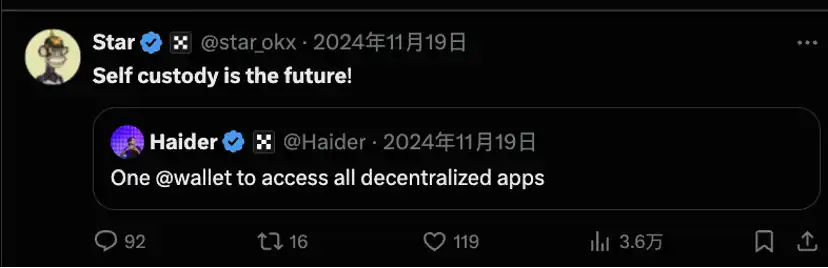
We believe that the future of Web3 is not built on centralized trust platforms but on code, transparency, and user sovereignty. True security does not rely on a single platform but is controlled by the users themselves. Therefore, the self-custody wallets we advocate for are not just a product concept but a paradigm shift in the industry, representing a return to trustlessness, transparency, and individual sovereignty. OKX is committed to promoting higher security standards, not only for itself but also for the entire industry, to provide more transparent and trustworthy solutions.
We hope to strengthen OKX's commitment to crypto security by helping users understand the concept of self-custody wallets, assisting users in making informed decisions, and raising awareness of security. OKX firmly believes that the industry must continue to evolve to protect user asset security. We support stricter security standards to ensure the long-term development of the entire industry.
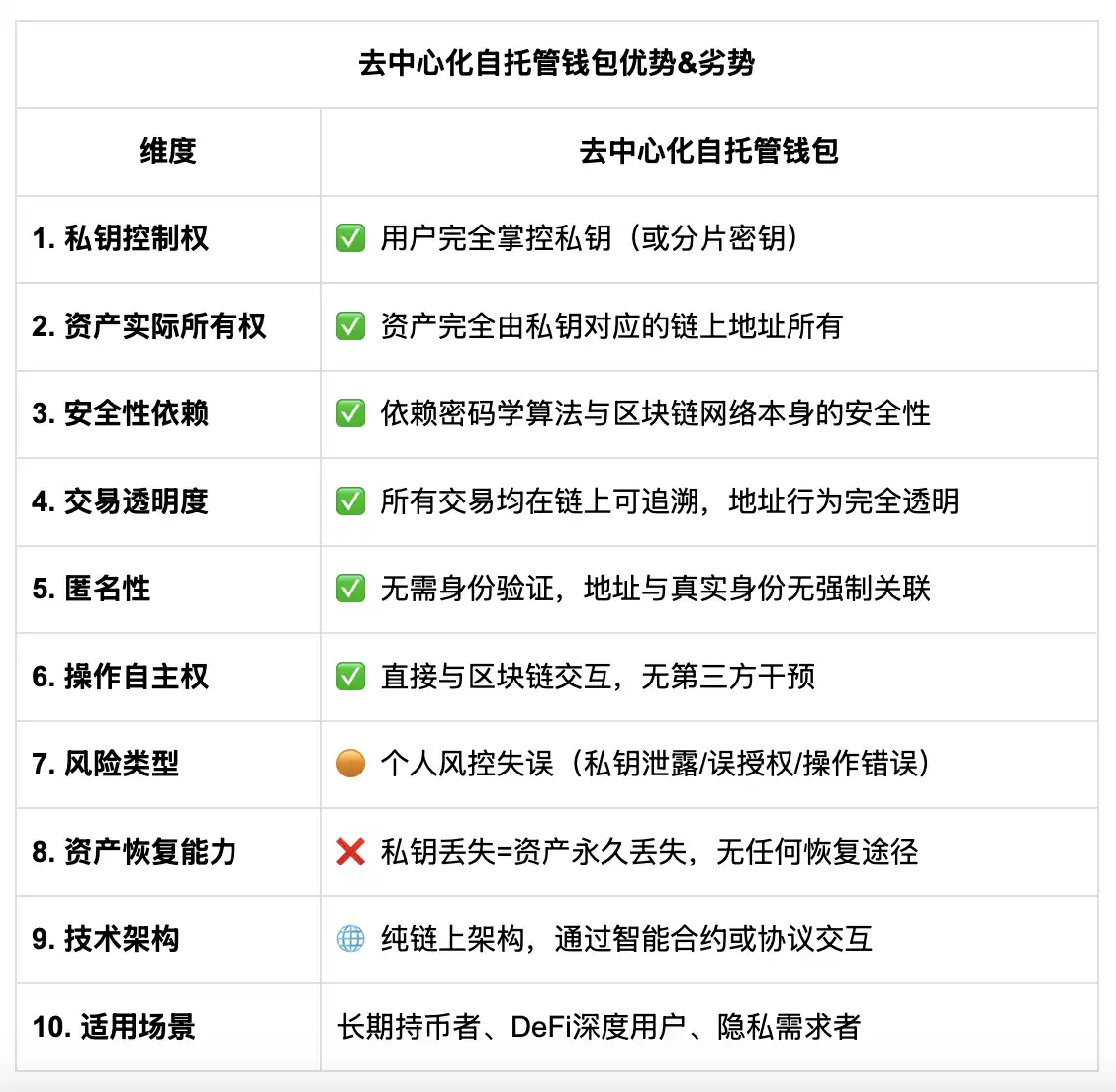
The essential difference between "platform security" in the traditional paradigm and "self-sovereign security" in the Web3 era is significant. "Not your key, not your money"—self-custody wallets give users absolute control over their crypto assets, enabling decentralized management through unique private keys. Users can complete asset storage, transactions, and other operations without relying on third-party institutions, truly becoming managers of their personal digital assets. This security mechanism based on mathematical proof completely breaks free from the traditional security framework reliant on human operations, safeguarding not only the integrity of asset ownership and privacy but also avoiding redemption risks due to centralization platform crises. However, absolute control comes with full responsibility, as users must independently uphold security obligations like safeguarding mnemonic phrases.
When it comes to account generation and private key backup, unlike traditional wallets that only support deriving multiple wallets from one set of mnemonics, the OKX Web3 Wallet is the only wallet that can create multiple sets of mnemonic wallets and derive multiple accounts from one set of mnemonics. This enhances user flexibility and security in asset management, effectively reduces the risk of private key exposure. In addition, the OKX Web3 Wallet has revamped the backup process, allowing users to simply log in to their iCloud/Google account and set an encryption password to complete an off-chain backup. This solution breaks free from traditional hardware dependencies, enabling quick asset recovery through cloud-verified encrypted backups even in cases of device loss or forgotten mnemonics. The triple protection system—cloud storage + password verification + local encryption—not only lowers the operational threshold but also establishes a single-point-of-failure-resistant insurance mechanism for encrypted assets.
Simultaneously, the OKX Web3 Wallet offers robust private key protection features such as prohibiting users from taking screenshots or screen recordings of private keys and mnemonics to prevent information leaks. To further enhance security, it also supports functions like segmented private key copying to ensure protection at every step. Through these protective measures, users' private keys and mnemonics are always kept under strict security measures, reducing potential security risks.
According to a public audit by SlowMist Technology, all private keys and mnemonics of OKX Web3 Wallet users are stored only on their local devices and are not uploaded to any external servers. Furthermore, the OKX Web3 Wallet's related SDK is open-source, having undergone extensive validation and continuous review by the global developer community, ensuring greater transparency. The OKX Web3 Wallet's private key security module complies with financial-grade security standards, ensuring mnemonic offline storage throughout without ever touching the internet.
To address the prevalent "infinite allowance" risk in the DeFi ecosystem, the OKX Web3 Wallet features built-in smart contract permission management functions, supporting custom authorization limits, one-click revocation of risky authorizations, continuous risk monitoring, 30-day inactive DApp risk alerts, regular pop-up warnings of risks, and other highlight features. This further eradicates asset exposure risks caused by over-permissions, establishing a "least privilege" security paradigm.
For instance, many users have previously authorized various contracts, but contracts that have remained inactive for an extended period may become targets for hacker attacks due to lack of maintenance by project teams. The OKX Web3 Wallet records user-authorized contracts via on-chain retrieval functionality and tracks and manages risk-free contracts. For long-inactive contracts, the system automatically detects them and promptly alerts users upon identifying risks. Every 30 days, the system sends a reminder to users who have not revoked authorizations for long-inactive contracts, advising them to regularly manage wallet contract authorizations, cancel unused contracts promptly to reduce potential risks. Moreover, the OKX Contract Monitoring Engine provides 24/7 security protection, continuously scanning user-authorized contracts and promptly notifying users to revoke authorizations upon identifying risks; if authorizations are not canceled within 24 hours, the system will issue another pop-up reminder.
Regarding on-chain interaction risk, the OKX Web3 Wallet provides powerful risk transaction identification capabilities, such as integrating the Eye of God KYT system to build an active defense network, real-time scanning of a risk address label library. At key points such as DApp interaction, asset transfer, etc., through machine learning to dynamically identify threats such as malicious contracts, phishing addresses, it achieves millisecond-level risk prevention before transactions. This protection system deeply integrates user autonomy with professional risk control capabilities, allowing self-custodial wallets to maintain decentralized characteristics while obtaining security capabilities that surpass centralized platforms.
The future of the industry is still unknown, but self-custodial wallets are undoubtedly a deterministic path—becoming the "Noah's Ark" of user asset security.
Disclaimer
This content is for reference only and should not be considered or construed as (i) investment advice or recommendation, (ii) an offer or solicitation to buy, sell, or hold digital assets, or (iii) financial, accounting, legal, or tax advice. We do not guarantee the accuracy, completeness, or usefulness of such information. Digital assets (including stablecoins and NFTs) are subject to market fluctuations, involve high risk, may depreciate, or even become worthless. You should carefully consider whether trading or holding digital assets is suitable for you based on your financial situation and risk tolerance. For your specific circumstances, please consult your legal/tax/investment professional. Not all products are available in all regions. For more details, please refer to the OKX Terms of Service and Risk Disclosure & Disclaimer. The OKX Web3 Mobile Wallet and its derivative services are subject to separate terms of service. You are responsible for understanding and complying with local laws and regulations.
This article is contributed content and does not represent the views of BlockBeats
You may also like

Japan’s Three Megabanks Plan Joint Stablecoin Issuance in Fiscal 2026
MUFG, SMBC, and Mizuho reportedly plan to jointly issue fiat-pegged stablecoins in fiscal 2026, signaling Japan’s growing push into bank-led digital payment infrastructure.

Humanity Discloses H Token Dual-Chain Attack Details, With Losses on Ethereum and BSC Exceeding $36 Million
Humanity said the H token attack across Ethereum and BSC caused more than $36 million in losses after leaked ProxyAdmin keys enabled malicious contract upgrades and token minting.

White House Discusses CLARITY Act With Law Enforcement Ahead of Senate Vote
The White House discussed the CLARITY Act with law enforcement ahead of a Senate vote, focusing on illicit finance risks and developer protections.

$75 billion in foreign capital has fled, and South Korean retail investors have absorbed it all using leverage

Bitcoin Trading Guide 2026: Strategies for Experienced Traders

What Is XAUT and PAXG? Why Tokenized Gold Is Booming in 2026

Cryptocurrency CEXs are flocking to sell US stocks, and traditional brokerages are facing an "uninvited guest."

Will the SpaceX IPO Hurt Bitcoin? Here's What Traders Are Watching
Foreign selling in the South Korean stock market accelerates, with cumulative net sales reportedly reaching $75 billion this year
On June 9, The Kobeissi Letter, citing Goldman Sachs data, reported that global investors are selling South Korean stocks at an unusually rapid pace. In the latest trading session, foreign investors sold about $801 million worth of Kospi constituent stocks again; total foreign outflows last week reached about $10 billion, and the market has been in net foreign selling on nearly every trading day over the past month. According to the data cited in the report, foreign investors have sold about $75 billion worth of South Korean stocks so far this year. Meanwhile, South Korean retail and institutional investors together recorded roughly $69 billion in net buying over the same period, suggesting that the market’s main buying support has come from domestic capital rather than returning overseas funds. The information currently disclosed still mainly comes from The Kobeissi Letter’s retelling and Goldman Sachs data summaries, while public details on the statistical period and the specific definition of “selling” remain relatively limited.

Fortune Warns of Strategy’s Financing Structure Risks as Bitcoin Premium Narrows
Fortune warned that Strategy’s Bitcoin treasury model faces growing financing risks as MSTR’s net asset premium narrows and preferred stock dividend pressure increases.

Ferrari Challenge Le Mans: Carl Moon to Dominate in WEEX Livery

Sahara AI Responds to SAHARA’s Sharp Drop: No Contract or Product Security Issues Found, Internal Investigation Underway
Sahara AI responded to SAHARA’s 60% price drop, saying no token contract or product security issues have been found and an internal investigation is underway.

WEEX Deposit/Withdrawal Dynamic Island: Your Asset Status, Always in Sight
Scaling Crypto Derivatives: The Digital Asset Infrastructure Behind High-Volume Trading
In the fast-moving digital asset ecosystem, derivatives platforms face an extreme architectural test. High-leverage futures markets demand more than just standard security—they require absolute operational precision, zero-latency matching engines, and ironclad structural scalability, all while navigating intense market volatility.
As global platforms scale to meet these demands, the industry is shifting away from rigid, monolithic setups toward a more agile, "decoupled" infrastructure philosophy.
The Blueprint for High-Volume Copy TradingFor elite global exchanges like WEEX (founded in 2018), this architectural choice becomes critical when scaling high-volume retail features like social copy trading. When thousands of users automatically mirror the real-time strategies of elite traders simultaneously, it triggers sudden, monumental spikes in concurrent transactional volume.
To prevent execution latency or settlement bottlenecks during these peak volatility events, a platform's primary engine must remain entirely dedicated to risk management, copy-trade synchronization, and order matching.
The Architectural Rule: New-generation platforms must separate front-end user execution engines from heavy backend infrastructural overhead to eliminate operational friction.
By separating these layers, platforms can maintain complete sovereignty over their trading environments and user experiences while strategically aligning with institutional-grade infrastructure ecosystems. This strategic framework allows modern exchanges to leverage advanced Digital Asset Custody infrastructure such as Cobo’s behind the scenes, ensuring that backend wallet management scales elastically alongside trading spikes.
Capitalizing on Market Momentum and 400× LeverageIn a derivatives arena where platforms offer up to 400× leverage on perpetual contracts, capital efficiency and market agility are core business metrics. To capture market momentum, an exchange needs the ability to rapidly expand its asset offerings, supporting everything from legacy crypto assets to sudden, trending altcoins across a massive library of trading pairs.
Adopting a flexible, scalable Wallet-as-a-Service (WaaS) solution such as Cobo’s could completely rewrite the development timeline for high-growth exchanges. Instead of spending months of engineering capital building out custom backend wallet architectures for every new blockchain network, platforms can deploy localized infrastructure in days.
This agility allows platforms to instantly scale their listings to over a thousand trading pairs without compromising security or delaying time-to-market. It mirrors the exact operational advantages seen during high-velocity market events, similar to how advanced wallet infrastructure empowers platforms during sudden asset surges; allowing exchanges to pass that speed and liquidity directly to their global user base.
A Mature Foundation for GrowthThe synergy between trusted infrastructure ecosystems and global trading platforms represents the natural evolution of a maturing crypto market. As WEEX continues to scale its global spot and derivatives offerings for over 6 million users, adopting robust backend paradigms proves that platforms no longer have to compromise between cutting-edge trading velocity and uncompromised structural security.

Morning Report | BitMine increased its holdings by 126,971 ETH last week; trader Eugene announced his exit from the crypto market

Wang Chuan: How can one not feel anxious after the neighbor Old Wang made thirty times profit by investing in storage stocks? (Seven) - A quarter-century cycle

Get Paid to Onboard? Try WEEX’s New Homepage with Rewards for Registration, Deposit & Trade
WEEX Custom Layout: Build Your Perfect Trading Workspace in Seconds
Japan’s Three Megabanks Plan Joint Stablecoin Issuance in Fiscal 2026
MUFG, SMBC, and Mizuho reportedly plan to jointly issue fiat-pegged stablecoins in fiscal 2026, signaling Japan’s growing push into bank-led digital payment infrastructure.
Humanity Discloses H Token Dual-Chain Attack Details, With Losses on Ethereum and BSC Exceeding $36 Million
Humanity said the H token attack across Ethereum and BSC caused more than $36 million in losses after leaked ProxyAdmin keys enabled malicious contract upgrades and token minting.
White House Discusses CLARITY Act With Law Enforcement Ahead of Senate Vote
The White House discussed the CLARITY Act with law enforcement ahead of a Senate vote, focusing on illicit finance risks and developer protections.
$75 billion in foreign capital has fled, and South Korean retail investors have absorbed it all using leverage
Bitcoin Trading Guide 2026: Strategies for Experienced Traders
What Is XAUT and PAXG? Why Tokenized Gold Is Booming in 2026


