
Market Prediction Fallacy: Is Trading Based on Fact or Rule?


Original Title: "Prediction Market Plunged into Another Major Controversy: Are You Trading on Fact or Rule?"
Original Author: Asher, Odaily Planet Daily
The prediction market can be said to be the most hotly debated track in the current Web3 discussion.
Prediction trading around macro events, the crypto industry, and even entertainment topics continues to heat up, with the level of discussion and participation constantly rising. However, as the market rapidly develops, some discordant voices have gradually emerged—certain events have deviated from users' expectations based on common sense or "real-world understanding" at settlement, triggering controversies regarding rule design, fairness, and platform credibility.
Recently, the prediction market has seen two consecutive high-controversy events. Below, the Odaily Planet Daily will sort out and discuss them.
Polymarket: U.S. Rescue of American Pilot in Iran Determined as U.S. Invasion of Iran
On April 3, a U.S. F-15E Strike Eagle fighter jet was shot down by the Iranian air defense system in southwestern Iran. Two crew members (one pilot, one weapon systems officer/WSO) parachuted out, with one quickly rescued and the other missing for several days, hiding in the Iranian mountains.
The U.S. military then launched a search and rescue (SAR) operation, involving armed aircraft, helicopters, etc., and successfully rescued the second severely injured crew member (Trump personally announced "WE GOT HIM"). The rescue operation involved U.S. military entering Iranian territory (mountain search and rescue, possible ground or low-altitude operations), which raised concerns against the current backdrop of sensitive geopolitical conflicts.
As the U.S. military entering Iranian territory can be considered to some extent as a U.S. invasion of Iran, it directly affected the prediction event on the Polymarket platform regarding when the U.S. military would invade Iran (US forces enter Iran by?).
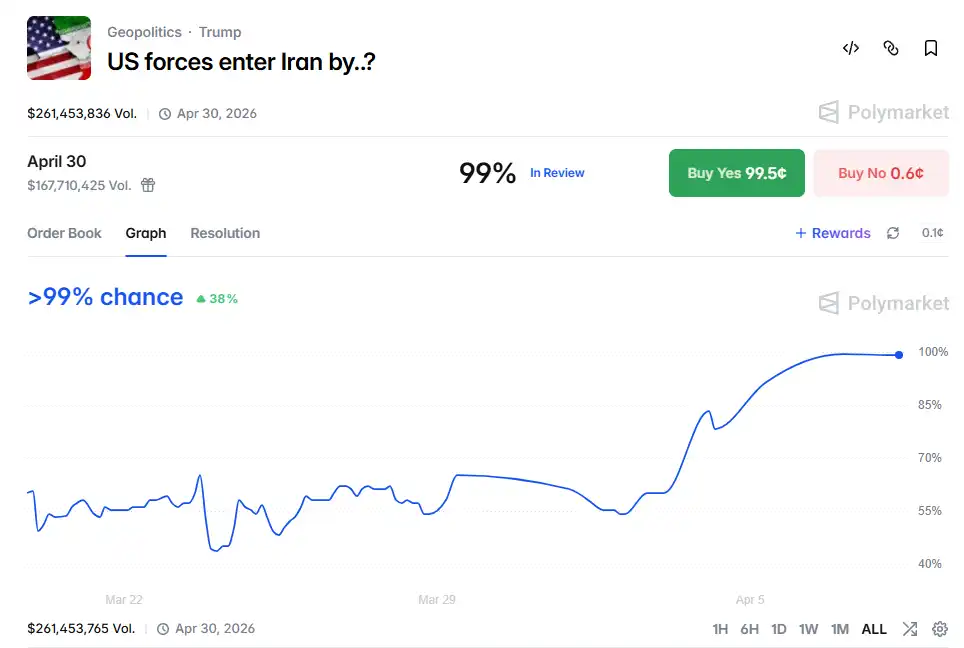
According to the settlement rules, active-duty U.S. military personnel (including special operations forces) entering Iranian land territory before a specified date would be considered an invasion, with the downed pilot not counting as an invasion, but U.S. special forces did indeed enter Iranian territory to rescue the pilot. Therefore, the special forces entering Iran to rescue the pilot met the standard for determining the U.S. invasion of Iran as Yes on Polymarket.
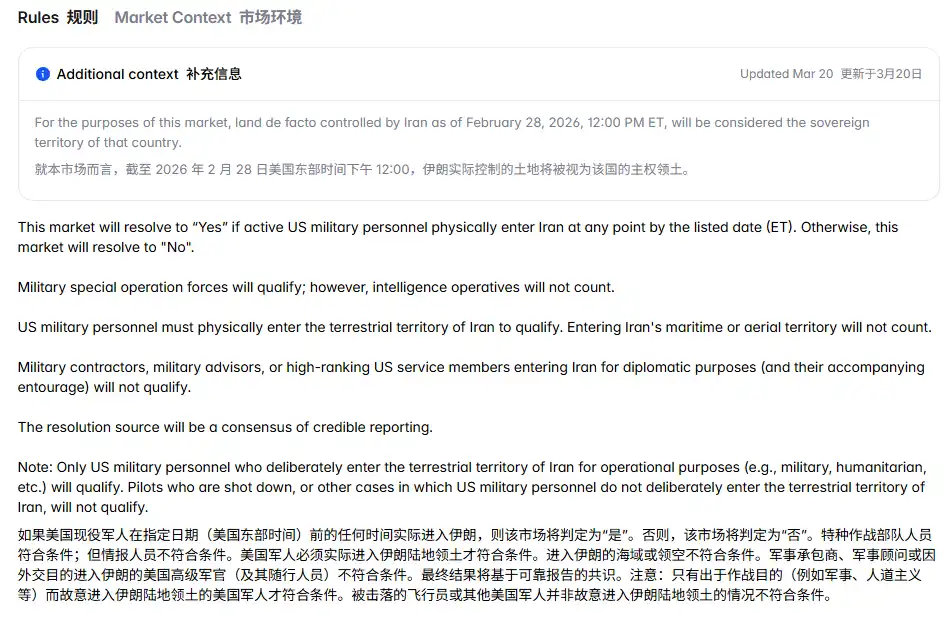
The "Pilot Rescue" event has been judged by Polymarket as the U.S. invasion of Iran, sparking strong community controversy.
Supporters of the "Count as Entry" (Yes side) believe that this action meets the definition of "entry" as per the rules. The U.S. Special Forces actively entered Iranian territory to carry out a mission, and the rules explicitly state that "special operation forces will qualify," including "for operational purposes (including humanitarian)." From an objective standpoint, this is the first confirmed U.S. ground penetration behavior in the current conflict context, with U.S. personnel indeed stepping on Iranian soil, hence should be considered an "entry."
Opponents of the "Count as Entry" (No side) argue that this definition is overly broad. They believe that this action was essentially a short-term, limited humanitarian rescue operation, not an invasion or occupation, and does not align with the general understanding of the public regarding "U.S. troops entering Iran."
Furthermore, the rules explicitly exclude that "pilots who are shot down... will not qualify," and this action revolves around the downed pilot, having the nature of "forced entry," which logically should fall into a similar exception category. Referring to past cases (such as similar regional actions not being considered invasions), rescue actions should not be equated with military entry; if judged as Yes, it may encourage marginal interpretations of the rules, weakening the seriousness and consistency of the market.
The Chinese community also generally believes that "entering Iran" should more specifically refer to large-scale ground or amphibious operations, rather than short-term actions of "rescue and leave."
Predict.fun: Polymarket Issuing Stablecoin Deemed as Token Launch
On the evening of April 6, Polymarket officially announced on X that it would undergo a comprehensive platform upgrade:
Rebuilding the trading engine, upgrading smart contracts; introducing a new native collateral token, Polymarket USD (1:1 pegged to USDC, to replace USDC.e, reducing bridging risks).
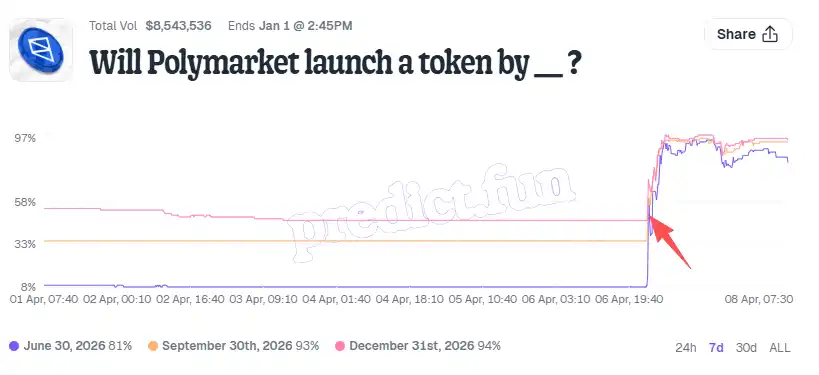
Notably, the second point mentioned the launch of the native collateral token Polymarket USD, directly impacting the probabilities of two related prediction events on Predict.fun.
One is token launch; the other is post-launch market cap:
1. When will Polymarket launch a token (Will Polymarket launch a token by ___ ?).
2. One day after opening, what was the FDV of Polymarket (Polymarket FDV above ___ one day after launch?)?
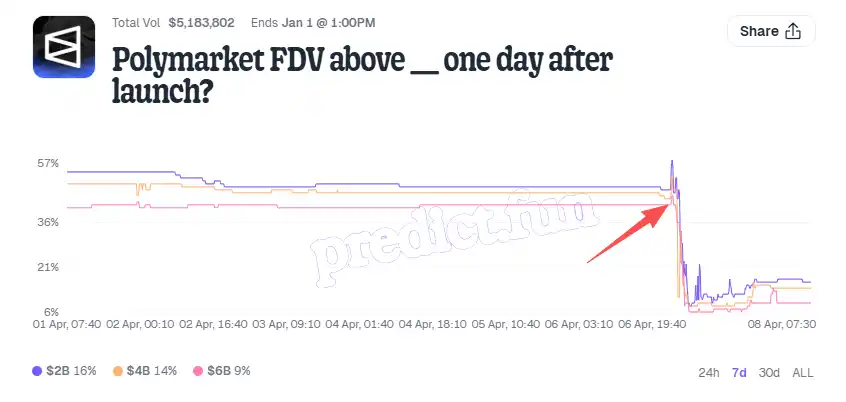
According to the settlement rules document, it is clearly stated that "any fungible token issued by Polymarket counts as 'issuance' for this event," and stablecoins are no exception. Therefore, Polymarket's stablecoin meets the criteria to be judged as Yes.
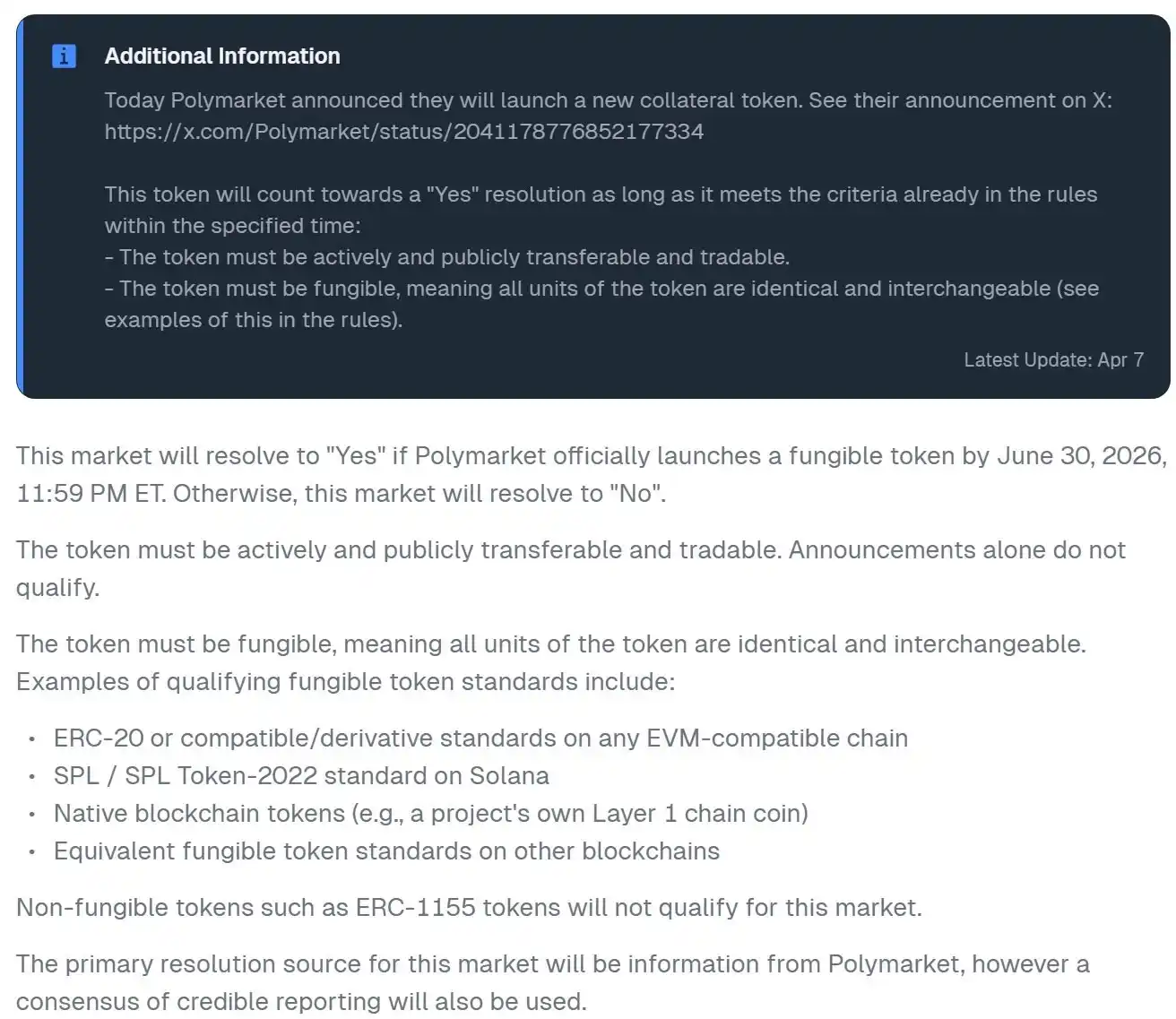
Settlement Rules Explanation
The community has engaged in a debate on this matter.
Supporters argue that based on the literal interpretation of the rules, "token issuance" is not limited to being a "governance token," but is a general reference to all tokens. Under this premise, Polymarket USD, as an ERC20/SPL fungible token issued by Polymarket, fundamentally meets the definition of "issuance." Furthermore, subsequent official clarifications are more of a reiteration of the original rules rather than a temporary rule change, making them somewhat reasonable in terms of compliance.
However, skeptics do not accept this explanation. On the one hand, they believe that including stablecoins in the category of "issuance" is an overinterpretation of the rules and a typical play on words. On the other hand, even if stablecoins are considered "issuance," the core of this prediction market is still the "Polymarket FDV," not the "Polymarket USD FDV." Stablecoins serve more as collateral or settlement tools, and their market value structure differs fundamentally from that of the project's native token (such as the POLY governance token), so they should not be directly equated or substituted for the overall project valuation logic.
Whose Side Are You On?
Overall, the controversial event in the prediction market actually revolves around a central question: are you betting on "reality" or on "rules"? Many times, these two do not completely overlap.
For those of us involved in prediction markets, understanding the rules themselves may be more important than predicting the outcome. How the information source is defined, whether there are any exceptions, whether there is room for interpretation—these details can directly determine the outcome at critical moments.
It is also for this reason that some high-probability events that appear to be a "financial management trap" may not be without risk, but may instead be a potential "loss trap." Many reversals occur precisely in these overlooked details. Instead of blind betting, take a closer look at the rules. It is more useful to do so than to complain after losing money.
You may also like

Sahara AI Responds to SAHARA’s Sharp Drop: No Contract or Product Security Issues Found, Internal Investigation Underway
Sahara AI responded to SAHARA’s 60% price drop, saying no token contract or product security issues have been found and an internal investigation is underway.

WEEX Deposit/Withdrawal Dynamic Island: Your Asset Status, Always in Sight

Scaling Crypto Derivatives: The Digital Asset Infrastructure Behind High-Volume Trading
In the fast-moving digital asset ecosystem, derivatives platforms face an extreme architectural test. High-leverage futures markets demand more than just standard security—they require absolute operational precision, zero-latency matching engines, and ironclad structural scalability, all while navigating intense market volatility.
As global platforms scale to meet these demands, the industry is shifting away from rigid, monolithic setups toward a more agile, "decoupled" infrastructure philosophy.
The Blueprint for High-Volume Copy TradingFor elite global exchanges like WEEX (founded in 2018), this architectural choice becomes critical when scaling high-volume retail features like social copy trading. When thousands of users automatically mirror the real-time strategies of elite traders simultaneously, it triggers sudden, monumental spikes in concurrent transactional volume.
To prevent execution latency or settlement bottlenecks during these peak volatility events, a platform's primary engine must remain entirely dedicated to risk management, copy-trade synchronization, and order matching.
The Architectural Rule: New-generation platforms must separate front-end user execution engines from heavy backend infrastructural overhead to eliminate operational friction.
By separating these layers, platforms can maintain complete sovereignty over their trading environments and user experiences while strategically aligning with institutional-grade infrastructure ecosystems. This strategic framework allows modern exchanges to leverage advanced Digital Asset Custody infrastructure such as Cobo’s behind the scenes, ensuring that backend wallet management scales elastically alongside trading spikes.
Capitalizing on Market Momentum and 400× LeverageIn a derivatives arena where platforms offer up to 400× leverage on perpetual contracts, capital efficiency and market agility are core business metrics. To capture market momentum, an exchange needs the ability to rapidly expand its asset offerings, supporting everything from legacy crypto assets to sudden, trending altcoins across a massive library of trading pairs.
Adopting a flexible, scalable Wallet-as-a-Service (WaaS) solution such as Cobo’s could completely rewrite the development timeline for high-growth exchanges. Instead of spending months of engineering capital building out custom backend wallet architectures for every new blockchain network, platforms can deploy localized infrastructure in days.
This agility allows platforms to instantly scale their listings to over a thousand trading pairs without compromising security or delaying time-to-market. It mirrors the exact operational advantages seen during high-velocity market events, similar to how advanced wallet infrastructure empowers platforms during sudden asset surges; allowing exchanges to pass that speed and liquidity directly to their global user base.
A Mature Foundation for GrowthThe synergy between trusted infrastructure ecosystems and global trading platforms represents the natural evolution of a maturing crypto market. As WEEX continues to scale its global spot and derivatives offerings for over 6 million users, adopting robust backend paradigms proves that platforms no longer have to compromise between cutting-edge trading velocity and uncompromised structural security.

Morning Report | BitMine increased its holdings by 126,971 ETH last week; trader Eugene announced his exit from the crypto market

Wang Chuan: How can one not feel anxious after the neighbor Old Wang made thirty times profit by investing in storage stocks? (Seven) - A quarter-century cycle

Get Paid to Onboard? Try WEEX’s New Homepage with Rewards for Registration, Deposit & Trade

WEEX Custom Layout: Build Your Perfect Trading Workspace in Seconds

See “Buy Walls” & “Sell Walls” Instantly: WEEX Launches the Depth Chart for Smarter Trades

What Is Quick Trade on WEEX? 2 Ways WEEX Ends Chart-Panel Jumping
Morning News | Five major virtual asset platforms in South Korea have experienced 57 incidents of hacking and system failures in six years; Grayscale submits registration application for Canton ETF

Should we escape the peak? The principle of the tail-end market in the stock market
RootData: May 2026 Cryptocurrency Exchange Transparency Research Report

Founder of Baixing.com: My Experience with Claude Code in Fourteen Points

Yang Ge Gary: Agent Economics and AI Microeconomics
When reasoning becomes a scarce resource, who captures its value?

Jensen Huang dramatically "rescues" the South Korean stock market

Stablecoins vs Deposit Tokens: On the surface, they seem like opposing sides, but in reality, they are interconnected

Bitcoin Crash to $50,000 or Bear Trap Before $100,000? Deep Dive for WEEX Traders
Sahara AI Responds to SAHARA’s Sharp Drop: No Contract or Product Security Issues Found, Internal Investigation Underway
Sahara AI responded to SAHARA’s 60% price drop, saying no token contract or product security issues have been found and an internal investigation is underway.
WEEX Deposit/Withdrawal Dynamic Island: Your Asset Status, Always in Sight
Scaling Crypto Derivatives: The Digital Asset Infrastructure Behind High-Volume Trading
In the fast-moving digital asset ecosystem, derivatives platforms face an extreme architectural test. High-leverage futures markets demand more than just standard security—they require absolute operational precision, zero-latency matching engines, and ironclad structural scalability, all while navigating intense market volatility.
As global platforms scale to meet these demands, the industry is shifting away from rigid, monolithic setups toward a more agile, "decoupled" infrastructure philosophy.
The Blueprint for High-Volume Copy TradingFor elite global exchanges like WEEX (founded in 2018), this architectural choice becomes critical when scaling high-volume retail features like social copy trading. When thousands of users automatically mirror the real-time strategies of elite traders simultaneously, it triggers sudden, monumental spikes in concurrent transactional volume.
To prevent execution latency or settlement bottlenecks during these peak volatility events, a platform's primary engine must remain entirely dedicated to risk management, copy-trade synchronization, and order matching.
The Architectural Rule: New-generation platforms must separate front-end user execution engines from heavy backend infrastructural overhead to eliminate operational friction.
By separating these layers, platforms can maintain complete sovereignty over their trading environments and user experiences while strategically aligning with institutional-grade infrastructure ecosystems. This strategic framework allows modern exchanges to leverage advanced Digital Asset Custody infrastructure such as Cobo’s behind the scenes, ensuring that backend wallet management scales elastically alongside trading spikes.
Capitalizing on Market Momentum and 400× LeverageIn a derivatives arena where platforms offer up to 400× leverage on perpetual contracts, capital efficiency and market agility are core business metrics. To capture market momentum, an exchange needs the ability to rapidly expand its asset offerings, supporting everything from legacy crypto assets to sudden, trending altcoins across a massive library of trading pairs.
Adopting a flexible, scalable Wallet-as-a-Service (WaaS) solution such as Cobo’s could completely rewrite the development timeline for high-growth exchanges. Instead of spending months of engineering capital building out custom backend wallet architectures for every new blockchain network, platforms can deploy localized infrastructure in days.
This agility allows platforms to instantly scale their listings to over a thousand trading pairs without compromising security or delaying time-to-market. It mirrors the exact operational advantages seen during high-velocity market events, similar to how advanced wallet infrastructure empowers platforms during sudden asset surges; allowing exchanges to pass that speed and liquidity directly to their global user base.
A Mature Foundation for GrowthThe synergy between trusted infrastructure ecosystems and global trading platforms represents the natural evolution of a maturing crypto market. As WEEX continues to scale its global spot and derivatives offerings for over 6 million users, adopting robust backend paradigms proves that platforms no longer have to compromise between cutting-edge trading velocity and uncompromised structural security.
Morning Report | BitMine increased its holdings by 126,971 ETH last week; trader Eugene announced his exit from the crypto market
Wang Chuan: How can one not feel anxious after the neighbor Old Wang made thirty times profit by investing in storage stocks? (Seven) - A quarter-century cycle
Get Paid to Onboard? Try WEEX’s New Homepage with Rewards for Registration, Deposit & Trade


