
Open Intents: Can ERC-7683 Become the "Walmart" of Ethereum Cross-Chain Intent Coordination?

Original Title: The Open Intents Framework: Intents As A Public Good
Original Author: YBB Capital Researcher Ac-Core
1. How to Solve Ethereum's Fragmentation Issue
Image Source: @ethereumfndn
With the rise of various L2 solutions and DeFi applications, Ethereum's liquidity fragmentation issue has become increasingly apparent. This is primarily characterized by the difficulty of unifying asset liquidity within the ecosystem, as assets are fragmented across L1 and various L2 chains. Competition for TVL among different L2 solutions has led to assets and transactions being spread across multiple decentralized platforms and protocols. However, these platforms lack effective interconnection and interoperability, causing liquidity on each chain to operate within its own separate "silos," exacerbating Ethereum's overall fragmentation cost.
Over 100+ new Ethereum chains are expected to launch in 2024 alone, resembling a scenario where entering a marketplace filled with diverse products requires settling transactions using different national currencies. On February 20 of this year, the Ethereum Foundation, acting akin to the "Emperor Qin Shi Huang unifying measurement," announced the launch of the Open Intents Framework, allowing Ethereum to have a seamless transaction experience akin to being on a single chain. Within just a few days, it garnered support from over 50 protocols.
According to the explanation on openintents.xyz, the Open Intents Framework consists of three core components (see Reference 1 for more information):
1. Open Resolver: The framework provides an open resolver written in TypeScript that can monitor on-chain events and process intents. Unlike resolvers dependent on specific infrastructure, this shared-reference resolver is protocol-agnostic, supporting functions such as indexing, transaction submission, and rebalancing. Developers can customize and adjust it according to their needs.
2. Composable Smart Contracts: The framework offers a series of pre-built smart contracts based on the ERC-7683 standard, which defines the logic for interpreting, executing, and settling intents. It inherently supports limit order transactions and Hyperlane ISM settlement.
3. UI Template: The framework also provides a pre-built, customizable user interface template designed to make the intent product more accessible to end users.
II. Core of the Open Intents Framework ERC-7683

Image Source: @KanishkKhurana_
ERC-7683 is a universal standard for cross-chain intents on Ethereum, jointly developed by Across (@AcrossProtocol) and Uniswap Labs (@Uniswap) to achieve cross-chain intent through standardization. It aims to provide a unified, standardized framework for Ethereum and other blockchains to express and execute cross-chain operations, especially across multiple L2 solutions and sidechains.
Core Content and Components of ERC-7683:
1. CrossChainOrder Structure: Defines the format of a cross-chain order to ensure consistency across different blockchains and platforms. It standardizes how cross-chain transactions are composed, enabling interoperability between operations on different chains;
2. ISettlementContract Interface: Standardizes the handling of the settlement process. ERC-7683 defines through this interface how transaction settlements are handled across different chains, allowing cross-chain transactions to flexibly execute settlements across different platforms, supporting customized transaction flows;
3. Fulfill: ERC-7683 introduces the "Fulfill" mechanism, allowing participants to competitively complete cross-chain intents in a shared network. Participants lower costs and improve efficiency by providing services in these networks (e.g., executing orders), enabling cross-chain transactions to be completed more efficiently, optimizing the user experience;
4. Fill Deadline: This is a Uni X timestamp marking the expiration time of the cross-chain intent. If the intent is not completed within the specified time, it will expire, avoiding long wait times for invalid transactions, etc.;
5. Order Data Type: Uses an EIP-712 type hash to specify the structure and format of intent data. Through this type hash, developers and platforms can clearly define how data is formatted for transmission and interpretation across different chains;
6. Order Data: Order Data includes the core parameters of a cross-chain transaction, such as the token, amount, chain, and recipient. These parameters define the expected outcome of the cross-chain transaction. It ensures that transaction participants can accurately understand and execute the cross-chain operation.
One of the key advantages of ERC-7683 is its ability to achieve seamless cross-chain interaction. By standardizing the expression of cross-chain intent, users can perform operations between different blockchains without the need for complex setups, such as token swaps or NFT transfers. This simplifies the operational process within a standardized framework, significantly reducing the technical barriers to cross-chain operations and enabling users to conduct cross-chain transactions more conveniently.
Furthermore, ERC-7683 enhances governance capabilities. It streamlines the governance process between different blockchains, particularly for Decentralized Autonomous Organizations (DAOs), making it easier to manage proposals and decisions across multiple chains. The uniformity of ERC-7683 enables DAOs to conduct cross-chain governance more efficiently on various platforms, improving governance flexibility and transparency.
3. The Ultimate Abstraction of Intent and DeFAI

Image Source: Self-made
Whether it is Intent or DeFAI, both are fundamentally derived from the financial attributes of DeFi. However, DeFi only has two real problems to solve: scalability and liquidity. Intent appears to have more practical significance in aggregating liquidity through UNI and ERC-7683, while DeFAI becomes more interesting with the wave of AI narrative and the automated AI trading already achieved by Hey Anon (@HeyAnonai). The respective solutions of Intent and DeFAI mainly focus on enhancing the user experience of DeFi, optimizing transaction execution, and strengthening protocol stability and security, but with differences:
The core objective of Intent is to simplify user interaction through an "intent-driven transaction" mechanism. Users can set the intent and strategy of a transaction, which the system automatically executes without requiring manual intervention at each step. This not only enhances the usability of DeFi but also optimizes strategy execution, improving transaction efficiency. Additionally, Intent may use cross-chain technology to address liquidity bottlenecks in DeFi. By enhancing cross-chain liquidity, Intent helps break down barriers between different chains, optimize liquidity pools, and thus improve the market depth and transaction efficiency of decentralized exchanges.
DeFAI, as an AI-based decentralized finance protocol, focuses on addressing compliance and risk management issues in DeFi. DeFAI utilizes AI technology to analyze and predict market trends, helping the protocol identify potential risks to enhance protocol stability and reduce operational risks. AI can process large amounts of market data to provide users with more precise decision support, optimizing market operations and risk management.
To address the issue of liquidity fragmentation, we have seen abstraction from account to chain to intent and to DeFAI. Ultimately, abstraction knows no bounds, with technology and market demands driving the creation of more abstraction layers. While we need abstraction, it should also be moderate. The issue of liquidity fragmentation itself resembles more of an "ecosystem integration problem," relying not only on increasing abstraction layers but also on optimizing existing protocols.
Four, Why Only Uniswap Can Truly Drive the Development of ERC-7683
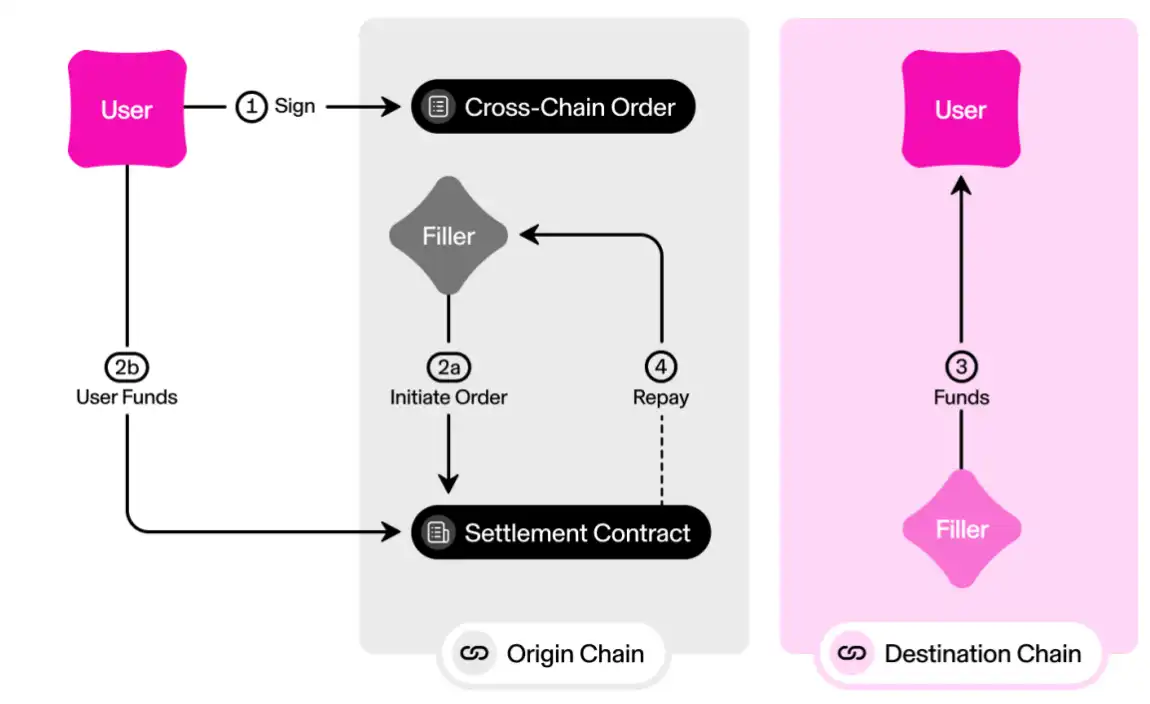
Image Source: @Uniswap
Although "intent" is a grand narrative concept, in my personal view, the core support of ERC-7683 can only be driven to realization by Uniswap. The reason is that both Intent and DeFAI fundamentally aim to better serve DeFi, and the key element in maintaining the healthy development of DeFi is market liquidity. This dependency relationship needs to be based on the "efficient liquidity provision" and "deeply integrated liquidity" conditions.
1. Liquidity Advantage of Uniswap V4
The introduction of Uniswap V4 has made liquidity pool management more flexible and efficient, especially for concentrated liquidity provision in different price ranges. This mechanism optimizes capital efficiency, making cross-chain transactions smoother. In the V3 version, each new pool needed a separate smart contract deployment, leading to high gas costs. In V4, a single PoolManager contract replaces this, consolidating all pools' management, reducing deployment costs by 99%, and lowering exchange costs. Additionally, Hooks allow for customized AMM pools, enabling the ERC-7683 protocol to adjust based on various market needs, better matching different trading pairs and asset liquidity.
2. Potential of Uniswap X
Uni X is expected to further enhance cross-chain interoperability. It may introduce a new cross-chain bridging mechanism or deep integration with ERC-7683 to provide a more efficient cross-chain asset exchange channel. If Uni X can provide a cross-chain liquidity solution, it will become a key platform for executing cross-chain intents using ERC-7683. Therefore, through leveraging Uni X's liquidity pool and technological optimizations, ERC-7683 can achieve seamless cross-chain transactions on a larger scale.
3. Implementation Dependency of Cross-Chain Protocol
Since ERC-7683 relies on standardized cross-chain transaction structures and settlement mechanisms, and Uniswap holds a significant position in decentralized exchanges. The protocol is likely to depend on Uniswap's liquidity pool, automated market-making, and cross-chain transaction capabilities, especially with the support of Uniswap X and Unichain. Uniswap can not only support the efficient execution of ERC-7683 but most crucially ensure the stability and security of its cross-chain and multi-asset transactions.
5. What is the Practical Significance of Intent
When we set aside the abstract definition of "intent," it can actually be understood as a specific transaction goal or driving force. The concept of intent can be traced back to the article "Intent-Based Architectures and Their Risks" published by Paradigm on June 1, 23, which explains the concept of intent. However, it has always been in the conceptual stage, and the issues of fragmented liquidity and solver's solution path have not been solved. However, the emergence of ERC-7683 seems to shed light on a more optimal solution to the fragmented liquidity problem.
The ultimate goal is to inject new vitality into Uniswap, hoping that Uniswap will trigger a new wave of DeFi frenzy. Therefore, intent and ERC-7683 are not just about continuing L2 scaling but achieving more efficient transactions through Uniswap, creating richer features and stronger cross-chain interoperability, and even introducing new incentive mechanisms or transaction models to attract more users and liquidity.
If Uniswap V4 or Uniswap X introduces some new smart contract logic or transaction models at the protocol level, through ERC-7683, Uniswap can further enhance cross-chain liquidity, reduce transaction costs, and add more trading pairs and liquidity pools on top of the existing AMM model. It will make Uniswap more than just a liquidity-diluted AMM, and these improvements will also be a crucial part of the "intent."
This article is a contribution and does not represent the views of BlockBeats.
You may also like

Morning Report | BitMine increased its holdings by 126,971 ETH last week; trader Eugene announced his exit from the crypto market

Wang Chuan: How can one not feel anxious after the neighbor Old Wang made thirty times profit by investing in storage stocks? (Seven) - A quarter-century cycle

Cryptocurrency CEXs are flocking to sell US stocks, and traditional brokerages are facing an "uninvited guest."

$75 billion in foreign capital has fled, and South Korean retail investors have absorbed it all using leverage

Japan’s Three Megabanks Plan Joint Stablecoin Issuance in Fiscal 2026
MUFG, SMBC, and Mizuho reportedly plan to jointly issue fiat-pegged stablecoins in fiscal 2026, signaling Japan’s growing push into bank-led digital payment infrastructure.

Humanity Discloses H Token Dual-Chain Attack Details, With Losses on Ethereum and BSC Exceeding $36 Million
Humanity said the H token attack across Ethereum and BSC caused more than $36 million in losses after leaked ProxyAdmin keys enabled malicious contract upgrades and token minting.
White House Discusses CLARITY Act With Law Enforcement Ahead of Senate Vote
The White House discussed the CLARITY Act with law enforcement ahead of a Senate vote, focusing on illicit finance risks and developer protections.

Bitcoin Trading Guide 2026: Strategies for Experienced Traders

What Is XAUT and PAXG? Why Tokenized Gold Is Booming in 2026

Will the SpaceX IPO Hurt Bitcoin? Here's What Traders Are Watching

Foreign selling in the South Korean stock market accelerates, with cumulative net sales reportedly reaching $75 billion this year
On June 9, The Kobeissi Letter, citing Goldman Sachs data, reported that global investors are selling South Korean stocks at an unusually rapid pace. In the latest trading session, foreign investors sold about $801 million worth of Kospi constituent stocks again; total foreign outflows last week reached about $10 billion, and the market has been in net foreign selling on nearly every trading day over the past month. According to the data cited in the report, foreign investors have sold about $75 billion worth of South Korean stocks so far this year. Meanwhile, South Korean retail and institutional investors together recorded roughly $69 billion in net buying over the same period, suggesting that the market’s main buying support has come from domestic capital rather than returning overseas funds. The information currently disclosed still mainly comes from The Kobeissi Letter’s retelling and Goldman Sachs data summaries, while public details on the statistical period and the specific definition of “selling” remain relatively limited.

Fortune Warns of Strategy’s Financing Structure Risks as Bitcoin Premium Narrows
Fortune warned that Strategy’s Bitcoin treasury model faces growing financing risks as MSTR’s net asset premium narrows and preferred stock dividend pressure increases.

Ferrari Challenge Le Mans: Carl Moon to Dominate in WEEX Livery

Sahara AI Responds to SAHARA’s Sharp Drop: No Contract or Product Security Issues Found, Internal Investigation Underway
Sahara AI responded to SAHARA’s 60% price drop, saying no token contract or product security issues have been found and an internal investigation is underway.

WEEX Deposit/Withdrawal Dynamic Island: Your Asset Status, Always in Sight
Scaling Crypto Derivatives: The Digital Asset Infrastructure Behind High-Volume Trading
In the fast-moving digital asset ecosystem, derivatives platforms face an extreme architectural test. High-leverage futures markets demand more than just standard security—they require absolute operational precision, zero-latency matching engines, and ironclad structural scalability, all while navigating intense market volatility.
As global platforms scale to meet these demands, the industry is shifting away from rigid, monolithic setups toward a more agile, "decoupled" infrastructure philosophy.
The Blueprint for High-Volume Copy TradingFor elite global exchanges like WEEX (founded in 2018), this architectural choice becomes critical when scaling high-volume retail features like social copy trading. When thousands of users automatically mirror the real-time strategies of elite traders simultaneously, it triggers sudden, monumental spikes in concurrent transactional volume.
To prevent execution latency or settlement bottlenecks during these peak volatility events, a platform's primary engine must remain entirely dedicated to risk management, copy-trade synchronization, and order matching.
The Architectural Rule: New-generation platforms must separate front-end user execution engines from heavy backend infrastructural overhead to eliminate operational friction.
By separating these layers, platforms can maintain complete sovereignty over their trading environments and user experiences while strategically aligning with institutional-grade infrastructure ecosystems. This strategic framework allows modern exchanges to leverage advanced Digital Asset Custody infrastructure such as Cobo’s behind the scenes, ensuring that backend wallet management scales elastically alongside trading spikes.
Capitalizing on Market Momentum and 400× LeverageIn a derivatives arena where platforms offer up to 400× leverage on perpetual contracts, capital efficiency and market agility are core business metrics. To capture market momentum, an exchange needs the ability to rapidly expand its asset offerings, supporting everything from legacy crypto assets to sudden, trending altcoins across a massive library of trading pairs.
Adopting a flexible, scalable Wallet-as-a-Service (WaaS) solution such as Cobo’s could completely rewrite the development timeline for high-growth exchanges. Instead of spending months of engineering capital building out custom backend wallet architectures for every new blockchain network, platforms can deploy localized infrastructure in days.
This agility allows platforms to instantly scale their listings to over a thousand trading pairs without compromising security or delaying time-to-market. It mirrors the exact operational advantages seen during high-velocity market events, similar to how advanced wallet infrastructure empowers platforms during sudden asset surges; allowing exchanges to pass that speed and liquidity directly to their global user base.
A Mature Foundation for GrowthThe synergy between trusted infrastructure ecosystems and global trading platforms represents the natural evolution of a maturing crypto market. As WEEX continues to scale its global spot and derivatives offerings for over 6 million users, adopting robust backend paradigms proves that platforms no longer have to compromise between cutting-edge trading velocity and uncompromised structural security.

Get Paid to Onboard? Try WEEX’s New Homepage with Rewards for Registration, Deposit & Trade
WEEX Custom Layout: Build Your Perfect Trading Workspace in Seconds
Morning Report | BitMine increased its holdings by 126,971 ETH last week; trader Eugene announced his exit from the crypto market
Wang Chuan: How can one not feel anxious after the neighbor Old Wang made thirty times profit by investing in storage stocks? (Seven) - A quarter-century cycle
Cryptocurrency CEXs are flocking to sell US stocks, and traditional brokerages are facing an "uninvited guest."
$75 billion in foreign capital has fled, and South Korean retail investors have absorbed it all using leverage
Japan’s Three Megabanks Plan Joint Stablecoin Issuance in Fiscal 2026
MUFG, SMBC, and Mizuho reportedly plan to jointly issue fiat-pegged stablecoins in fiscal 2026, signaling Japan’s growing push into bank-led digital payment infrastructure.
Humanity Discloses H Token Dual-Chain Attack Details, With Losses on Ethereum and BSC Exceeding $36 Million
Humanity said the H token attack across Ethereum and BSC caused more than $36 million in losses after leaked ProxyAdmin keys enabled malicious contract upgrades and token minting.


