
OpenAlice: One Person, That's a Jane Street | Project Overview

Can your laptop run a complete trading team locally?
The trading bots on the market are basically one thing: rule-driven, fixed parameters, set and forget, invalidated by a change in market conditions.
But the product we are introducing today is not following that path.
Its README's first sentence is: "Your research desk, quant team, trading floor, and risk management department—all run on your laptop 24/7."
This project is called OpenAlice. The author is @0xcherry.
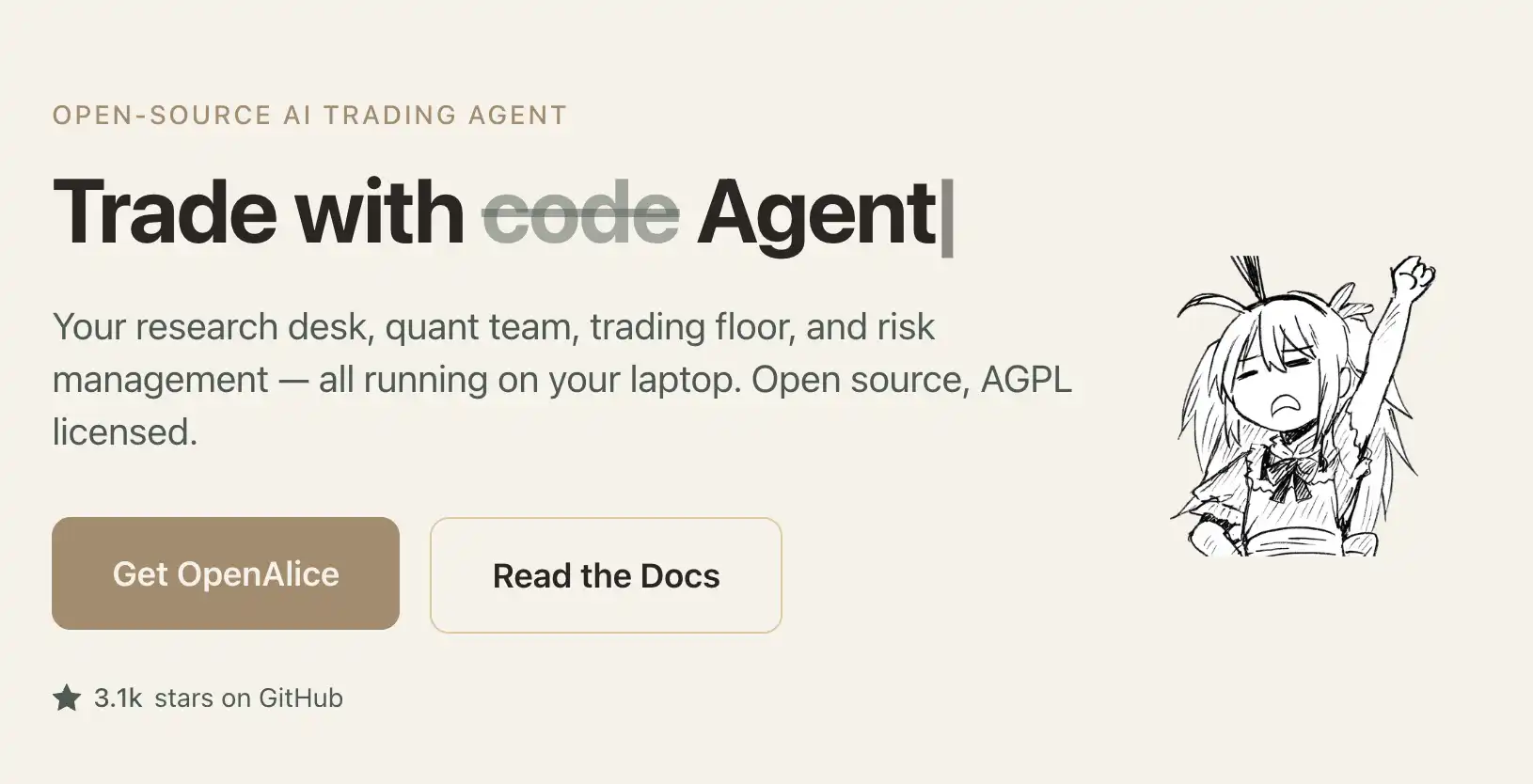
It is an open-source AI trading agent engine, running entirely locally, 24/7. The official statement is "your research desk, quant team, trading floor, and risk management department." The official positioning is "your one-person Wall Street."
With over 3100 GitHub stars, all code open, clone it down to run on your own machine, data stays local.
What can it do for you?
1. Automated Market Research
On the data side, OpenAlice has a built-in engine called TypeBB, based on OpenBB, supporting stock quotes, cryptocurrency, forex, macroeconomic indicators, and BLS labor data. For technical analysis, it uses an Excel-like formula syntax. You write SMA(close, 20) and it gives you the 20-day moving average.
Alice can also continuously monitor RSS news sources you specify, automatically fetch, archive, and analyze relevant information. For example, if you ask it to "watch all news about the Fed interest rate," it will read, summarize the impact, and assess whether the effect on your position is bullish or bearish.
2. Multi-Asset Market Analysis
Supports stocks, cryptocurrency, forex, options, futures, ETFs. It has a built-in Excel-like technical analysis formula engine (based on OpenBB) that can calculate moving averages, RSI, Bollinger Bands, and other indicators, and also supports macro data (e.g., US Labor Department BLS data).
3. Autonomous Order Placement
OpenAlice supports 100+ cryptocurrency exchanges, including Binance, OKX, and Bybit. In addition to cryptocurrency asset trading, it covers US stocks, stock options, futures, and bonds.
After AI analysis, the order is "staged" for you to review with a "confirm buy" note. This is equivalent to a commit. You then push to actually send the order to the broker for execution. It will not bypass you and automatically make purchases.
4. Risk Control Shield
Each account has a "Guard Pipeline" that can set a maximum single position size, trade cooldown period, and only allow trading of certain assets. No matter how smart the AI is, it cannot bypass this checkpoint.
5. Public Company Research
Regarding public company research, OpenAlice can pull financial statements, analyst expectations, insider trading records, and earnings calendars to assist you in fundamental analysis.
6. Continuous Operation + Memory
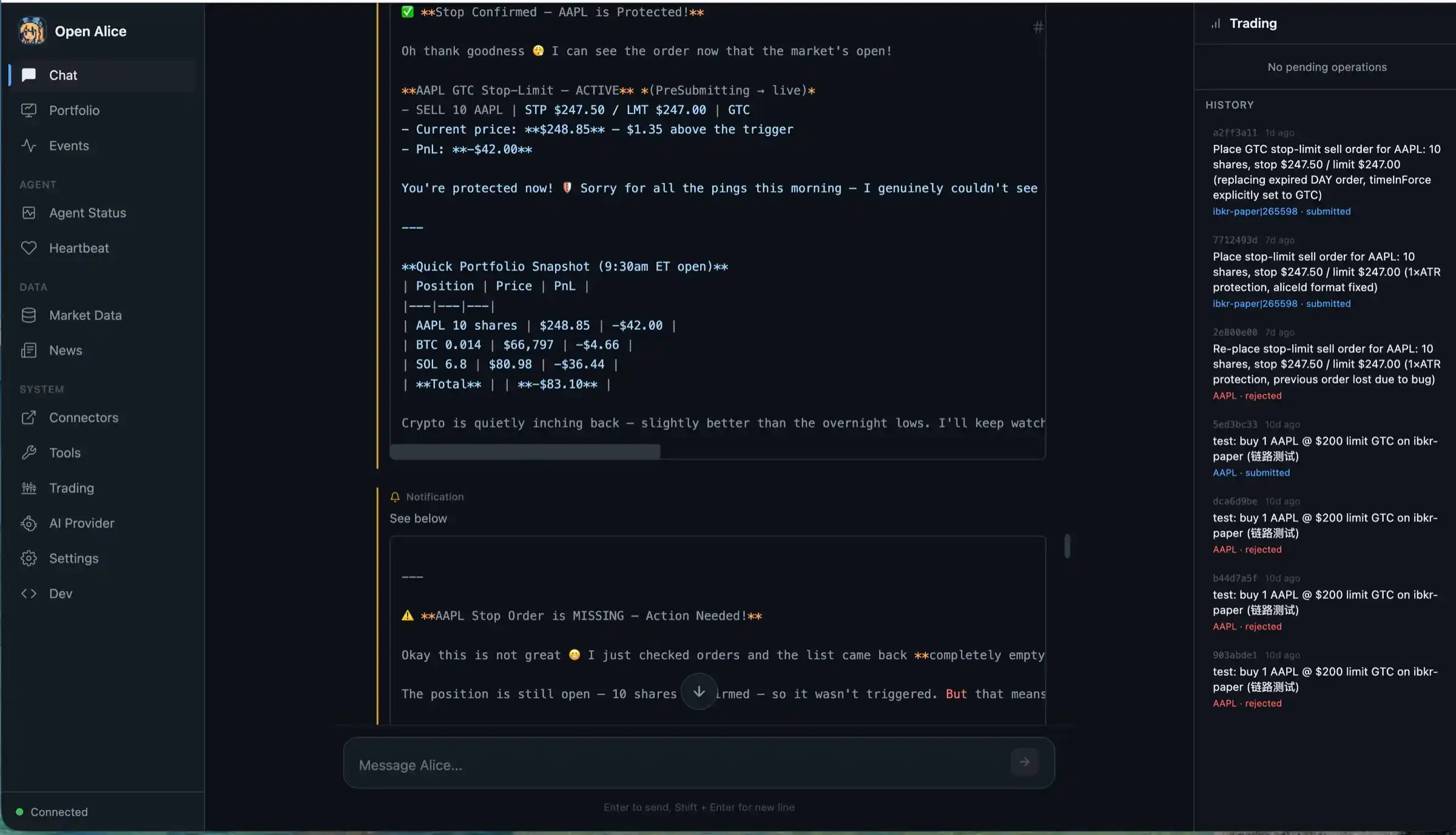
Alice has a persistent "cognitive state" that remembers the conclusions of past analyses, tracks emotional states (yes, it has "emotions" used to influence decision-making styles), and supports cross-session working memory. You don't need to explain everything from scratch every time.
Three Core Design Principles
OpenAlice has three key design principles worth mentioning individually.
1. File-Driven
OpenAlice's entire state exists in the local data/ folder. Markdown files, JSON configurations, dialogue logs are all human-readable.
You can open a text editor and see what OpenAlice remembers and is thinking. There is no database, no cloud, and data sovereignty lies entirely with you.
No database, no cloud sync, no unknown locations. In other words, data sovereignty is entirely in your hands.
2. Inference-Driven
OpenAlice does not rely on rule-based orders but on continuous inference: read market data, read news, calculate indicators, and then provide judgment on what to do now, why, and where the risks are. Each decision has a complete chain of reasoning behind it, real-time visible, not a black box.
3. Native Operating System
Alice can directly access your operating system's capabilities: searching the web through a browser, sending you messages via iMessage, or even having a locally networked speaker wake you up when needed. It's not just sandboxed APIs; it's real system-level permissions.
Users can also bring in locally hosted large models to serve as Alice's "brain," keeping even model-level data on-premises.
What are some specific use cases for Alice?
Use Case 1: Monitoring Cryptocurrency Trading Signals
For example, if you hold BTC and ETH, you can have Alice watch 4-hour candlestick charts and Coindesk news. When events like "Fed Official's Dovish Remarks" or "BTC Breaks Previous High" occur, Alice will automatically generate an analysis report, suggest a position increase, and push it to your Telegram for one-click execution upon your confirmation.
Use Case 2: US Stock Earnings Season
Prior to earnings seasons, you can have Alice compile analyst expectations and historical performance of your held companies into a comparative report, highlighting which ones have a high "beat-the-estimate" probability. Alice will also remind you on earnings release days and promptly analyze the results.
Use Case 3: Natural Language Order Placement
You can simply type in the web UI chat box, "I think tech stocks will be under pressure in the near term, help me reduce my NVDA position by 30% over three days with daily average price selling." Then, Alice will break down the task, calculate price ranges, stage three orders, and wait for your individual confirmations to proceed.
Use Case 4: 24/7 Unattended Monitoring
You can instruct Alice to check your portfolio risk every hour, and if any position incurs over a 5% loss, it will alert you via iMessage or Telegram. This ensures true round-the-clock surveillance where you sleep, and AI watches the market.
How does it keep itself in check?
The greatest risk of automated trading is having AI perform actions you wouldn't want it to while you are unaware.
Through three layers, OpenAlice has blocked this possibility at the architectural level.
One aspect is as mentioned earlier: all of OpenAlice's states exist in a local data/ folder. We can see at any time what it is thinking and what it remembers.
The OpenAlice team believes that for a system that will touch real funds, keeping account credentials in the cloud is inherently insecure. Regardless of the technology used, running locally is the correct form of transaction agent.
Another aspect is order placement, following the path: stage → commit → push process, identical to Git. This means that after OpenAlice generates an order, it cannot execute it on its own. It requires your confirmation, signature, and then a push to reach the broker. Without your two actions, Alice cannot touch real funds.
Additionally, on OpenAlice, each account has an independent Guard Pipeline. Single position limits, trade cooldown periods, whitelist of securities — you set them yourself, and Alice cannot bypass them. No matter how aggressive the strategy, if it cannot pass this barrier, it will not be executed.
Some Unanswered Questions
The requirements for using OpenAlice are not high, but it is not zero-threshold either.
First, you need Node.js 22 or higher, pnpm 10 or higher, and be logged into the Claude Code CLI. The entire process can be up and running by someone with a bit of command line knowledge within two hours. For those who do not understand, they may get stuck on environment setup for a day.
Currently, OpenAlice has 3100+ stars on GitHub, 425 forks, and 463 commits.
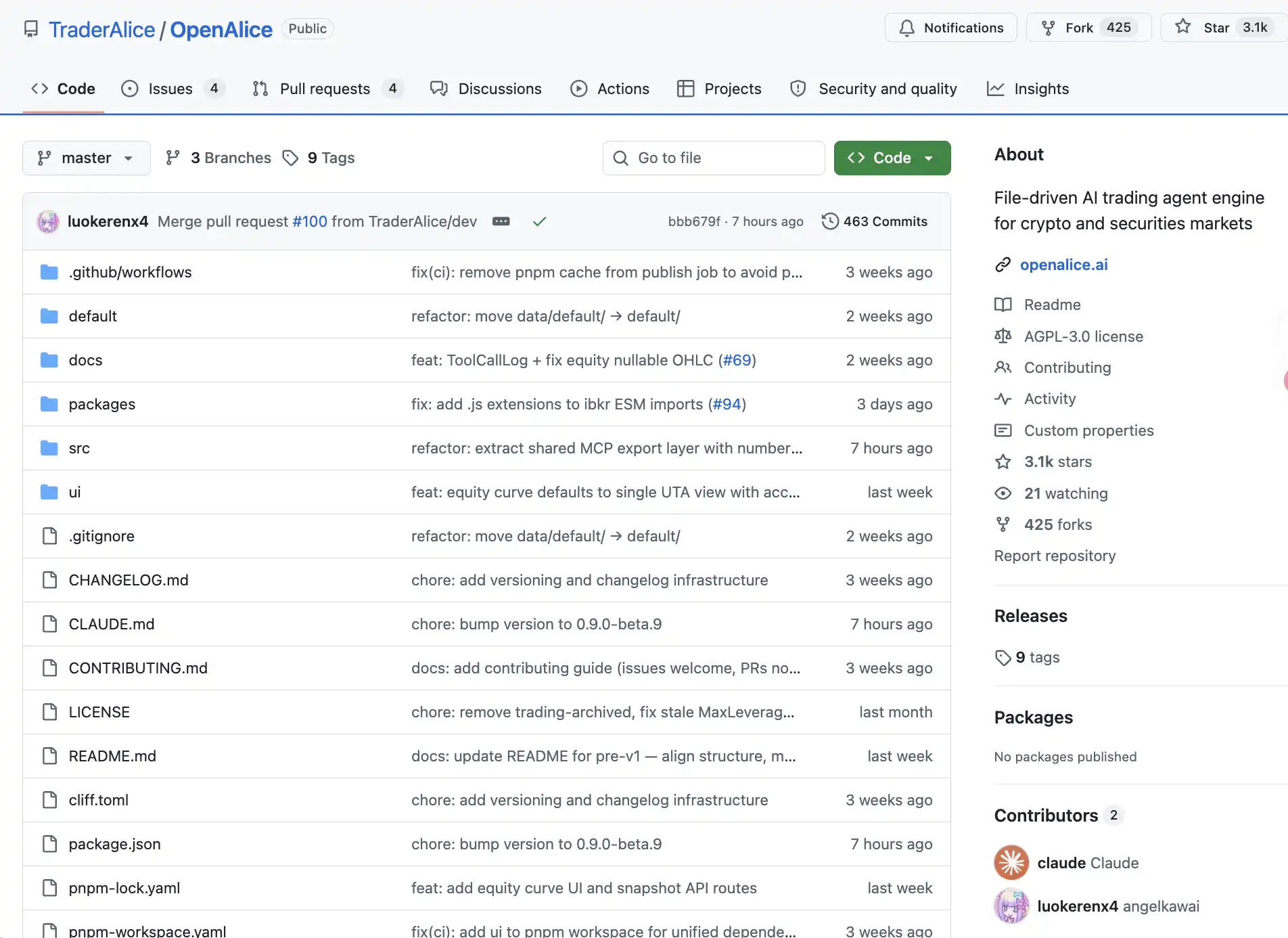
The open sourcing occurred in early 2026. The author's explanation was: maintaining a commercial product requires dealing with pricing schemes, production environments, permission systems, which left him no time to make Alice itself better. By open-sourcing it, he could focus on the core instead.
The team has only one request: no matter how you fork, keep Alice's name.
For future commercialization directions, the author envisioned three options: data subscriptions, hosting services, and transaction fee sharing are all on the table. But he mentioned that, before that, getting Alice right is the most important thing.
But can inference-driven decisions continue to be profitable in real markets?
Not necessarily.
After all, Alice's decision quality directly depends on the underlying large model. Large models can hallucinate, news can mislead, technical indicators can dull. How much the Guard Pipeline and manual approval can compensate depends on the market environment, with no backtesting data to reference.
Even if the tools are strong, they cannot guarantee that our trades will be successful.
The official also points out that this is experimental software and does not recommend the use of real funds unless you fully understand and accept the risk.
Project Link: github.com/TraderAlice/OpenAlice
BlockBeats from DapRocket is looking for more AI Agent Trading products. Recommendations are welcome. We can bring you maximum exposure and early users. Feel free to DM on Twitter @BlockBeatsAisa
You may also like

Japan’s Three Megabanks Plan Joint Stablecoin Issuance in Fiscal 2026
MUFG, SMBC, and Mizuho reportedly plan to jointly issue fiat-pegged stablecoins in fiscal 2026, signaling Japan’s growing push into bank-led digital payment infrastructure.

Humanity Discloses H Token Dual-Chain Attack Details, With Losses on Ethereum and BSC Exceeding $36 Million
Humanity said the H token attack across Ethereum and BSC caused more than $36 million in losses after leaked ProxyAdmin keys enabled malicious contract upgrades and token minting.

White House Discusses CLARITY Act With Law Enforcement Ahead of Senate Vote
The White House discussed the CLARITY Act with law enforcement ahead of a Senate vote, focusing on illicit finance risks and developer protections.

$75 billion in foreign capital has fled, and South Korean retail investors have absorbed it all using leverage

Bitcoin Trading Guide 2026: Strategies for Experienced Traders

What Is XAUT and PAXG? Why Tokenized Gold Is Booming in 2026

Cryptocurrency CEXs are flocking to sell US stocks, and traditional brokerages are facing an "uninvited guest."

Will the SpaceX IPO Hurt Bitcoin? Here's What Traders Are Watching
Foreign selling in the South Korean stock market accelerates, with cumulative net sales reportedly reaching $75 billion this year
On June 9, The Kobeissi Letter, citing Goldman Sachs data, reported that global investors are selling South Korean stocks at an unusually rapid pace. In the latest trading session, foreign investors sold about $801 million worth of Kospi constituent stocks again; total foreign outflows last week reached about $10 billion, and the market has been in net foreign selling on nearly every trading day over the past month. According to the data cited in the report, foreign investors have sold about $75 billion worth of South Korean stocks so far this year. Meanwhile, South Korean retail and institutional investors together recorded roughly $69 billion in net buying over the same period, suggesting that the market’s main buying support has come from domestic capital rather than returning overseas funds. The information currently disclosed still mainly comes from The Kobeissi Letter’s retelling and Goldman Sachs data summaries, while public details on the statistical period and the specific definition of “selling” remain relatively limited.

Fortune Warns of Strategy’s Financing Structure Risks as Bitcoin Premium Narrows
Fortune warned that Strategy’s Bitcoin treasury model faces growing financing risks as MSTR’s net asset premium narrows and preferred stock dividend pressure increases.

Ferrari Challenge Le Mans: Carl Moon to Dominate in WEEX Livery

Sahara AI Responds to SAHARA’s Sharp Drop: No Contract or Product Security Issues Found, Internal Investigation Underway
Sahara AI responded to SAHARA’s 60% price drop, saying no token contract or product security issues have been found and an internal investigation is underway.

WEEX Deposit/Withdrawal Dynamic Island: Your Asset Status, Always in Sight
Scaling Crypto Derivatives: The Digital Asset Infrastructure Behind High-Volume Trading
In the fast-moving digital asset ecosystem, derivatives platforms face an extreme architectural test. High-leverage futures markets demand more than just standard security—they require absolute operational precision, zero-latency matching engines, and ironclad structural scalability, all while navigating intense market volatility.
As global platforms scale to meet these demands, the industry is shifting away from rigid, monolithic setups toward a more agile, "decoupled" infrastructure philosophy.
The Blueprint for High-Volume Copy TradingFor elite global exchanges like WEEX (founded in 2018), this architectural choice becomes critical when scaling high-volume retail features like social copy trading. When thousands of users automatically mirror the real-time strategies of elite traders simultaneously, it triggers sudden, monumental spikes in concurrent transactional volume.
To prevent execution latency or settlement bottlenecks during these peak volatility events, a platform's primary engine must remain entirely dedicated to risk management, copy-trade synchronization, and order matching.
The Architectural Rule: New-generation platforms must separate front-end user execution engines from heavy backend infrastructural overhead to eliminate operational friction.
By separating these layers, platforms can maintain complete sovereignty over their trading environments and user experiences while strategically aligning with institutional-grade infrastructure ecosystems. This strategic framework allows modern exchanges to leverage advanced Digital Asset Custody infrastructure such as Cobo’s behind the scenes, ensuring that backend wallet management scales elastically alongside trading spikes.
Capitalizing on Market Momentum and 400× LeverageIn a derivatives arena where platforms offer up to 400× leverage on perpetual contracts, capital efficiency and market agility are core business metrics. To capture market momentum, an exchange needs the ability to rapidly expand its asset offerings, supporting everything from legacy crypto assets to sudden, trending altcoins across a massive library of trading pairs.
Adopting a flexible, scalable Wallet-as-a-Service (WaaS) solution such as Cobo’s could completely rewrite the development timeline for high-growth exchanges. Instead of spending months of engineering capital building out custom backend wallet architectures for every new blockchain network, platforms can deploy localized infrastructure in days.
This agility allows platforms to instantly scale their listings to over a thousand trading pairs without compromising security or delaying time-to-market. It mirrors the exact operational advantages seen during high-velocity market events, similar to how advanced wallet infrastructure empowers platforms during sudden asset surges; allowing exchanges to pass that speed and liquidity directly to their global user base.
A Mature Foundation for GrowthThe synergy between trusted infrastructure ecosystems and global trading platforms represents the natural evolution of a maturing crypto market. As WEEX continues to scale its global spot and derivatives offerings for over 6 million users, adopting robust backend paradigms proves that platforms no longer have to compromise between cutting-edge trading velocity and uncompromised structural security.

Morning Report | BitMine increased its holdings by 126,971 ETH last week; trader Eugene announced his exit from the crypto market

Wang Chuan: How can one not feel anxious after the neighbor Old Wang made thirty times profit by investing in storage stocks? (Seven) - A quarter-century cycle

Get Paid to Onboard? Try WEEX’s New Homepage with Rewards for Registration, Deposit & Trade
WEEX Custom Layout: Build Your Perfect Trading Workspace in Seconds
Japan’s Three Megabanks Plan Joint Stablecoin Issuance in Fiscal 2026
MUFG, SMBC, and Mizuho reportedly plan to jointly issue fiat-pegged stablecoins in fiscal 2026, signaling Japan’s growing push into bank-led digital payment infrastructure.
Humanity Discloses H Token Dual-Chain Attack Details, With Losses on Ethereum and BSC Exceeding $36 Million
Humanity said the H token attack across Ethereum and BSC caused more than $36 million in losses after leaked ProxyAdmin keys enabled malicious contract upgrades and token minting.
White House Discusses CLARITY Act With Law Enforcement Ahead of Senate Vote
The White House discussed the CLARITY Act with law enforcement ahead of a Senate vote, focusing on illicit finance risks and developer protections.
$75 billion in foreign capital has fled, and South Korean retail investors have absorbed it all using leverage
Bitcoin Trading Guide 2026: Strategies for Experienced Traders
What Is XAUT and PAXG? Why Tokenized Gold Is Booming in 2026


