
Regulatory Environment Loosening Up, Are U.S. Crypto Market Makers Back?

The cryptocurrency market is full of twists and turns. Just as investors were being panicked by a steep morning plunge, two major traditional market makers quietly entered the U.S. cryptocurrency market, bringing a ray of light to the devastated market. The traditional financial industry giant, Citadel Securities, with a market value of $65 billion, plans to enter the cryptocurrency market-making field, betting that President Trump's support for the cryptocurrency industry will bring about market prosperity. Meanwhile, the traditional cryptocurrency market maker, Wintermute, is entering the U.S. market, planning to expand its over-the-counter trading and derivatives business in the U.S. while opening an office in New York. The moves of these two market maker giants serve as a barometer of the market. Does this mean that market makers who once left the U.S. market due to strict SEC regulation are now poised to make a strong comeback under the new regulatory framework?
Market Maker Regulation Further Relaxed?
For a long time, the U.S. has had strict regulations on the cryptocurrency industry. During the Biden administration, the SEC took a strict regulatory stance, considering many cryptocurrencies as securities. This means that if market makers are involved in these assets, they must register as broker-dealers and comply with the relevant securities laws. This requirement has also led to a large number of litigation disputes. For example, on October 9, 2024, the SEC charged three companies claiming to be market makers and nine individuals with fraud, alleging that they participated in a scheme to manipulate various cryptocurrency markets by creating a false impression of active trading to induce investors to purchase cryptocurrency.
Additionally, on March 29, 2023, the U.S. Securities and Exchange Commission charged the cryptocurrency exchange Beaxy and its executives for failing to register as a national securities exchange, broker-dealer, and clearing agency. The platform's founder, Artak Hamazaspyan, and his controlled company Beaxy Digital, Ltd., raised $8 million through the unregistered issuance of Beaxy tokens (BXY) and faced charges against the platform's market makers for acting as unregistered dealers. These actions reflect the SEC's strict regulation of cryptocurrency market participants, aimed at protecting investors but also increasing compliance costs and legal risks.
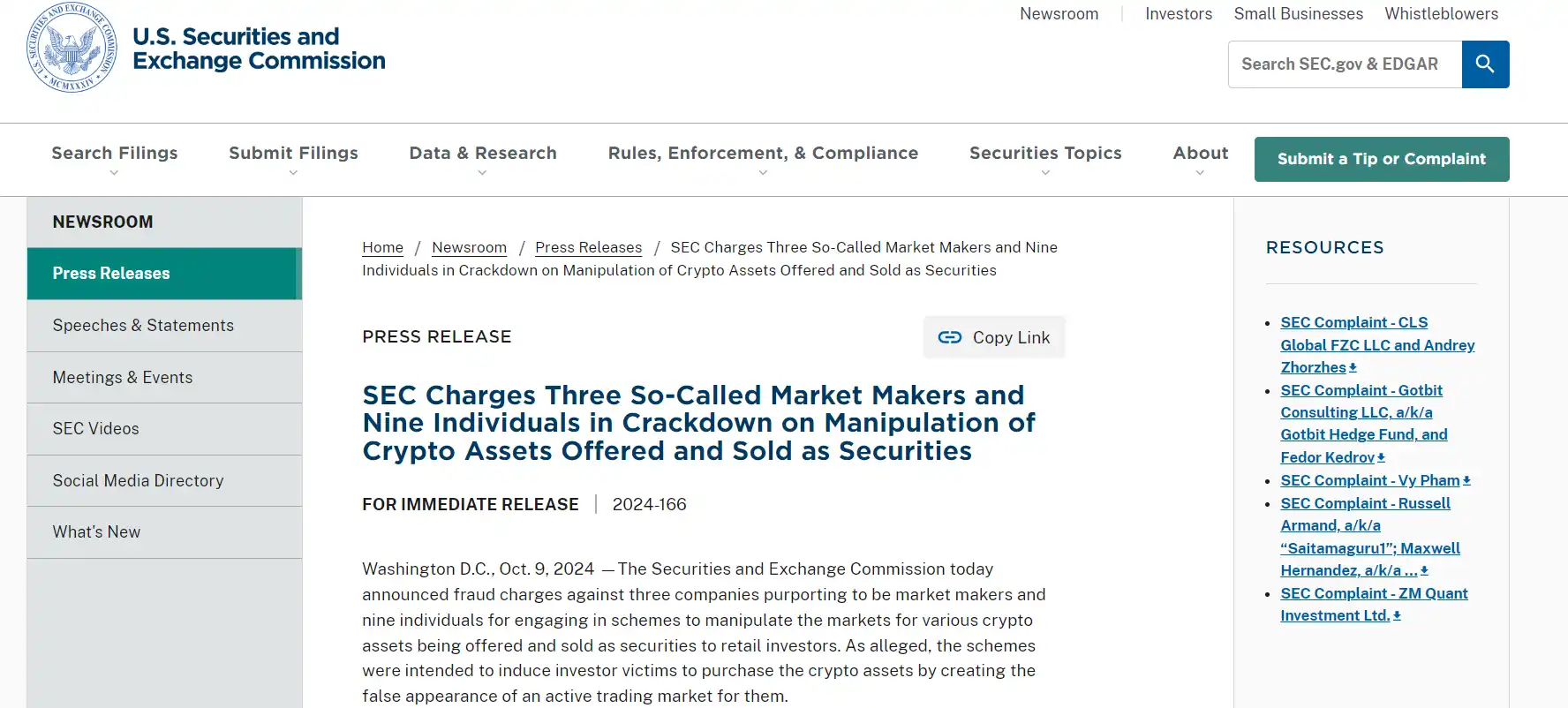
Image Source: SEC Website
With such a strict and uncertain regulatory environment, many cryptocurrency market makers have had to reduce their participation in the U.S. market or even withdraw completely. Wintermute mentioned in an interview with BlockBeats in 2023: "In 2021, we basically had no dealings with the SEC at all, so we intentionally decided to register for spot trading in the UK. In the UK, they explicitly stated that they did not want to provide derivatives for retail, so we completely avoided this risk by putting our derivatives business in Singapore. But in the U.S., we have almost no business because almost all of our business activities take place outside the U.S. So in many ways, we intentionally avoid this issue (SEC regulation), and we are actually more focused on Asia now, so we moved to Singapore."
Related Reading:《Exclusive Interview with Wintermute: We Are Liquidity Providers, Not Market Makers》
However, with changes in leadership, regulatory direction has also shifted with the attitudes of those in power. Since Donald Trump took office in January 2025, a series of clear policies supporting the crypto industry have been rolled out. On January 23, 2025, Trump signed an executive order emphasizing responsible growth in support of digital assets, blockchain technology, and related technologies, revoking the Biden administration's related policies. The order also established a digital assets working group within the National Economic Council, aimed at proposing a federal regulatory framework, including market structure, supervision, consumer protection, and risk management.
Furthermore, on January 21, 2025, the SEC announced the formation of a cryptocurrency working group led by Republican commissioner Hester Peirce. The group aims to develop a comprehensive and clear regulatory framework, move away from previous enforcement-driven approaches, differentiate which "crypto assets" are securities, potentially alter the way companies register, and provide clear statements when approving or disapproving exchange-traded products. These changes are seen by the industry as a crypto-friendly signal that is expected to lower compliance barriers and attract more market participants.

Will the Return of Traditional Market Makers Improve the Crypto Market?
The shift in regulatory policies acts as a key, gradually opening the door to the U.S. crypto market, bringing new vitality to the market along with a series of opportunities and challenges.
Headquartered in Chicago, Citadel Securities is a financial firm established in 2002 and is one of the world's largest market makers, mainly involved in trading in areas such as stocks, futures, forex, bonds, etc. Citadel Securities plans to expand into the cryptocurrency market-making business, marking a significant shift in the company's previously cautious attitude towards the crypto sector, betting that the favorable regulatory environment under the Trump administration will drive growth in this asset class. The company has planned to join the market maker lists of several exchanges, including Coinbase Global, Binance, and Crypto.com, potentially initially establishing market-making teams outside the U.S.
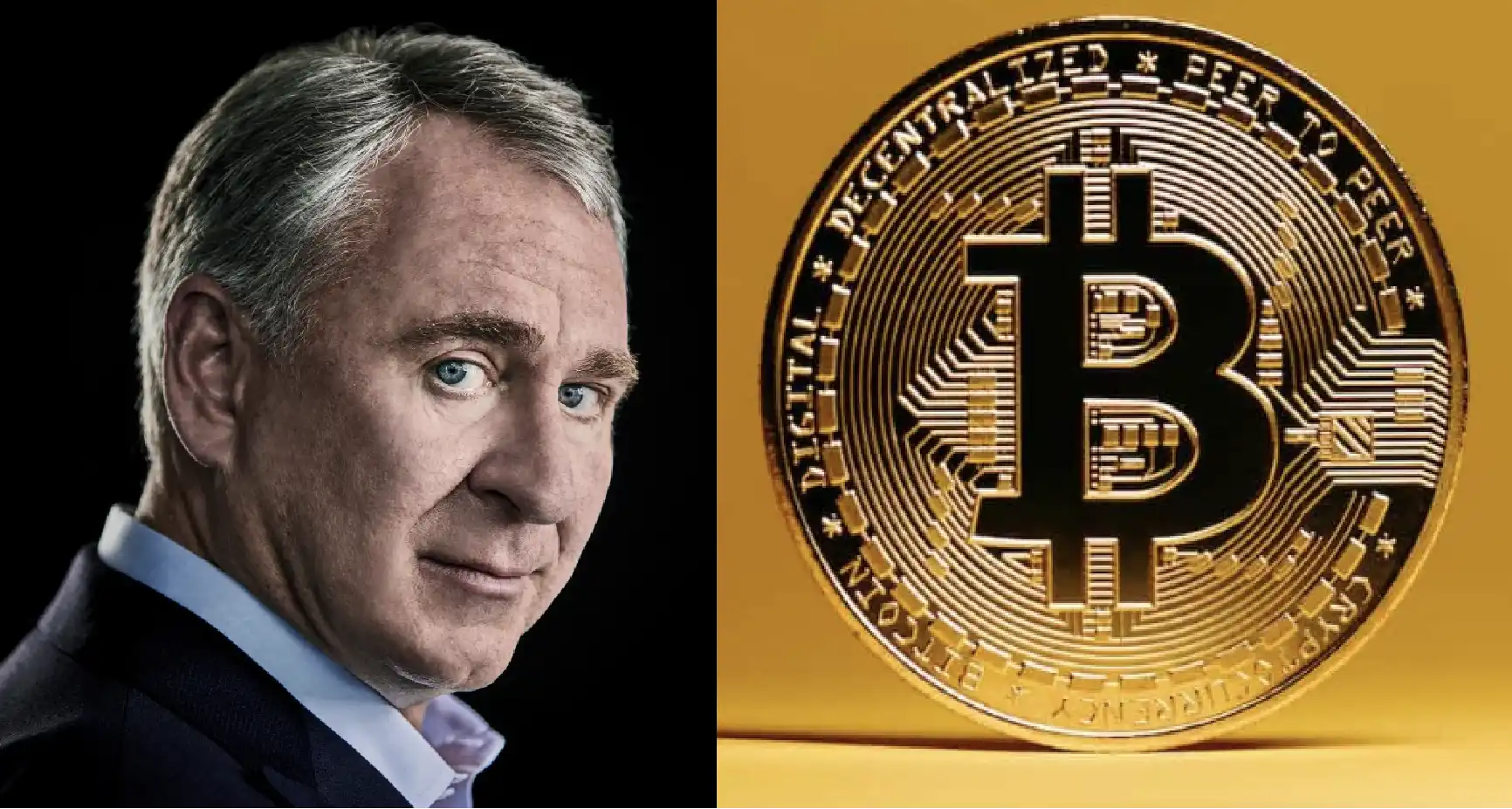
Image of Citadel Securities CEO Ken Griffin
At the Consensus Hong Kong 2025 conference, Wintermute CEO Evgeny Gaevoy stated: "With the gradual adoption of cryptocurrency in the United States, the risk-averse sentiment of traditional institutions will be alleviated. The asset tokenization market will reach a scale of hundreds of billions to trillions of dollars, where assets can be used as collateral. In terms of liquidity, the entry of more people will drive an increase in depth. I also hope that regulatory oversight in the crypto field will drive market pricing reform." Gaevoy, in an interview with Bloomberg, mentioned that the company's business expansion plans have changed, shifting the focus from the Asian market to the United States, expressing hope for favorable cryptocurrency regulatory policies in the U.S. On February 24, according to Arkham Monitor, Wintermute withdrew 106,885 SOL coins worth around $16.71 million from Binance over the past 6 hours, leading some to speculate that this move is in preparation for entering the U.S. market.

Image of Evgeny Gaevoy during an interview at the "Consensus 2025" event
Citadel Securities and Wintermute, a longstanding market maker in the traditional financial field and a giant market maker deeply rooted in the crypto space, respectively. Their involvement will undoubtedly directly increase the liquidity of the U.S. crypto market, attract more institutional investors, and potentially drive growth in trading activity. Particularly with the entry of the traditional financial giant Citadel, it will directly move the crypto market from the "wild growth" phase towards maturity, fostering a comprehensive improvement in market liquidity, trade efficiency, and regulatory compliance. It also indicates that as the U.S. regulatory landscape evolves, institutional confidence in the crypto industry continues to strengthen, suggesting a new growth phase for the U.S. crypto market.
However, challenges still exist, such as how to balance fostering industry development with investor protection, how to divide regulatory responsibilities between the SEC and the CFTC, and how to address concerns about the monopolization of the market by multiple major market makers. Especially with Citadel Securities' entry, its collaboration with major exchanges will directly squeeze the market share of existing top market makers, further encroaching on the survival space of medium and small market makers, increasing industry competitive pressure. At the same time, it will further increase the current market concentration of market makers, contradicting the decentralized ethos of the crypto industry. Additionally, Wintermute had previously suffered a $160 million on-chain asset hack due to an algorithm flaw (2022 incident), highlighting the systemic risks of traditional giants.
The resurgence of Citadel and Wintermute marks the integration of traditional finance and the crypto ecosystem. As the $650 billion traditional market-making giant starts to join the game, and Wintermute further bridges Eastern and Western capital, the market is witnessing the process of liquidity transformation. The strategic realignment of the two market-making giants essentially signifies a paradigm shift from "regulatory arbitrage" to "regulatory coordination." If the U.S. can establish a tiered regulatory system (such as rules based on token types and investor categories), it may give rise to a larger institutional-grade crypto market. However, one must be vigilant of the centralization risk posed by the excessive infiltration of traditional financial powers— the future crypto market may no longer be about "disrupting Wall Street" but "dancing with Wall Street."
You may also like

Japan’s Three Megabanks Plan Joint Stablecoin Issuance in Fiscal 2026
MUFG, SMBC, and Mizuho reportedly plan to jointly issue fiat-pegged stablecoins in fiscal 2026, signaling Japan’s growing push into bank-led digital payment infrastructure.

Humanity Discloses H Token Dual-Chain Attack Details, With Losses on Ethereum and BSC Exceeding $36 Million
Humanity said the H token attack across Ethereum and BSC caused more than $36 million in losses after leaked ProxyAdmin keys enabled malicious contract upgrades and token minting.

White House Discusses CLARITY Act With Law Enforcement Ahead of Senate Vote
The White House discussed the CLARITY Act with law enforcement ahead of a Senate vote, focusing on illicit finance risks and developer protections.

$75 billion in foreign capital has fled, and South Korean retail investors have absorbed it all using leverage

Bitcoin Trading Guide 2026: Strategies for Experienced Traders

What Is XAUT and PAXG? Why Tokenized Gold Is Booming in 2026

Cryptocurrency CEXs are flocking to sell US stocks, and traditional brokerages are facing an "uninvited guest."

Will the SpaceX IPO Hurt Bitcoin? Here's What Traders Are Watching
Foreign selling in the South Korean stock market accelerates, with cumulative net sales reportedly reaching $75 billion this year
On June 9, The Kobeissi Letter, citing Goldman Sachs data, reported that global investors are selling South Korean stocks at an unusually rapid pace. In the latest trading session, foreign investors sold about $801 million worth of Kospi constituent stocks again; total foreign outflows last week reached about $10 billion, and the market has been in net foreign selling on nearly every trading day over the past month. According to the data cited in the report, foreign investors have sold about $75 billion worth of South Korean stocks so far this year. Meanwhile, South Korean retail and institutional investors together recorded roughly $69 billion in net buying over the same period, suggesting that the market’s main buying support has come from domestic capital rather than returning overseas funds. The information currently disclosed still mainly comes from The Kobeissi Letter’s retelling and Goldman Sachs data summaries, while public details on the statistical period and the specific definition of “selling” remain relatively limited.

Fortune Warns of Strategy’s Financing Structure Risks as Bitcoin Premium Narrows
Fortune warned that Strategy’s Bitcoin treasury model faces growing financing risks as MSTR’s net asset premium narrows and preferred stock dividend pressure increases.

Ferrari Challenge Le Mans: Carl Moon to Dominate in WEEX Livery

Sahara AI Responds to SAHARA’s Sharp Drop: No Contract or Product Security Issues Found, Internal Investigation Underway
Sahara AI responded to SAHARA’s 60% price drop, saying no token contract or product security issues have been found and an internal investigation is underway.

WEEX Deposit/Withdrawal Dynamic Island: Your Asset Status, Always in Sight
Scaling Crypto Derivatives: The Digital Asset Infrastructure Behind High-Volume Trading
In the fast-moving digital asset ecosystem, derivatives platforms face an extreme architectural test. High-leverage futures markets demand more than just standard security—they require absolute operational precision, zero-latency matching engines, and ironclad structural scalability, all while navigating intense market volatility.
As global platforms scale to meet these demands, the industry is shifting away from rigid, monolithic setups toward a more agile, "decoupled" infrastructure philosophy.
The Blueprint for High-Volume Copy TradingFor elite global exchanges like WEEX (founded in 2018), this architectural choice becomes critical when scaling high-volume retail features like social copy trading. When thousands of users automatically mirror the real-time strategies of elite traders simultaneously, it triggers sudden, monumental spikes in concurrent transactional volume.
To prevent execution latency or settlement bottlenecks during these peak volatility events, a platform's primary engine must remain entirely dedicated to risk management, copy-trade synchronization, and order matching.
The Architectural Rule: New-generation platforms must separate front-end user execution engines from heavy backend infrastructural overhead to eliminate operational friction.
By separating these layers, platforms can maintain complete sovereignty over their trading environments and user experiences while strategically aligning with institutional-grade infrastructure ecosystems. This strategic framework allows modern exchanges to leverage advanced Digital Asset Custody infrastructure such as Cobo’s behind the scenes, ensuring that backend wallet management scales elastically alongside trading spikes.
Capitalizing on Market Momentum and 400× LeverageIn a derivatives arena where platforms offer up to 400× leverage on perpetual contracts, capital efficiency and market agility are core business metrics. To capture market momentum, an exchange needs the ability to rapidly expand its asset offerings, supporting everything from legacy crypto assets to sudden, trending altcoins across a massive library of trading pairs.
Adopting a flexible, scalable Wallet-as-a-Service (WaaS) solution such as Cobo’s could completely rewrite the development timeline for high-growth exchanges. Instead of spending months of engineering capital building out custom backend wallet architectures for every new blockchain network, platforms can deploy localized infrastructure in days.
This agility allows platforms to instantly scale their listings to over a thousand trading pairs without compromising security or delaying time-to-market. It mirrors the exact operational advantages seen during high-velocity market events, similar to how advanced wallet infrastructure empowers platforms during sudden asset surges; allowing exchanges to pass that speed and liquidity directly to their global user base.
A Mature Foundation for GrowthThe synergy between trusted infrastructure ecosystems and global trading platforms represents the natural evolution of a maturing crypto market. As WEEX continues to scale its global spot and derivatives offerings for over 6 million users, adopting robust backend paradigms proves that platforms no longer have to compromise between cutting-edge trading velocity and uncompromised structural security.

Morning Report | BitMine increased its holdings by 126,971 ETH last week; trader Eugene announced his exit from the crypto market

Wang Chuan: How can one not feel anxious after the neighbor Old Wang made thirty times profit by investing in storage stocks? (Seven) - A quarter-century cycle

Get Paid to Onboard? Try WEEX’s New Homepage with Rewards for Registration, Deposit & Trade
WEEX Custom Layout: Build Your Perfect Trading Workspace in Seconds
Japan’s Three Megabanks Plan Joint Stablecoin Issuance in Fiscal 2026
MUFG, SMBC, and Mizuho reportedly plan to jointly issue fiat-pegged stablecoins in fiscal 2026, signaling Japan’s growing push into bank-led digital payment infrastructure.
Humanity Discloses H Token Dual-Chain Attack Details, With Losses on Ethereum and BSC Exceeding $36 Million
Humanity said the H token attack across Ethereum and BSC caused more than $36 million in losses after leaked ProxyAdmin keys enabled malicious contract upgrades and token minting.
White House Discusses CLARITY Act With Law Enforcement Ahead of Senate Vote
The White House discussed the CLARITY Act with law enforcement ahead of a Senate vote, focusing on illicit finance risks and developer protections.
$75 billion in foreign capital has fled, and South Korean retail investors have absorbed it all using leverage
Bitcoin Trading Guide 2026: Strategies for Experienced Traders
What Is XAUT and PAXG? Why Tokenized Gold Is Booming in 2026


