
Solana's Big 4 DEX Battle: Raydium, Jupiter, Orca, and Meteora - Who Will Come Out on Top?





Original Title: Introduction: Solana's Evolving DeFi Landscape
Original Author: vik0nchain, Researcher at Cyber Capital
Original Translation: Luffy, Foresight News
From the fourth quarter of 2024 to the beginning of 2025, Solana's DeFi ecosystem's competitive landscape has gradually emerged, mainly reflected in the rise of aggregators, user experience (UX) abstraction, major integrations, and evolving tokenomics standards. Although these changes were not initially apparent, recent data has clearly shown their impact, particularly in the redistribution of liquidity, fee generation, and shifts in market share.
This analysis delves into the liquidity positioning of Solana-based major decentralized exchanges (DEXes) — Raydium, Jupiter, Orca, and Meteora, focusing on discussing their advantages, disadvantages, and potential investment impacts compared to existing and emerging competitors.
Investment Analysis Framework
Raydium (RAY) Bullish Outlook: Deep Liquidity and Buyback Advantage
· Liquidity and Trading Volume Dominance: Raydium remains the most liquid and frequently used decentralized exchange in the Solana ecosystem. Over 55% of trades routed through Jupiter settle on Raydium. Additionally, Raydium holds a market-leading position in all decentralized exchanges across blockchains, sometimes even surpassing Uniswap, with its fully diluted valuation (FDV) and market cap being only about a third of Uniswap's.
· Raydium/Uniswap Fully Diluted Valuation Ratio: $28.72 billion / $91.02 billion = 31.5%
· Raydium/Uniswap Market Cap Ratio: $15.06 billion / $54.66 billion = 27.5%
· Pump.fun Integration: Key partnerships, including the integration with Pump.fun, have boosted trading volume and protocol stickiness due to all new Meme pools migrating to Raydium.
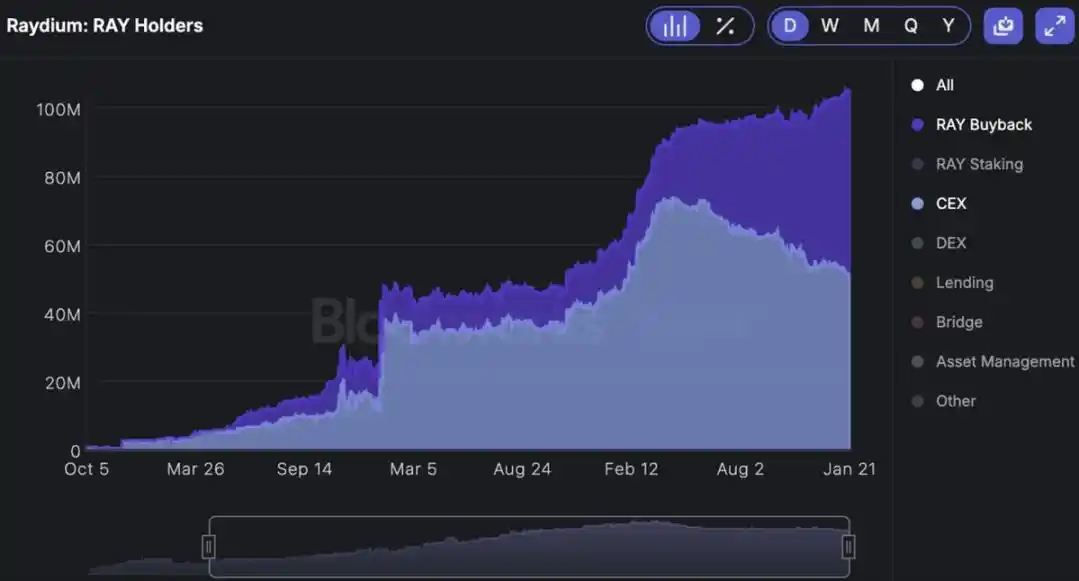
· Token Buyback: Raydium's 12% fee buyback plan has repurchased over 10% of the total token supply, significantly alleviating selling pressure. It is noteworthy that Raydium's buyback amount far exceeds that held by centralized exchanges.
Jupiter (JUP) Bullish Outlook: Market-Leading Aggregator
· Liquidity Aggregation Advantage: Jupiter, as a leading aggregator on Solana, plays a key role.
· Moonshot Acquisition: The acquisition of Moonshot enables Jupiter to integrate on/off-ramps within its decentralized exchange, enhancing competitiveness by simplifying the user experience.
· Unlocking Pressure: Due to token unlocking, Jupiter faces a 127% supply expansion, bringing mid-term inflation risk. Although a buyback mechanism has been recently announced, the internally estimated annual buyback rate is 2.4%, providing some support to the token economy but having limited impact in the competition with Raydium.
· Business Model: As aggregator fees are charged additionally on top of underlying protocol fees, in a low-fee environment, the aggregator model faces challenges.
· Lack of Competitors: Being the pioneering aggregator on Solana, Jupiter lacks strong competitors.
Meteora Bullish Outlook: Emerging Liquidity Aggregator
· Aggregated Liquidity Efficiency: Unlike standalone decentralized exchanges, liquidity aggregators like Meteora inherently have lower downside risk and more stable capital efficiency.
· Token Issuance Catalyst: A successful token launch for Meteora could shift liquidity preferences, providing long-term momentum for its market positioning. Unlike industry LP leader Kamino, MET points are not publicly displayed on the user interface. Furthermore, since the announcement of the MET points system over a year ago, there has been no official statement regarding airdrops. While liquidity providers can earn higher yields elsewhere in the ecosystem (such as lulo.fi), market positioning and airdrop expectations may be the primary drivers for liquidity providers.
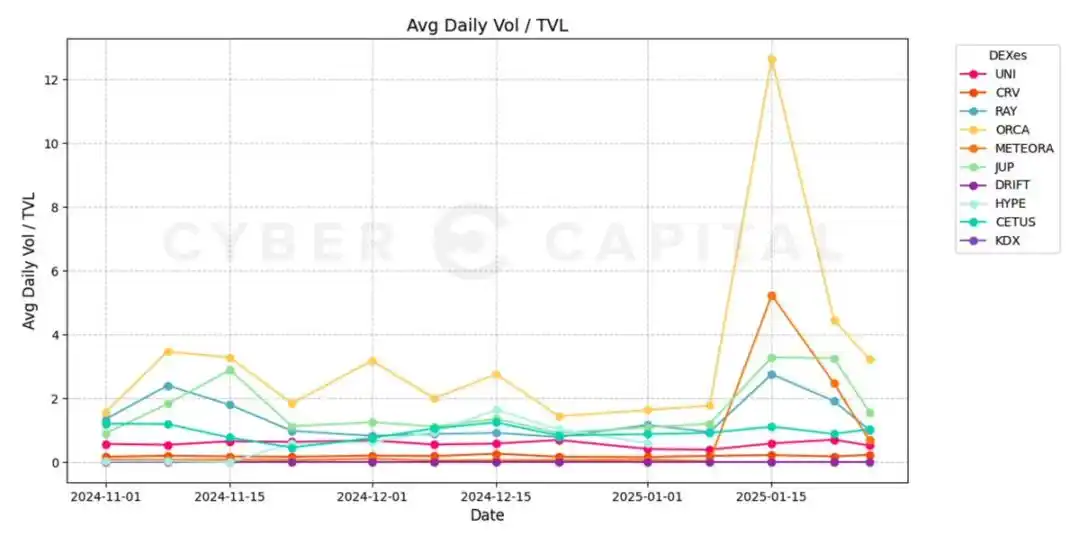
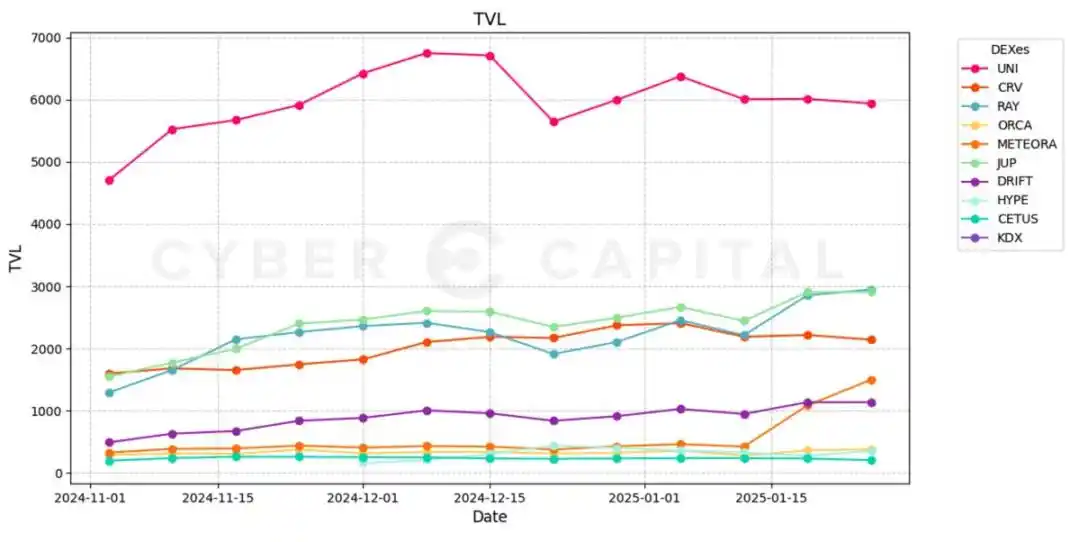
· Total Value Locked (TVL) Retention: With the Pengu airdrop and significant events like the Trump and Melania-related Memecoin launch, Meteora has made strides. Although during the Memecoin launch, the trading volume / Total Value Locked (Vol/TVL) ratio of many pairs rose due to temporary demand, Meteora's TVL continued to grow post-event, demonstrating good retention.
· Integration Development: Virtuals migrated to Solana in the first quarter of 2024 and announced integration with the Meteora liquidity pool.
Orca Bleak Outlook: Insufficient Liquidity Retention
· Insufficient Liquidity Depth: Despite high efficiency, Orca's pool size is significantly smaller than Raydium's, resulting in higher slippage for large trades.
· Market Positioning Issue: Jupiter's routing mechanism prioritizes exchanges with deeper liquidity, making emerging low-liquidity decentralized exchanges and liquidity pools unattractive. The emergence of Meteora as a liquidity aggregator further limits the competitive survival of non-leading decentralized exchanges in the routing framework, as routing only occurs when the slippage cost is lower than Meteora's fee premium, a situation that is very rare beyond the surge in market demand.
· Limited Liquidity Provider Incentives: Orca lacks a robust liquidity mining strategy, leading to a lower long-term liquidity provider retention rate.
· Inefficient Capital Allocation: Unlike Meteora, Orca has not yet implemented automated yield optimization, requiring manual LP management, resulting in a more cumbersome user experience.
· Unpromising Liquidity Trend: The upcoming Meteora token launch may divert liquidity providers completely from Orca, making its situation even more challenging.
· Insufficient Integration: Failure to reach a partnership with Pump.fun at the beginning of 2024 followed by a recent missed opportunity with Virtuals highlights its competitive disadvantage in acquiring orders from emerging retail-driven applications. Without upcoming catalysts to reverse this trend, the liquidity migration may continue. These factors have prevented Orca from retaining the additional user volume gained during network demand peaks.
Key Catalysts and Risks
Critical Catalysts to Watch
· RAY Buyback vs. Centralized Exchange Holdings Comparison: RAY's buyback rate now exceeds the total RAY held by centralized exchanges, reinforcing the token's scarcity.
· Total Locked Value Growth Trend: The continued dominance of Raydium, Jupiter, and Meteora indicates the sustainability of long-term liquidity. In high-pressure market conditions, the performance of emerging protocols deserves attention and should not be overlooked.
· Partnership Dynamics: Just as Pumpfun's integration brought significant liquidity to Raydium, Meteora's integration with Virtuals could have a similar effect. Given the impact of such partnerships on liquidity and total value locked, collaborations with lesser-known players are closely watched.
· Meteora's Token Issuance: This event could mark a turning point in the decentralized exchange liquidity distribution on Solana.
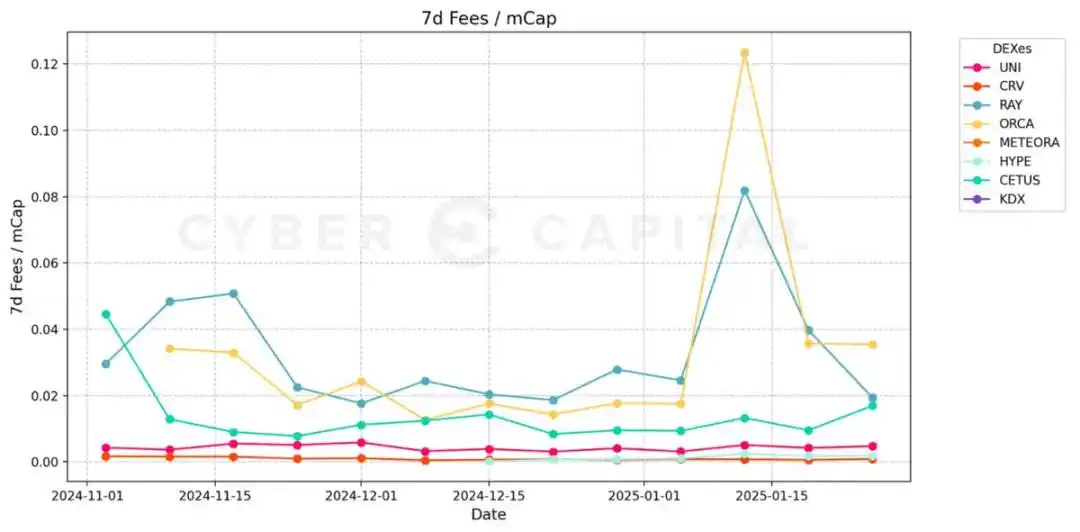
· Fee-to-Market Cap Ratio: Orca demonstrated high efficiency during a month of strong demand, but its retention of liquidity fell short, hindering long-term competitiveness. On the other hand, JUP faced the opposite situation due to constraints in its business model. Compared to the latest "hot project" Hyperliquid, Raydium generated ten times the fee with an eighth of the fully diluted valuation.
Risks
· JUP Inflationary Pressure: Despite Jupiter's aggregator position being solid, its large token supply could create short-term price pressure. Orca Market Share Erosion: If the trend of liquidity providers migrating continues, Orca may face ongoing liquidity drain. Meteora Airdrop and Tokenomics Implementation Risk: While early total value locked growth has been strong, its tokenomics and incentive structure remain untested.
Conclusion and Investment Outlook
Solana's decentralized exchange landscape is moving towards higher efficiency and deeper liquidity concentration. Raydium's outstanding liquidity positioning, active buyback mechanism, and market leadership make it a decentralized exchange with strong investment confidence. Jupiter's aggregator role remains critical and provides a competitive barrier, but token supply dilution poses a short-term challenge. Orca was once a competitive player, but faces serious challenges in liquidity retention and capital efficiency, becoming an increasingly fragile asset, indicating the dilemma of missing key integrations and struggling to compete head-on with established players. Meteora is poised to rise upon the successful launch of its upcoming token.
Based on our current theory, investment positions in decentralized exchanges should focus on the leading decentralized exchanges, decentralized exchange aggregators, and liquidity aggregators within a given ecosystem, while holding a small position in emerging participants that meet catalyst criteria.
You may also like

WEEX Deposit/Withdrawal Dynamic Island: Your Asset Status, Always in Sight

Scaling Crypto Derivatives: The Digital Asset Infrastructure Behind High-Volume Trading
In the fast-moving digital asset ecosystem, derivatives platforms face an extreme architectural test. High-leverage futures markets demand more than just standard security—they require absolute operational precision, zero-latency matching engines, and ironclad structural scalability, all while navigating intense market volatility.
As global platforms scale to meet these demands, the industry is shifting away from rigid, monolithic setups toward a more agile, "decoupled" infrastructure philosophy.
The Blueprint for High-Volume Copy TradingFor elite global exchanges like WEEX (founded in 2018), this architectural choice becomes critical when scaling high-volume retail features like social copy trading. When thousands of users automatically mirror the real-time strategies of elite traders simultaneously, it triggers sudden, monumental spikes in concurrent transactional volume.
To prevent execution latency or settlement bottlenecks during these peak volatility events, a platform's primary engine must remain entirely dedicated to risk management, copy-trade synchronization, and order matching.
The Architectural Rule: New-generation platforms must separate front-end user execution engines from heavy backend infrastructural overhead to eliminate operational friction.
By separating these layers, platforms can maintain complete sovereignty over their trading environments and user experiences while strategically aligning with institutional-grade infrastructure ecosystems. This strategic framework allows modern exchanges to leverage advanced Digital Asset Custody infrastructure such as Cobo’s behind the scenes, ensuring that backend wallet management scales elastically alongside trading spikes.
Capitalizing on Market Momentum and 400× LeverageIn a derivatives arena where platforms offer up to 400× leverage on perpetual contracts, capital efficiency and market agility are core business metrics. To capture market momentum, an exchange needs the ability to rapidly expand its asset offerings, supporting everything from legacy crypto assets to sudden, trending altcoins across a massive library of trading pairs.
Adopting a flexible, scalable Wallet-as-a-Service (WaaS) solution such as Cobo’s could completely rewrite the development timeline for high-growth exchanges. Instead of spending months of engineering capital building out custom backend wallet architectures for every new blockchain network, platforms can deploy localized infrastructure in days.
This agility allows platforms to instantly scale their listings to over a thousand trading pairs without compromising security or delaying time-to-market. It mirrors the exact operational advantages seen during high-velocity market events, similar to how advanced wallet infrastructure empowers platforms during sudden asset surges; allowing exchanges to pass that speed and liquidity directly to their global user base.
A Mature Foundation for GrowthThe synergy between trusted infrastructure ecosystems and global trading platforms represents the natural evolution of a maturing crypto market. As WEEX continues to scale its global spot and derivatives offerings for over 6 million users, adopting robust backend paradigms proves that platforms no longer have to compromise between cutting-edge trading velocity and uncompromised structural security.

Morning Report | BitMine increased its holdings by 126,971 ETH last week; trader Eugene announced his exit from the crypto market

Wang Chuan: How can one not feel anxious after the neighbor Old Wang made thirty times profit by investing in storage stocks? (Seven) - A quarter-century cycle

Get Paid to Onboard? Try WEEX’s New Homepage with Rewards for Registration, Deposit & Trade

WEEX Custom Layout: Build Your Perfect Trading Workspace in Seconds

See “Buy Walls” & “Sell Walls” Instantly: WEEX Launches the Depth Chart for Smarter Trades

What Is Quick Trade on WEEX? 2 Ways WEEX Ends Chart-Panel Jumping
Morning News | Five major virtual asset platforms in South Korea have experienced 57 incidents of hacking and system failures in six years; Grayscale submits registration application for Canton ETF

Should we escape the peak? The principle of the tail-end market in the stock market

RootData: May 2026 Cryptocurrency Exchange Transparency Research Report

Founder of Baixing.com: My Experience with Claude Code in Fourteen Points

Yang Ge Gary: Agent Economics and AI Microeconomics
When reasoning becomes a scarce resource, who captures its value?

Jensen Huang dramatically "rescues" the South Korean stock market

Stablecoins vs Deposit Tokens: On the surface, they seem like opposing sides, but in reality, they are interconnected

Bitcoin Crash to $50,000 or Bear Trap Before $100,000? Deep Dive for WEEX Traders
How Could the SpaceX IPO Affect Bitcoin, Altcoins season, and Crypto Liquidity?
WEEX Deposit/Withdrawal Dynamic Island: Your Asset Status, Always in Sight
Scaling Crypto Derivatives: The Digital Asset Infrastructure Behind High-Volume Trading
In the fast-moving digital asset ecosystem, derivatives platforms face an extreme architectural test. High-leverage futures markets demand more than just standard security—they require absolute operational precision, zero-latency matching engines, and ironclad structural scalability, all while navigating intense market volatility.
As global platforms scale to meet these demands, the industry is shifting away from rigid, monolithic setups toward a more agile, "decoupled" infrastructure philosophy.
The Blueprint for High-Volume Copy TradingFor elite global exchanges like WEEX (founded in 2018), this architectural choice becomes critical when scaling high-volume retail features like social copy trading. When thousands of users automatically mirror the real-time strategies of elite traders simultaneously, it triggers sudden, monumental spikes in concurrent transactional volume.
To prevent execution latency or settlement bottlenecks during these peak volatility events, a platform's primary engine must remain entirely dedicated to risk management, copy-trade synchronization, and order matching.
The Architectural Rule: New-generation platforms must separate front-end user execution engines from heavy backend infrastructural overhead to eliminate operational friction.
By separating these layers, platforms can maintain complete sovereignty over their trading environments and user experiences while strategically aligning with institutional-grade infrastructure ecosystems. This strategic framework allows modern exchanges to leverage advanced Digital Asset Custody infrastructure such as Cobo’s behind the scenes, ensuring that backend wallet management scales elastically alongside trading spikes.
Capitalizing on Market Momentum and 400× LeverageIn a derivatives arena where platforms offer up to 400× leverage on perpetual contracts, capital efficiency and market agility are core business metrics. To capture market momentum, an exchange needs the ability to rapidly expand its asset offerings, supporting everything from legacy crypto assets to sudden, trending altcoins across a massive library of trading pairs.
Adopting a flexible, scalable Wallet-as-a-Service (WaaS) solution such as Cobo’s could completely rewrite the development timeline for high-growth exchanges. Instead of spending months of engineering capital building out custom backend wallet architectures for every new blockchain network, platforms can deploy localized infrastructure in days.
This agility allows platforms to instantly scale their listings to over a thousand trading pairs without compromising security or delaying time-to-market. It mirrors the exact operational advantages seen during high-velocity market events, similar to how advanced wallet infrastructure empowers platforms during sudden asset surges; allowing exchanges to pass that speed and liquidity directly to their global user base.
A Mature Foundation for GrowthThe synergy between trusted infrastructure ecosystems and global trading platforms represents the natural evolution of a maturing crypto market. As WEEX continues to scale its global spot and derivatives offerings for over 6 million users, adopting robust backend paradigms proves that platforms no longer have to compromise between cutting-edge trading velocity and uncompromised structural security.
Morning Report | BitMine increased its holdings by 126,971 ETH last week; trader Eugene announced his exit from the crypto market
Wang Chuan: How can one not feel anxious after the neighbor Old Wang made thirty times profit by investing in storage stocks? (Seven) - A quarter-century cycle
Get Paid to Onboard? Try WEEX’s New Homepage with Rewards for Registration, Deposit & Trade
WEEX Custom Layout: Build Your Perfect Trading Workspace in Seconds


