
TVL increased fivefold in one month, is AC going to turn Sonic into the new DeFi yield farming paradise?


During a time when other chains focus on the MeMe market and are continuously drawn to various sudden events, Sonic Labs, formerly Fantom, has been focusing on DeFi development. Sonic has announced several new measures to incentivize DeFi projects in its ecosystem, resulting in a 500% increase in Sonic's TVL in the past month. What has Sonic done, and how can retail investors participate in the Sonic ecosystem?
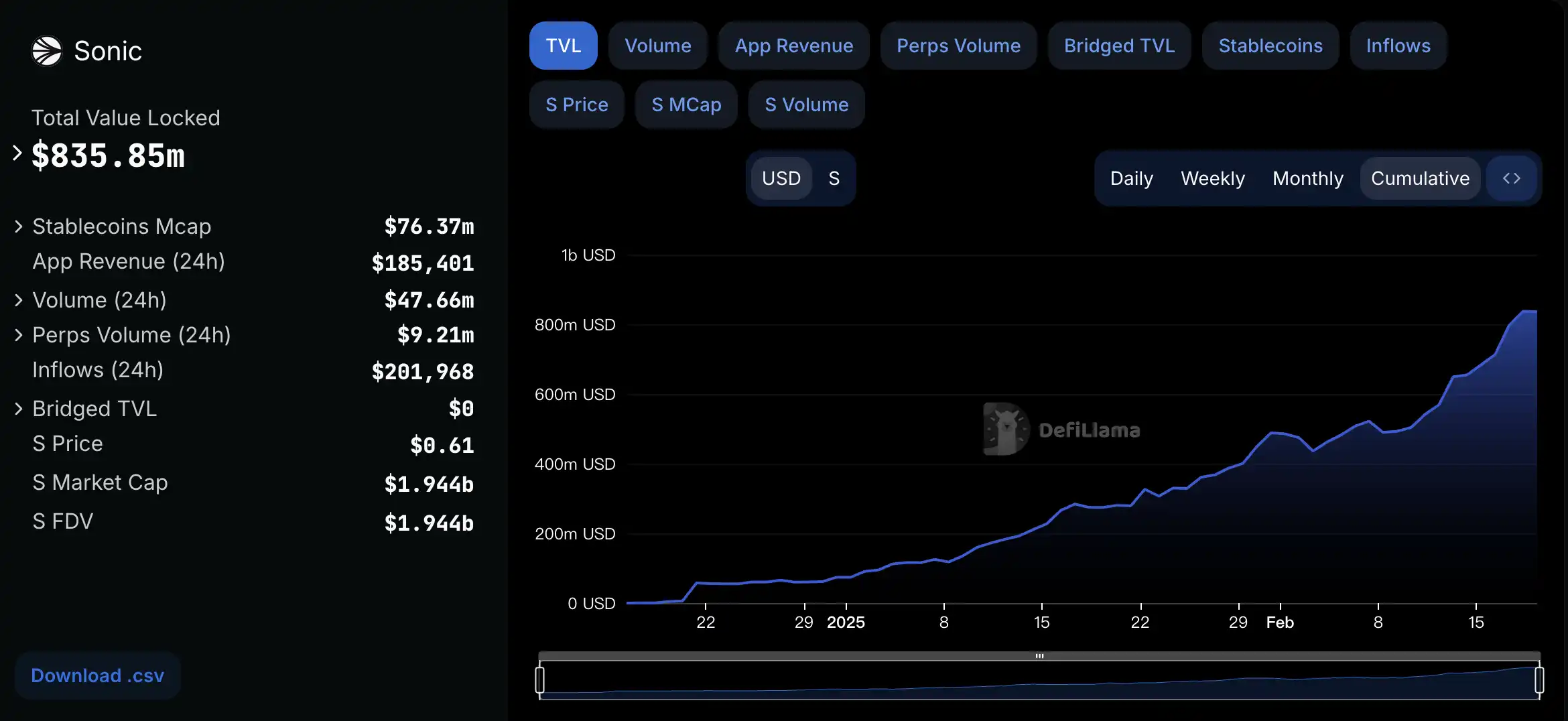
Main Chain, New Layout: What Has AC Brother Done Since Sonic's Return?
In 2021, Fantom was highly successful, with its TVL reaching as high as $8 billion. However, after the departure of Chief Developer Andre Cronje and the end of DeFi Summer, Fantom gradually faded into obscurity. With AC's return at the end of last year, the Fantom brand was upgraded to Sonic, and the former star team used new technology to build a new chain, which indeed achieved good results in the first two months after release.
During these two months, $110 million in external funds flowed into Sonic, with Solana accounting for the majority, followed closely by Base and ETH. The DEX trading volume on Sonic also surpassed the $1 billion mark.
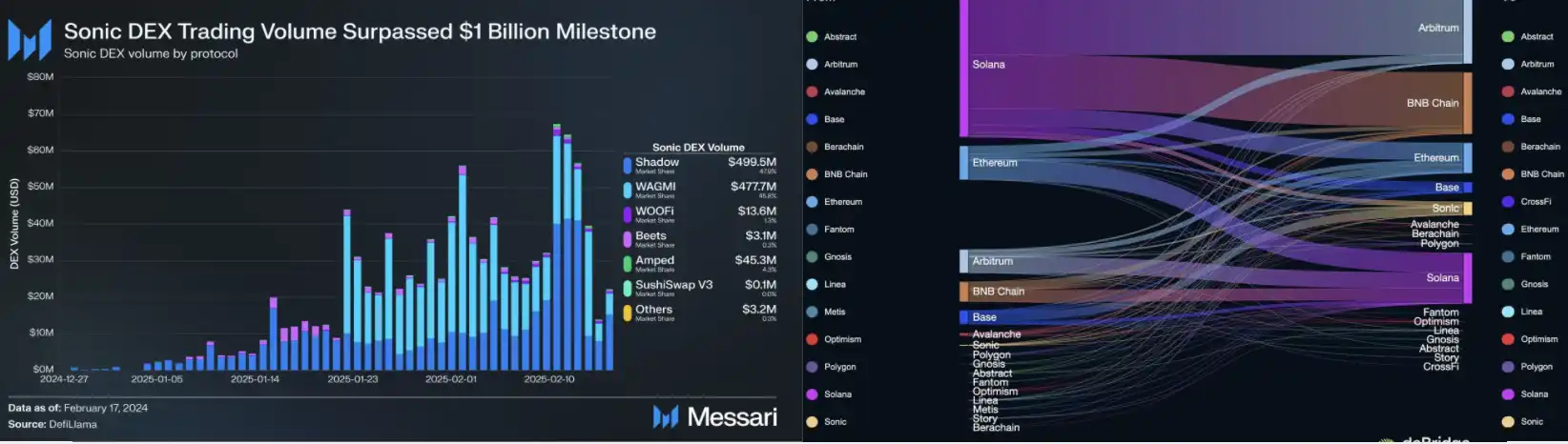
How did Sonic achieve this? For a DeFi chain, the liquidity pathway is essential.
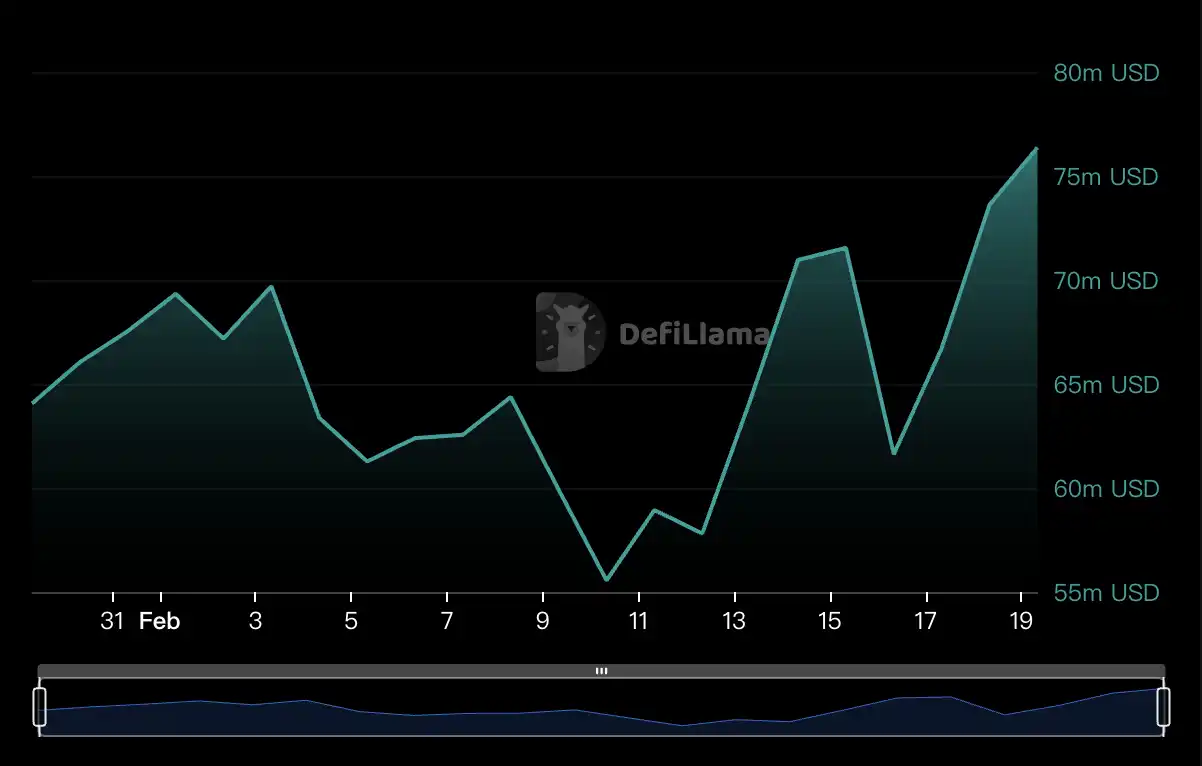
After integrating USDT into Sonic, the total stablecoin market value has increased by 32%, and the current total market value of stablecoins such as USDT, USDC, scUSD, stkscUSD, and USDC.e has reached $76 million.
$S has now been bridged to Solana but has not yet deeply interacted with Solana's DeFi protocols, leading to relatively low liquidity in the $S pool. Continued observation is recommended for potential future collaborations between Sonic and Solana's DeFi protocols.
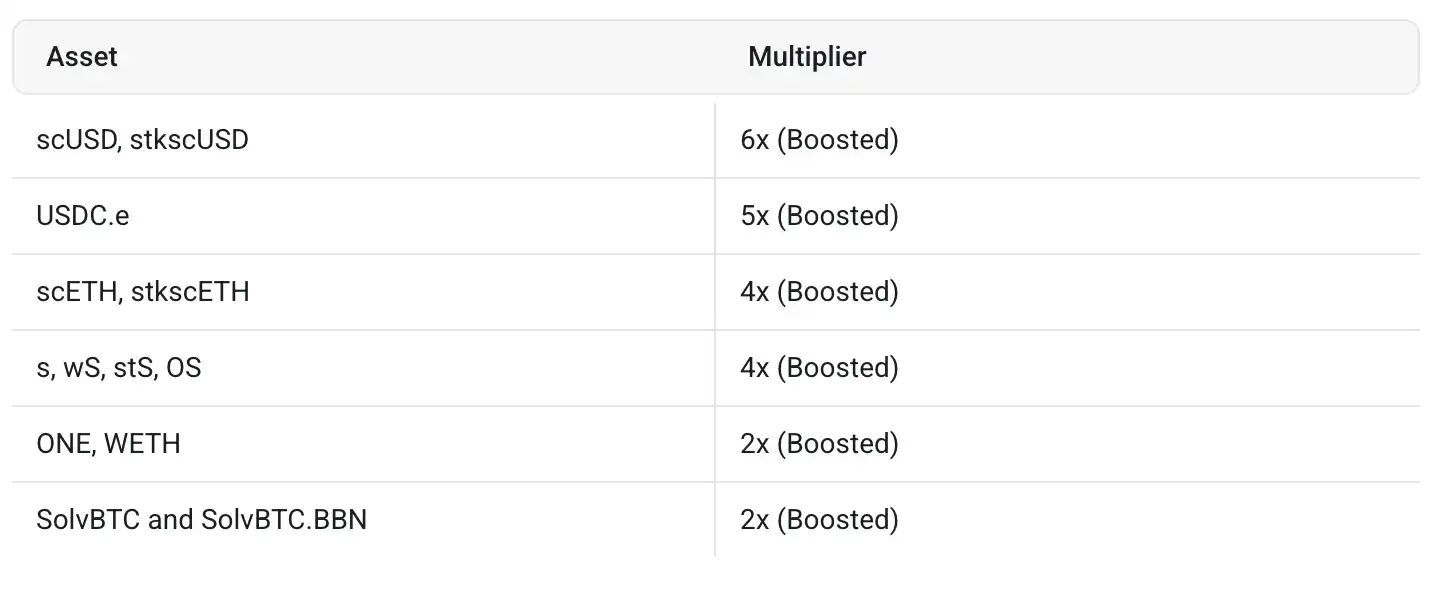
Sonic has leveraged a nested staking model through three DeFi protocols to bring users leveraged earnings, bringing BTC and ETH liquidity into Sonic under a mutually beneficial scenario.
Lombard Finance: Lombard Finance is a key player in Bitcoin-focused DeFi, most notably launching LBTC, a liquid staking version of Bitcoin. By staking BTC with Lombard, users receive a 1:1 "LBTC" reward.
Ether.fi: Ether.fi is a decentralized Ethereum staking protocol that allows users to stake Ethereum (ETH) directly and receive staking rewards. Ether.fi has partnered with Lombard to launch the first Bitcoin-backed staking token "eBTC."
eBTC uses LBTC as collateral in the background, allowing eBTC holders to potentially earn multi-tiered rewards as they benefit from both LBTC staking rewards (backed by actual Bitcoin) and Ether.fi's staking strategies on Ethereum. eBTC can also be deposited into Rings on Ethereum to mint scBTC.
Rings Protocol: A project on Sonic that enables users to deposit various tokens — from stablecoins to Ethereum and Bitcoin derivatives — and mint interest-bearing "sc" version assets (such as scUSD, scETH, and scBTC) by staking Bitcoin-based assets like LBTC, eBTC, and wBTC. Users can deposit these assets into Rings Protocol, mint scBTC, and use or stake them on Sonic to earn weekly rewards. Rings leverages Veda Labs' farming strategies to generate yield using deposited assets across Ethereum and protocols on Sonic.
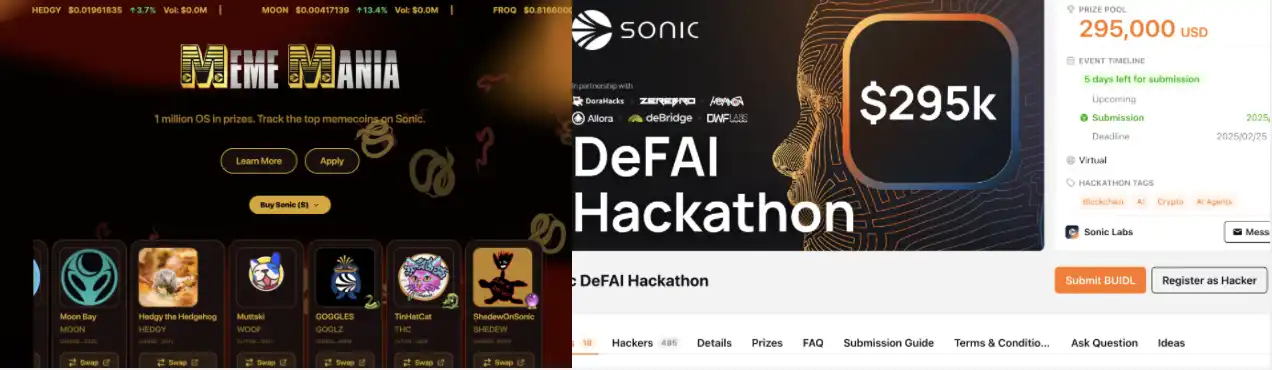
Sonic DeFAI Hackathon, Sonic Meme Mania Competition
The hackathon offers a prize pool of $295,000 worth of $S to support AI agents building social and on-chain operations on Sonic. It has attracted 18 AI projects and garnered the attention of 485 technical enthusiasts with a registration deadline of February 25th.
A total of $1 million in $OS is allocated as prizes, with the highest market value among participants approaching $7 million. Sonic's meme coin infrastructure is relatively underdeveloped, and it remains to be seen whether, while driving DeFi as the fastest blockchain, it will also follow Solana's strategy to expand meme user base.
Additionally,
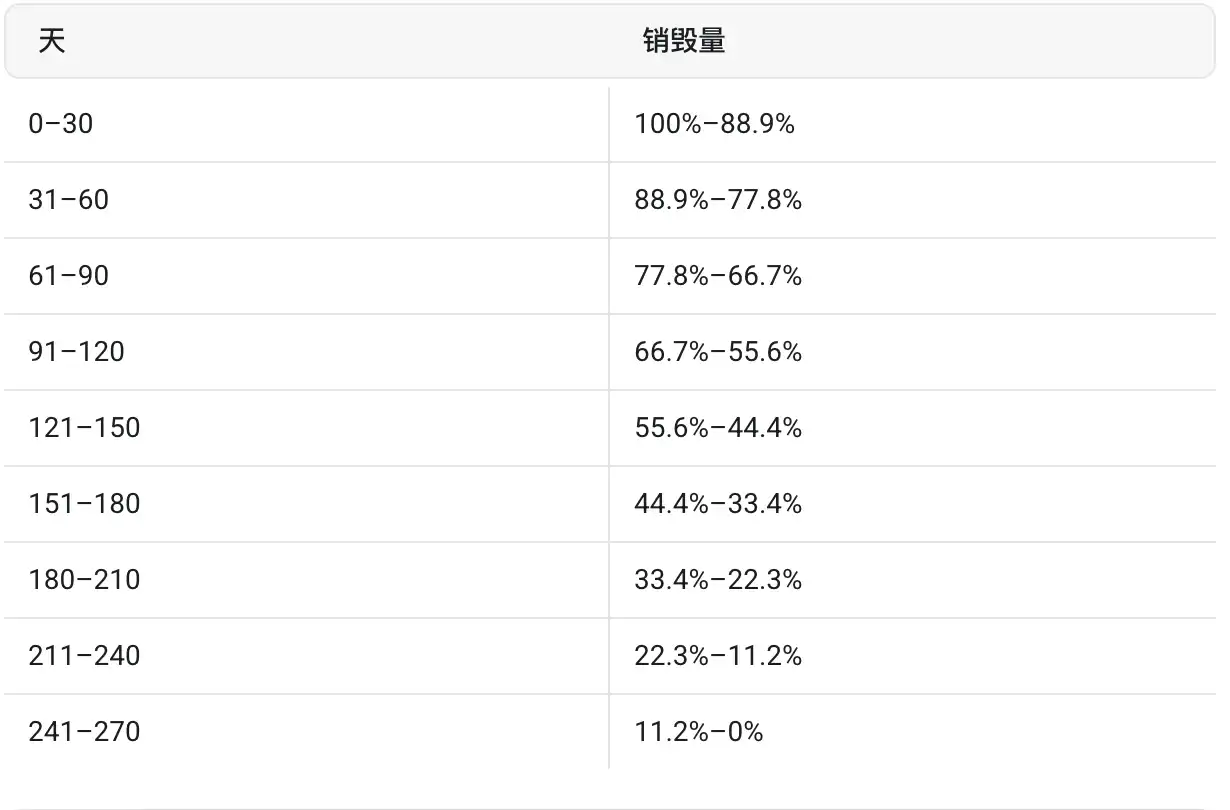
Sonic plans to release a total of 200 million $S tokens over a 1-year period, with the first season lasting 6 months, representing 40-60% of the airdrop total supply. Of these, 25% of the airdrop is for immediate circulating tokens, and 75% is for tradable locked NFT certificates. Users can trade NFTs and, following the unlock schedule in the table below, partially burn them for $S liquidity to unlock them early. The flexible airdrop unlock model has attracted many users.
What Opportunities Does the Sonic Ecosystem Offer Amidst the Widely Circulated High Returns?
Airdrop
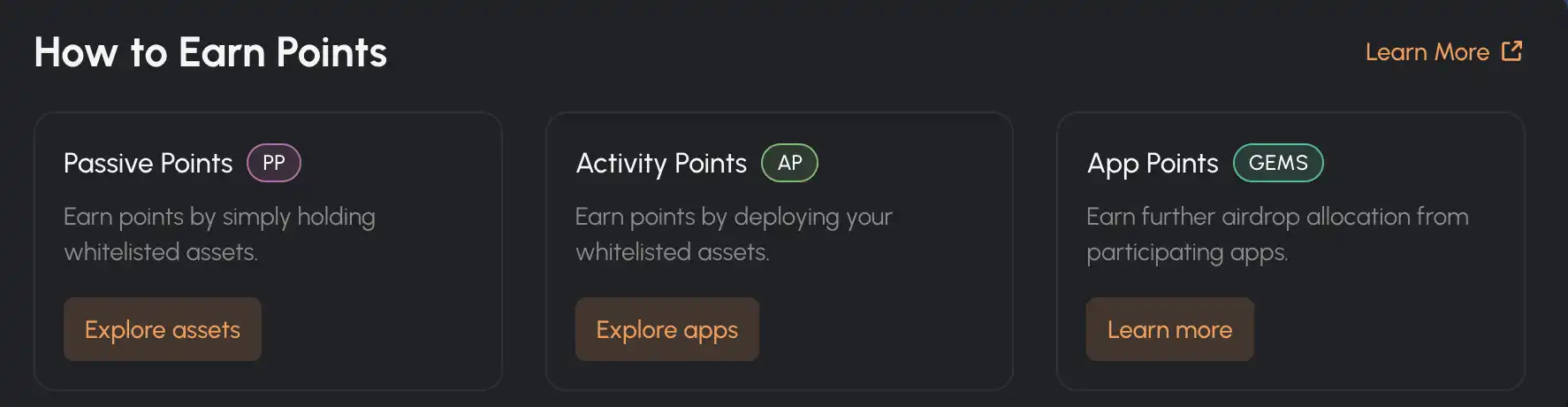
There are currently three ways to earn airdrop points: Passive Points (PP) only require holding whitelist assets in a Web3 wallet. Activity Points (AP) require providing whitelist assets in a project as liquidity. DApps Points (Gems) are distributed to ecosystem developers based on their contributions to the ecosystem.
According to on-chain analyst @phtevenstrong,
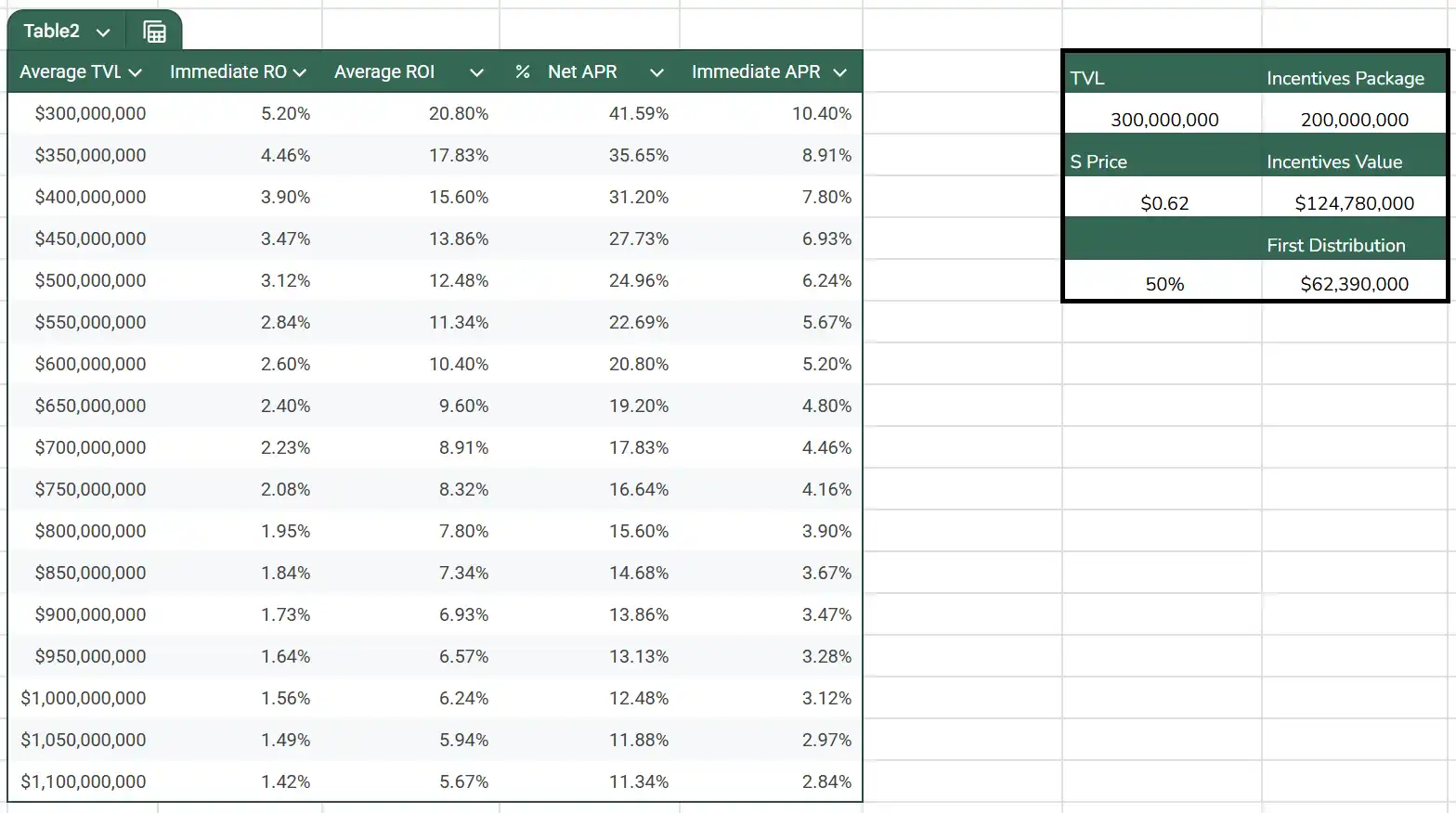
The $S token currently has a fully circulating supply with no VC shares, eliminating dilution risk. Close to half of the liquidity is currently locked, with 31% of the total supply staked and an additional 5-10% of $S locked in DeFi protocols. Assuming a 50% airdrop in six months, we need to estimate the average TVL for that period.
$300M TVL → Additional +20% APR
$500M TVL → Additional +12.5% APR
Base Points Farming Strategy
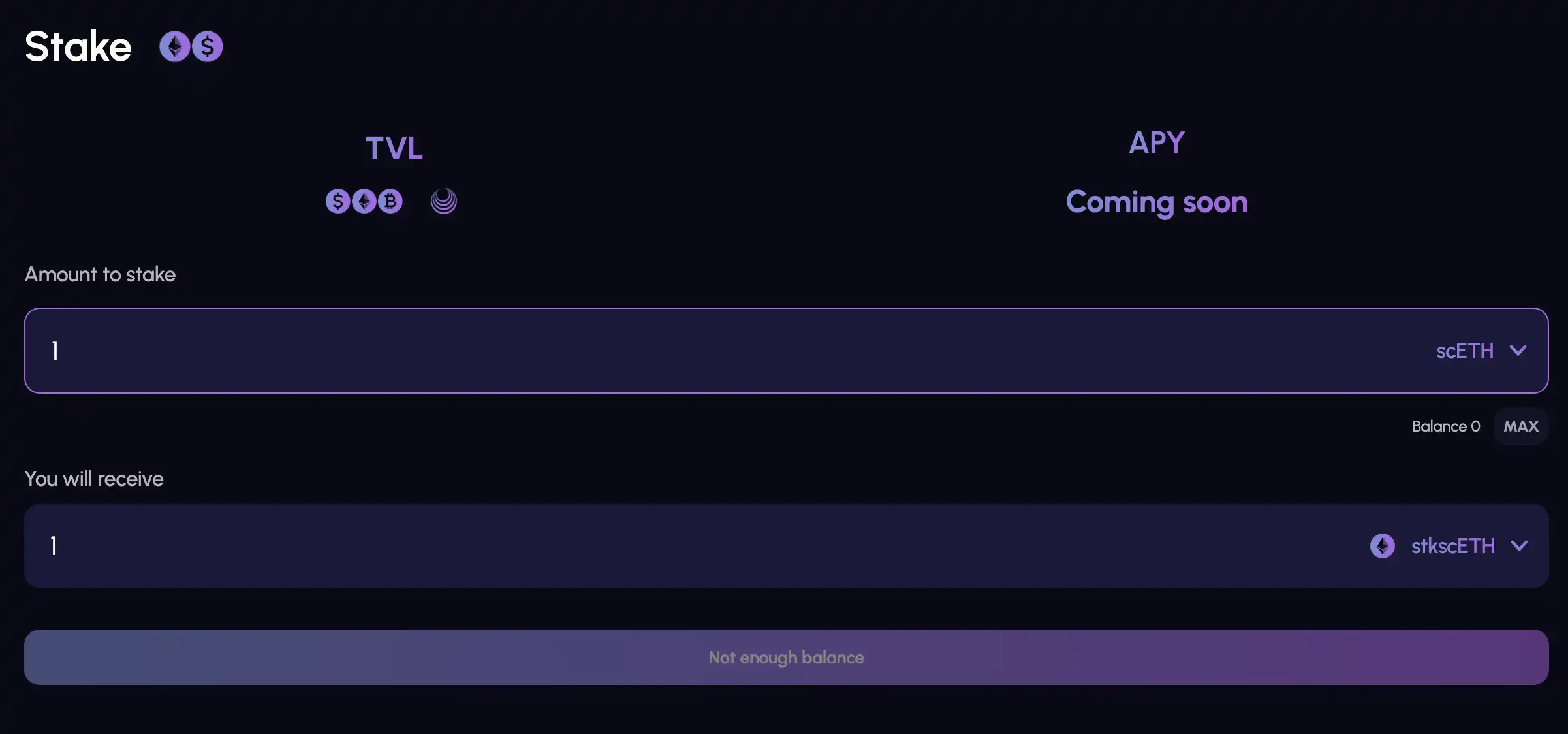
Rings Protocol's scETH Loop strategy: Staking ETH on the Rings Protocol to mint interest-bearing scETH. Borrowing: Collateralizing scETH on the Euler platform to borrow Wrapped Ether (WETH) with a 91.5% loan-to-value ratio (LTV). Leveraging: Reinvesting the borrowed WETH to potentially achieve 10x leverage. Expected Returns: Without considering Rings points and rEUL rewards, the theoretical annualized percentage yield (APR) can reach 87.49%.
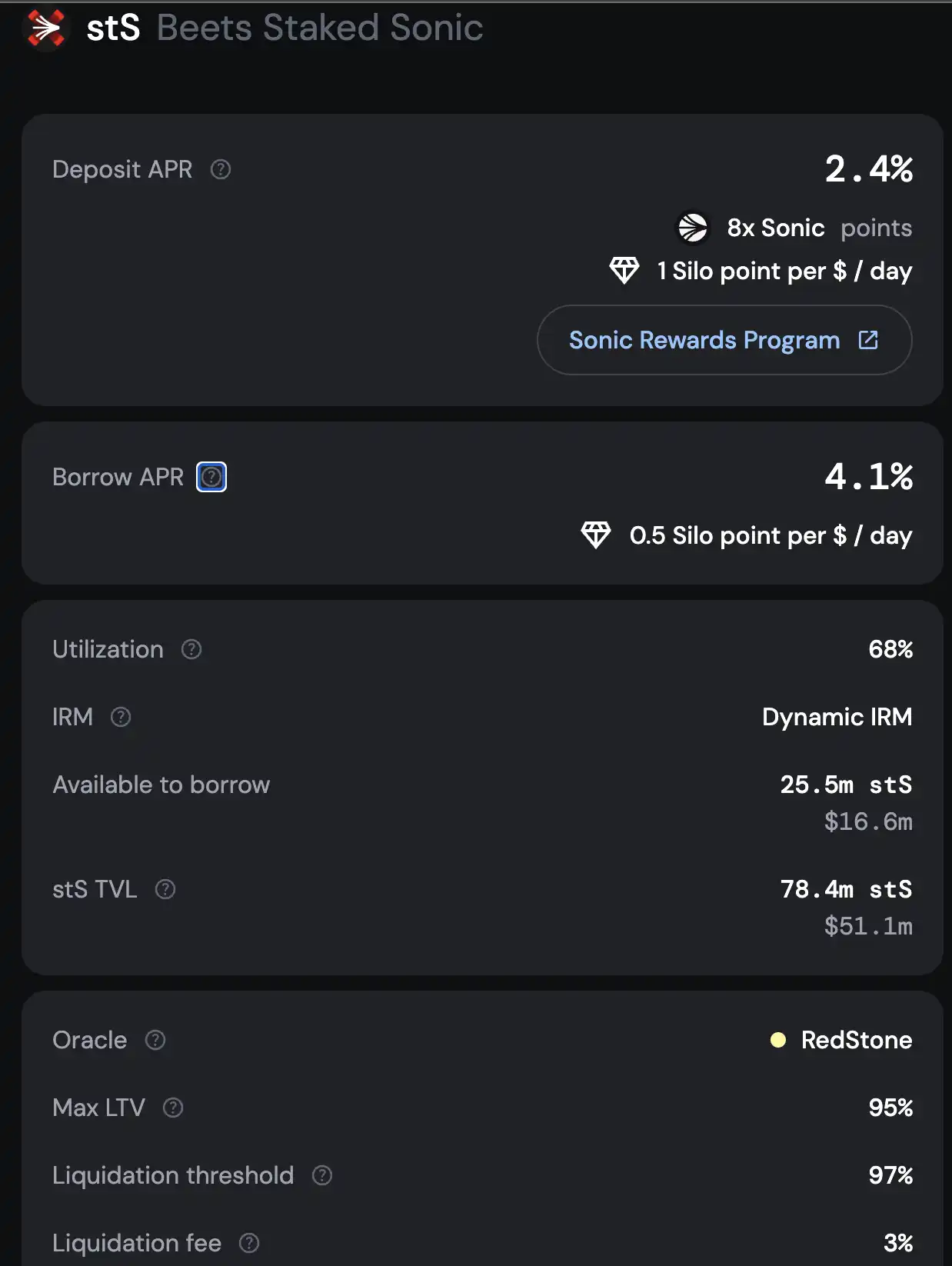
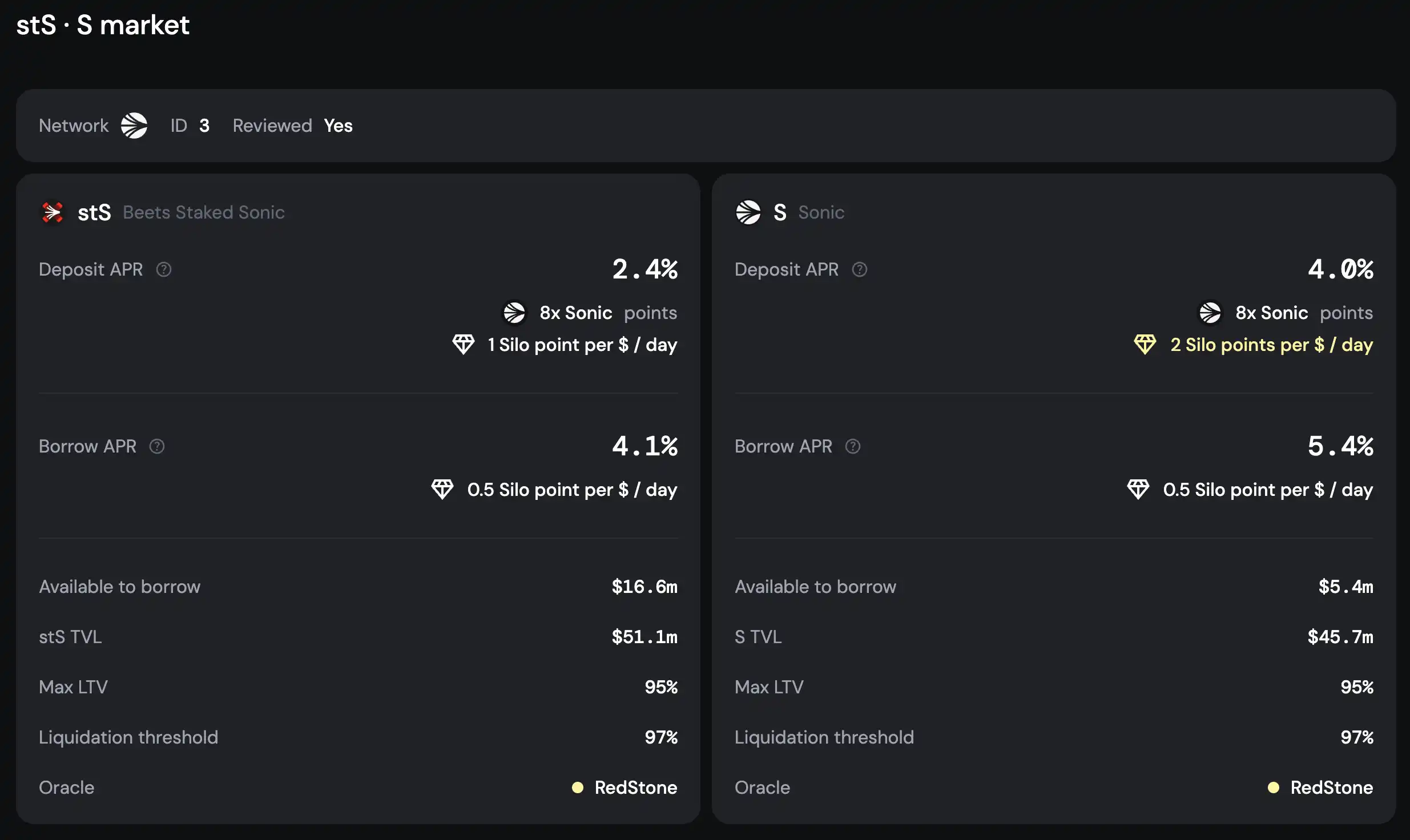
Silo Finance's stS/S Hedge Loop strategy: 1. Borrowing: Borrowing stS tokens on Silo Finance with a 95% LTV, achieving 20x leverage. 2. Staking: Staking the borrowed stS tokens to earn 2.4% lending yield and 5.3% staking yield. 3. Points Reward: Layering a 10% points reward to enhance overall returns. Expected Returns: Base yield is 7.7%, plus a 10% points reward, totaling 17.7%. The full strategy's APR can reach 74%.
Reverse Hedge Arbitrage Strategy 1. Borrow: Borrow stS tokens on Silo Finance to receive an 8x points bonus. 2. Lend: Lend out stS tokens to earn a 4.1% lending yield. 3. Points Reward: Earn 0.5 Silo points daily to further enhance returns. Expected Returns: Base return of 4.1% plus the daily 0.5 Silo points reward to boost overall yield.
After the MeMe market gradually calmed down, DeFi returned to the mainstream spotlight. Sonic, a DeFi-focused project, has seen excellent growth in the first three months, integrating the DeFai concept. Facing the pressure of hype and the subsequent emergence of Monad, Sonic aims to establish a solid foothold using its high-performance chain and AI to create a new DeFi paradigm. It is expected to bring new vitality to the market with more interesting innovations amidst the fierce competition among numerous projects.
You may also like

Sahara AI Responds to SAHARA’s Sharp Drop: No Contract or Product Security Issues Found, Internal Investigation Underway
Sahara AI responded to SAHARA’s 60% price drop, saying no token contract or product security issues have been found and an internal investigation is underway.

WEEX Deposit/Withdrawal Dynamic Island: Your Asset Status, Always in Sight

Scaling Crypto Derivatives: The Digital Asset Infrastructure Behind High-Volume Trading
In the fast-moving digital asset ecosystem, derivatives platforms face an extreme architectural test. High-leverage futures markets demand more than just standard security—they require absolute operational precision, zero-latency matching engines, and ironclad structural scalability, all while navigating intense market volatility.
As global platforms scale to meet these demands, the industry is shifting away from rigid, monolithic setups toward a more agile, "decoupled" infrastructure philosophy.
The Blueprint for High-Volume Copy TradingFor elite global exchanges like WEEX (founded in 2018), this architectural choice becomes critical when scaling high-volume retail features like social copy trading. When thousands of users automatically mirror the real-time strategies of elite traders simultaneously, it triggers sudden, monumental spikes in concurrent transactional volume.
To prevent execution latency or settlement bottlenecks during these peak volatility events, a platform's primary engine must remain entirely dedicated to risk management, copy-trade synchronization, and order matching.
The Architectural Rule: New-generation platforms must separate front-end user execution engines from heavy backend infrastructural overhead to eliminate operational friction.
By separating these layers, platforms can maintain complete sovereignty over their trading environments and user experiences while strategically aligning with institutional-grade infrastructure ecosystems. This strategic framework allows modern exchanges to leverage advanced Digital Asset Custody infrastructure such as Cobo’s behind the scenes, ensuring that backend wallet management scales elastically alongside trading spikes.
Capitalizing on Market Momentum and 400× LeverageIn a derivatives arena where platforms offer up to 400× leverage on perpetual contracts, capital efficiency and market agility are core business metrics. To capture market momentum, an exchange needs the ability to rapidly expand its asset offerings, supporting everything from legacy crypto assets to sudden, trending altcoins across a massive library of trading pairs.
Adopting a flexible, scalable Wallet-as-a-Service (WaaS) solution such as Cobo’s could completely rewrite the development timeline for high-growth exchanges. Instead of spending months of engineering capital building out custom backend wallet architectures for every new blockchain network, platforms can deploy localized infrastructure in days.
This agility allows platforms to instantly scale their listings to over a thousand trading pairs without compromising security or delaying time-to-market. It mirrors the exact operational advantages seen during high-velocity market events, similar to how advanced wallet infrastructure empowers platforms during sudden asset surges; allowing exchanges to pass that speed and liquidity directly to their global user base.
A Mature Foundation for GrowthThe synergy between trusted infrastructure ecosystems and global trading platforms represents the natural evolution of a maturing crypto market. As WEEX continues to scale its global spot and derivatives offerings for over 6 million users, adopting robust backend paradigms proves that platforms no longer have to compromise between cutting-edge trading velocity and uncompromised structural security.

Morning Report | BitMine increased its holdings by 126,971 ETH last week; trader Eugene announced his exit from the crypto market

Wang Chuan: How can one not feel anxious after the neighbor Old Wang made thirty times profit by investing in storage stocks? (Seven) - A quarter-century cycle

Get Paid to Onboard? Try WEEX’s New Homepage with Rewards for Registration, Deposit & Trade

WEEX Custom Layout: Build Your Perfect Trading Workspace in Seconds

See “Buy Walls” & “Sell Walls” Instantly: WEEX Launches the Depth Chart for Smarter Trades

What Is Quick Trade on WEEX? 2 Ways WEEX Ends Chart-Panel Jumping
Morning News | Five major virtual asset platforms in South Korea have experienced 57 incidents of hacking and system failures in six years; Grayscale submits registration application for Canton ETF

Should we escape the peak? The principle of the tail-end market in the stock market

RootData: May 2026 Cryptocurrency Exchange Transparency Research Report

Founder of Baixing.com: My Experience with Claude Code in Fourteen Points

Yang Ge Gary: Agent Economics and AI Microeconomics
When reasoning becomes a scarce resource, who captures its value?

Jensen Huang dramatically "rescues" the South Korean stock market

Stablecoins vs Deposit Tokens: On the surface, they seem like opposing sides, but in reality, they are interconnected

Bitcoin Crash to $50,000 or Bear Trap Before $100,000? Deep Dive for WEEX Traders
Sahara AI Responds to SAHARA’s Sharp Drop: No Contract or Product Security Issues Found, Internal Investigation Underway
Sahara AI responded to SAHARA’s 60% price drop, saying no token contract or product security issues have been found and an internal investigation is underway.
WEEX Deposit/Withdrawal Dynamic Island: Your Asset Status, Always in Sight
Scaling Crypto Derivatives: The Digital Asset Infrastructure Behind High-Volume Trading
In the fast-moving digital asset ecosystem, derivatives platforms face an extreme architectural test. High-leverage futures markets demand more than just standard security—they require absolute operational precision, zero-latency matching engines, and ironclad structural scalability, all while navigating intense market volatility.
As global platforms scale to meet these demands, the industry is shifting away from rigid, monolithic setups toward a more agile, "decoupled" infrastructure philosophy.
The Blueprint for High-Volume Copy TradingFor elite global exchanges like WEEX (founded in 2018), this architectural choice becomes critical when scaling high-volume retail features like social copy trading. When thousands of users automatically mirror the real-time strategies of elite traders simultaneously, it triggers sudden, monumental spikes in concurrent transactional volume.
To prevent execution latency or settlement bottlenecks during these peak volatility events, a platform's primary engine must remain entirely dedicated to risk management, copy-trade synchronization, and order matching.
The Architectural Rule: New-generation platforms must separate front-end user execution engines from heavy backend infrastructural overhead to eliminate operational friction.
By separating these layers, platforms can maintain complete sovereignty over their trading environments and user experiences while strategically aligning with institutional-grade infrastructure ecosystems. This strategic framework allows modern exchanges to leverage advanced Digital Asset Custody infrastructure such as Cobo’s behind the scenes, ensuring that backend wallet management scales elastically alongside trading spikes.
Capitalizing on Market Momentum and 400× LeverageIn a derivatives arena where platforms offer up to 400× leverage on perpetual contracts, capital efficiency and market agility are core business metrics. To capture market momentum, an exchange needs the ability to rapidly expand its asset offerings, supporting everything from legacy crypto assets to sudden, trending altcoins across a massive library of trading pairs.
Adopting a flexible, scalable Wallet-as-a-Service (WaaS) solution such as Cobo’s could completely rewrite the development timeline for high-growth exchanges. Instead of spending months of engineering capital building out custom backend wallet architectures for every new blockchain network, platforms can deploy localized infrastructure in days.
This agility allows platforms to instantly scale their listings to over a thousand trading pairs without compromising security or delaying time-to-market. It mirrors the exact operational advantages seen during high-velocity market events, similar to how advanced wallet infrastructure empowers platforms during sudden asset surges; allowing exchanges to pass that speed and liquidity directly to their global user base.
A Mature Foundation for GrowthThe synergy between trusted infrastructure ecosystems and global trading platforms represents the natural evolution of a maturing crypto market. As WEEX continues to scale its global spot and derivatives offerings for over 6 million users, adopting robust backend paradigms proves that platforms no longer have to compromise between cutting-edge trading velocity and uncompromised structural security.
Morning Report | BitMine increased its holdings by 126,971 ETH last week; trader Eugene announced his exit from the crypto market
Wang Chuan: How can one not feel anxious after the neighbor Old Wang made thirty times profit by investing in storage stocks? (Seven) - A quarter-century cycle
Get Paid to Onboard? Try WEEX’s New Homepage with Rewards for Registration, Deposit & Trade


