
Warmonger Trump has forgotten about Americans waiting in airport lines for hours


In recent times, international news has been dominated by the Iran situation and President Trump's fluctuating stance on the war.
However, one thing that once monopolized the headlines in 2025 is now rarely mentioned in the mainstream media—on February 14, due to a deadlock between the Democrats and Republicans on the Department of Homeland Security (DHS) funding bill, a partial DHS shutdown officially began.
As of today, the shutdown has not ended.
During this nearly two-month shutdown period, over 100,000 DHS employees have been unable to receive their pay, and nearly 11% of Transportation Security Administration (TSA) employees have been absent. In New Orleans, passengers queuing for security screening snaked from inside the terminal building to outside, even circling the parking lot seven times before reaching the entrance.
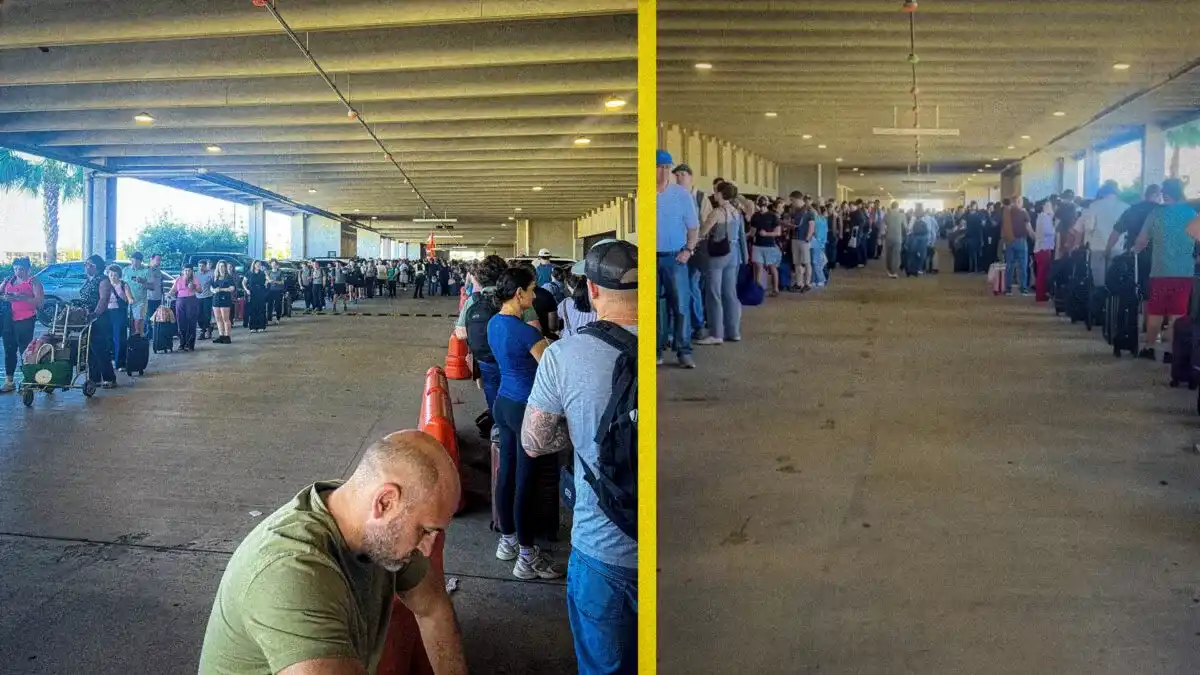
For the United States, which has almost no high-speed rail network and heavily relies on air travel, turbulence in the civil aviation system is deadly. Even Musk publicly expressed willingness to personally pay the salaries of affected TSA employees.
Also starting in March, the prediction market Polymarket launched a weekly updated "This week's number of delayed flights in the US" prediction event—traders can bet on how many flights will be delayed each week, with the opportunity to earn money if their prediction is correct and lose everything if wrong.
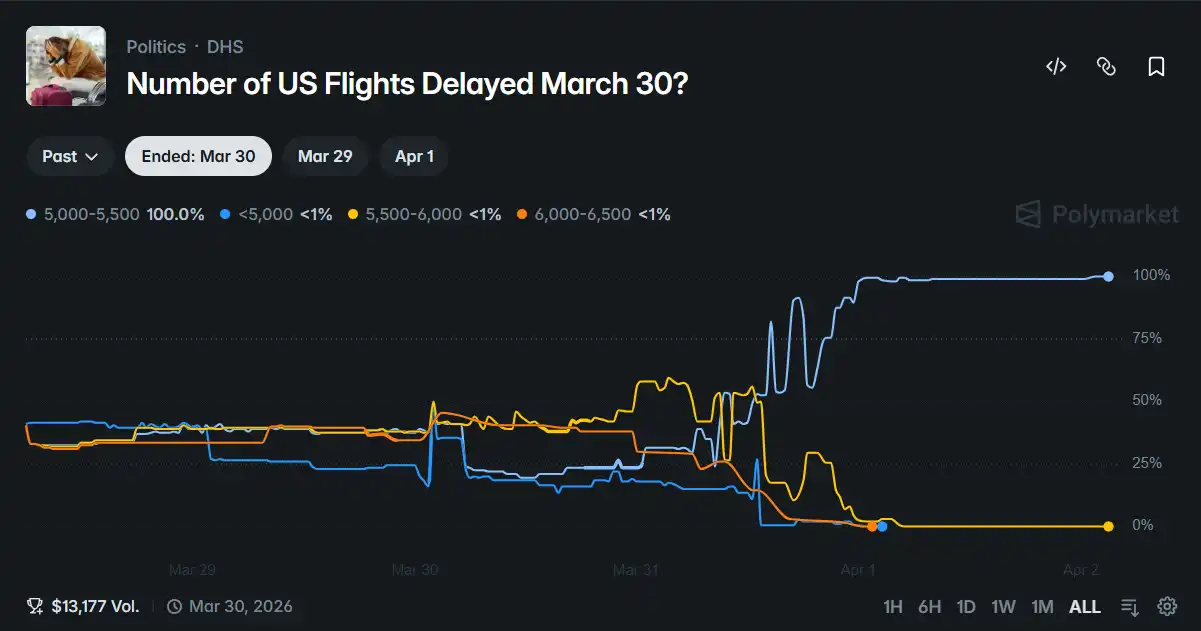
In addition to this purely entertainment-based event, Polymarket has also launched several topics of significant reference value. Through the probabilities reflected by these topics, we can attempt to interpret the current state of the government shutdown and even domestic affairs in the United States.
The Shutdown Game Between the Two Parties
This shutdown has already broken Trump's previous record of 35 days. In the embarrassing situation of widespread flight delays and the near-collapse of the security system, the most concerning question for the affected population within the United States is when the shutdown will end.
Currently on Polymarket, there is already a related event: "DHS Shutdown will end by ___." As of the time of writing, the probability of the shutdown ending between April 5th and 8th is 9%, and the probability of the shutdown not ending in April is 44%.
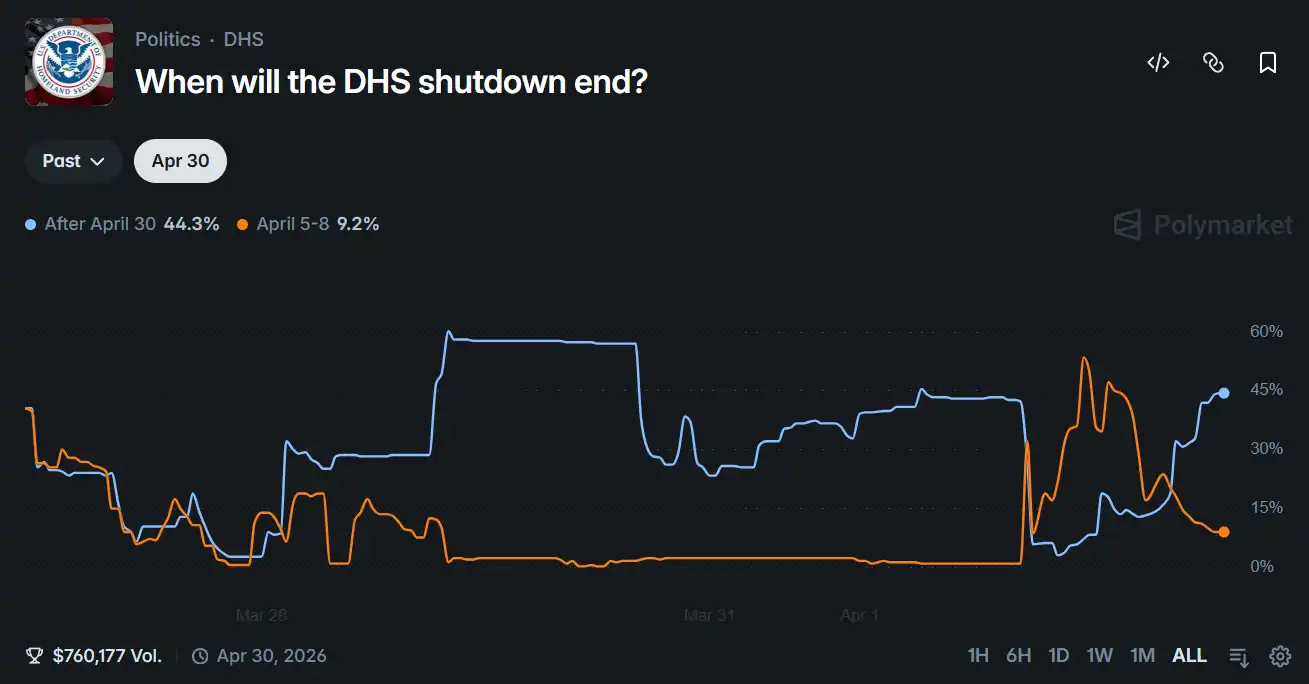
Many "smart money" has been placed on these two time points—senior traders with high accuracy in past predictions and outstanding profitability in the political sector. Behind such trading profiles, it confirms a clear logic: if the shutdown does not end within the April 5th to 8th window, the likelihood of reaching an agreement this month will significantly decrease.
April 5-8 coincides with Congress returning to work after a break, and the two parties will once again put the appropriations bill on the table. If they can reach an agreement in the days following their return to work and the bill is passed by both the Senate and the House, the shutdown will come to an end.
However, if this window is missed once again, the Senate and the House will then be caught up in other scheduling matters. Without strong political pressure, the motivation for both parties to return to the negotiating table will significantly weaken.
Musk's "Tab" and ICE's "Overtime"
Due to ongoing TSA staff shortages causing severe delays at major airports, Musk tweeted on March 21 that he was willing to pay TSA workers' salaries, giving rise to the Polymarket trading event "Will Musk pay TSA staff salaries?".
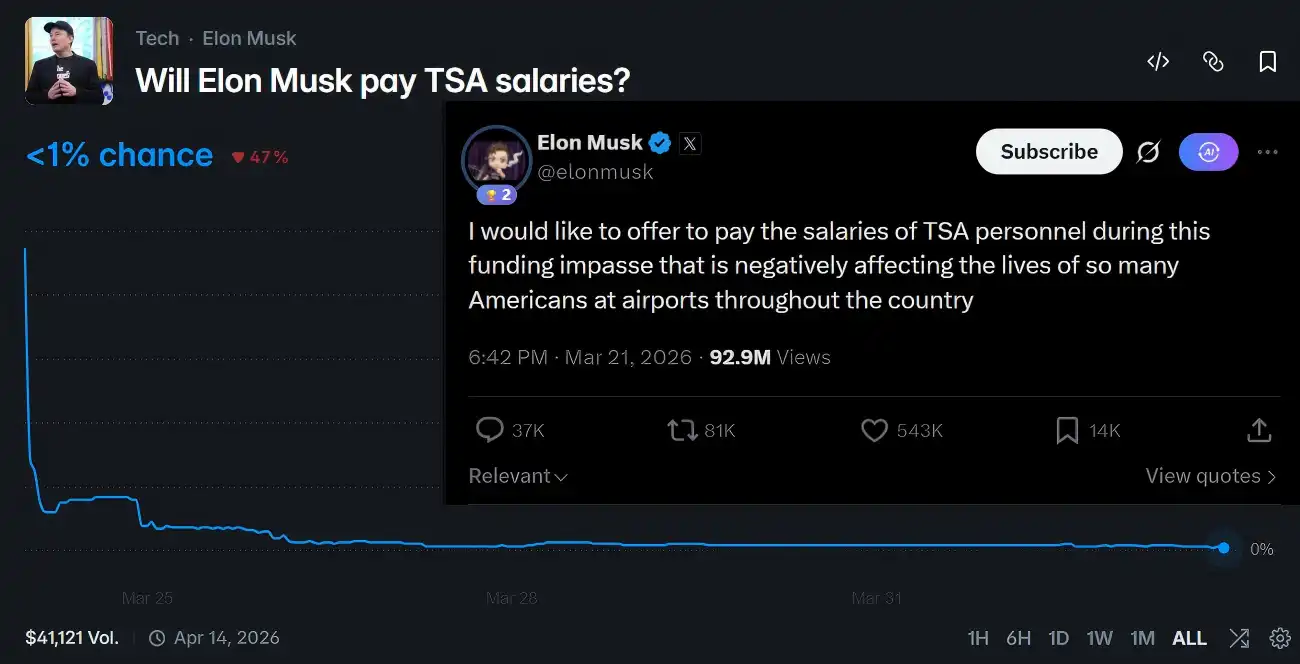
However, shortly after Musk's tweet, the White House rejected the proposal citing legal compliance and conflicts of interest: under U.S. federal law, government employees cannot accept external compensation related to their official duties; furthermore, Musk's deep involvement in federal government contracts presents a significant conflict of interest in directly paying wages.
While there is legal basis for the rejection, ordinary people still have to live. To minimize the impact of the aviation system's paralysis on the midterm elections, in March, Trump ordered the deployment of Immigration and Customs Enforcement (ICE) agents to airports to replace TSA workers who had resigned due to unpaid leave.
However, the scene that unfolded after these ICE agents arrived at the airport made the entire shutdown situation look even more absurd.
Since taking office, ICE has been aggressively downsizing recruitment and training processes to achieve the goal of "arresting 3,000 people daily and deporting millions annually" – planning to hire an additional ten thousand law enforcement officers and shortening the original 16-week physical training to 8 weeks.

In short, the professionalism of these ICE agents themselves is already questionable.
Yet TSA's security work requires systematic training, covering core skills such as X-ray machine operation and explosive detection, which ICE agents simply do not possess.
Thus, a historic scene unfolds: TSA workers are volunteering on the job while also showing ICE agents the security screening process and teaching them how to maintain order. Most ICE agents are not performing actual security screening but are patrolling the terminals, using their law enforcement status to interrogate and deport suspected undocumented immigrants.

The data confirmed the outcome of this farce: After ICE was deployed to the airport, the flight delay situation did not significantly improve. As of the end of March, the U.S. aviation system still experienced thousands of flight delays per day on average, with nearly a 40% TSA absenteeism rate at the Atlanta airport and over 350 flight delays in a single day. These numbers indicate that the ICE agents, who were supposed to act as a shutdown cushion, did not play the role that everyone expected.
The "Nuclear Option" to Break the Deadlock
Another transaction event related to this government shutdown is "Will the Republican Party use the 'nuclear option' to break obstruction by December 31, 2026?", with the current probability at 31%.
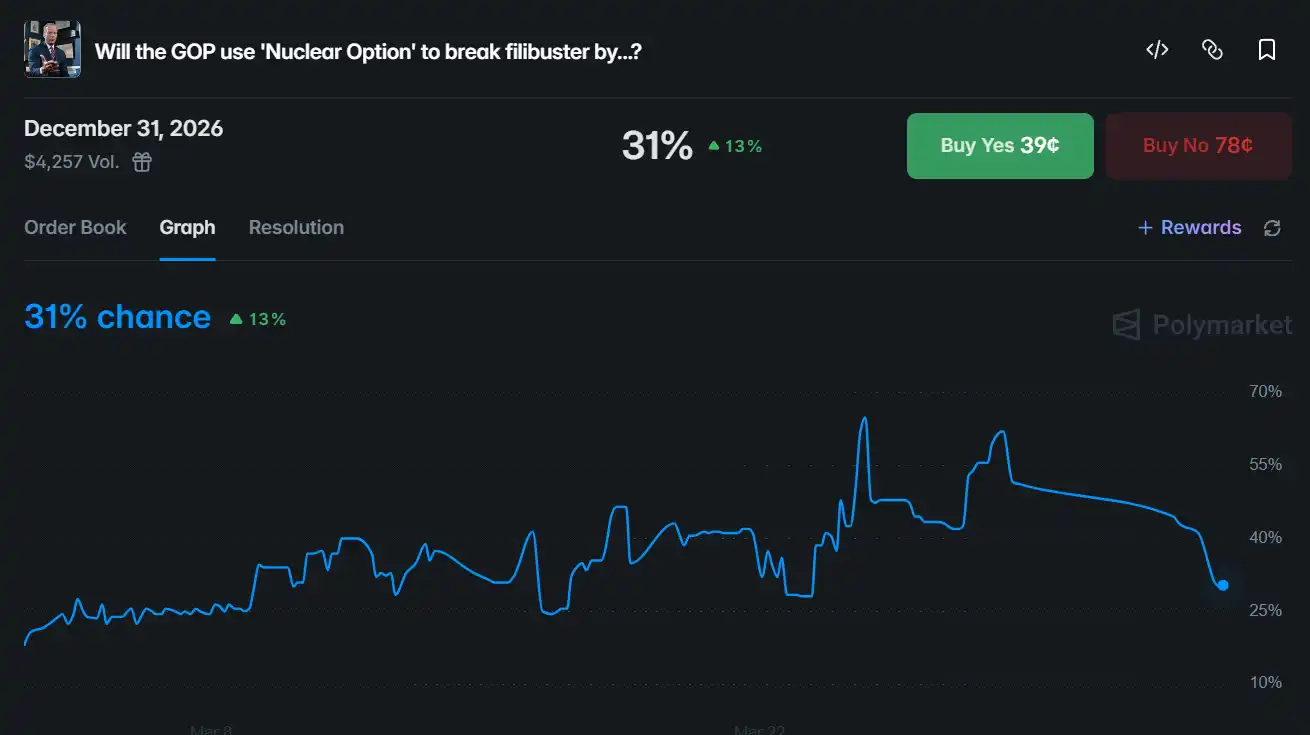
At first glance, the term "nuclear option" may seem intimidating; however, in the U.S. political arena, it is not a literal nuclear weapon but rather one of the few yet highly destructive bargaining chips the Republican Party holds.
In the U.S. legislative system, the House of Representatives is responsible for proposing and drafting fiscal appropriation bills, while the Senate is responsible for deliberation and voting. Typically, ending debate and advancing to a vote in the Senate requires the support of 60 votes — meaning the minority party only needs 41 votes to indefinitely delay debate and block any bill.
The "nuclear option" provides a way to bypass this threshold: a senator can make a procedural appeal to overturn the presiding officer's ruling with a simple majority (51 votes), thus forcibly lowering the vote threshold required to end debate from 60 votes.
Currently, the Republican Party holds 53 seats in the Senate, and once the nuclear option is triggered, the Democrats' ability to obstruct will be nearly nonexistent.
However, the reason it's called the "nuclear" option is that it comes with a high cost to the user: breaking Senate procedural rules would be seen as an abuse of power by voters; more importantly, if the Republican Party loses the majority in the future, the same rules could be used by the Democrats to retaliate.
The hole dug today may need to be filled by the digger tomorrow. The 31% probability is the market's true pricing of this dilemma.
Amidst this ongoing shutdown deadlock, Trump also finds himself dealing with the escalating situation in Iran.
On one side, there is a high-stakes diplomatic and military game, while on the other side, there are airport queues, unpaid wages, and interparty wrangling — the troubles that this U.S. administration needs to coordinate are far more numerous than what the headlines suggest. Internal and foreign crises never wait for each other to be resolved first.
Amid this turmoil, the rich landscape of political and current events prediction markets will continue to act as an objective mirror, helping us capture the true trajectory of these narratives.
You may also like

Morning Report | BitMine increased its holdings by 126,971 ETH last week; trader Eugene announced his exit from the crypto market

Wang Chuan: How can one not feel anxious after the neighbor Old Wang made thirty times profit by investing in storage stocks? (Seven) - A quarter-century cycle

Cryptocurrency CEXs are flocking to sell US stocks, and traditional brokerages are facing an "uninvited guest."

$75 billion in foreign capital has fled, and South Korean retail investors have absorbed it all using leverage

Japan’s Three Megabanks Plan Joint Stablecoin Issuance in Fiscal 2026
MUFG, SMBC, and Mizuho reportedly plan to jointly issue fiat-pegged stablecoins in fiscal 2026, signaling Japan’s growing push into bank-led digital payment infrastructure.

Humanity Discloses H Token Dual-Chain Attack Details, With Losses on Ethereum and BSC Exceeding $36 Million
Humanity said the H token attack across Ethereum and BSC caused more than $36 million in losses after leaked ProxyAdmin keys enabled malicious contract upgrades and token minting.
White House Discusses CLARITY Act With Law Enforcement Ahead of Senate Vote
The White House discussed the CLARITY Act with law enforcement ahead of a Senate vote, focusing on illicit finance risks and developer protections.

Bitcoin Trading Guide 2026: Strategies for Experienced Traders

What Is XAUT and PAXG? Why Tokenized Gold Is Booming in 2026

Will the SpaceX IPO Hurt Bitcoin? Here's What Traders Are Watching

Foreign selling in the South Korean stock market accelerates, with cumulative net sales reportedly reaching $75 billion this year
On June 9, The Kobeissi Letter, citing Goldman Sachs data, reported that global investors are selling South Korean stocks at an unusually rapid pace. In the latest trading session, foreign investors sold about $801 million worth of Kospi constituent stocks again; total foreign outflows last week reached about $10 billion, and the market has been in net foreign selling on nearly every trading day over the past month. According to the data cited in the report, foreign investors have sold about $75 billion worth of South Korean stocks so far this year. Meanwhile, South Korean retail and institutional investors together recorded roughly $69 billion in net buying over the same period, suggesting that the market’s main buying support has come from domestic capital rather than returning overseas funds. The information currently disclosed still mainly comes from The Kobeissi Letter’s retelling and Goldman Sachs data summaries, while public details on the statistical period and the specific definition of “selling” remain relatively limited.

Fortune Warns of Strategy’s Financing Structure Risks as Bitcoin Premium Narrows
Fortune warned that Strategy’s Bitcoin treasury model faces growing financing risks as MSTR’s net asset premium narrows and preferred stock dividend pressure increases.

Ferrari Challenge Le Mans: Carl Moon to Dominate in WEEX Livery

Sahara AI Responds to SAHARA’s Sharp Drop: No Contract or Product Security Issues Found, Internal Investigation Underway
Sahara AI responded to SAHARA’s 60% price drop, saying no token contract or product security issues have been found and an internal investigation is underway.

WEEX Deposit/Withdrawal Dynamic Island: Your Asset Status, Always in Sight
Scaling Crypto Derivatives: The Digital Asset Infrastructure Behind High-Volume Trading
In the fast-moving digital asset ecosystem, derivatives platforms face an extreme architectural test. High-leverage futures markets demand more than just standard security—they require absolute operational precision, zero-latency matching engines, and ironclad structural scalability, all while navigating intense market volatility.
As global platforms scale to meet these demands, the industry is shifting away from rigid, monolithic setups toward a more agile, "decoupled" infrastructure philosophy.
The Blueprint for High-Volume Copy TradingFor elite global exchanges like WEEX (founded in 2018), this architectural choice becomes critical when scaling high-volume retail features like social copy trading. When thousands of users automatically mirror the real-time strategies of elite traders simultaneously, it triggers sudden, monumental spikes in concurrent transactional volume.
To prevent execution latency or settlement bottlenecks during these peak volatility events, a platform's primary engine must remain entirely dedicated to risk management, copy-trade synchronization, and order matching.
The Architectural Rule: New-generation platforms must separate front-end user execution engines from heavy backend infrastructural overhead to eliminate operational friction.
By separating these layers, platforms can maintain complete sovereignty over their trading environments and user experiences while strategically aligning with institutional-grade infrastructure ecosystems. This strategic framework allows modern exchanges to leverage advanced Digital Asset Custody infrastructure such as Cobo’s behind the scenes, ensuring that backend wallet management scales elastically alongside trading spikes.
Capitalizing on Market Momentum and 400× LeverageIn a derivatives arena where platforms offer up to 400× leverage on perpetual contracts, capital efficiency and market agility are core business metrics. To capture market momentum, an exchange needs the ability to rapidly expand its asset offerings, supporting everything from legacy crypto assets to sudden, trending altcoins across a massive library of trading pairs.
Adopting a flexible, scalable Wallet-as-a-Service (WaaS) solution such as Cobo’s could completely rewrite the development timeline for high-growth exchanges. Instead of spending months of engineering capital building out custom backend wallet architectures for every new blockchain network, platforms can deploy localized infrastructure in days.
This agility allows platforms to instantly scale their listings to over a thousand trading pairs without compromising security or delaying time-to-market. It mirrors the exact operational advantages seen during high-velocity market events, similar to how advanced wallet infrastructure empowers platforms during sudden asset surges; allowing exchanges to pass that speed and liquidity directly to their global user base.
A Mature Foundation for GrowthThe synergy between trusted infrastructure ecosystems and global trading platforms represents the natural evolution of a maturing crypto market. As WEEX continues to scale its global spot and derivatives offerings for over 6 million users, adopting robust backend paradigms proves that platforms no longer have to compromise between cutting-edge trading velocity and uncompromised structural security.

Get Paid to Onboard? Try WEEX’s New Homepage with Rewards for Registration, Deposit & Trade
WEEX Custom Layout: Build Your Perfect Trading Workspace in Seconds
Morning Report | BitMine increased its holdings by 126,971 ETH last week; trader Eugene announced his exit from the crypto market
Wang Chuan: How can one not feel anxious after the neighbor Old Wang made thirty times profit by investing in storage stocks? (Seven) - A quarter-century cycle
Cryptocurrency CEXs are flocking to sell US stocks, and traditional brokerages are facing an "uninvited guest."
$75 billion in foreign capital has fled, and South Korean retail investors have absorbed it all using leverage
Japan’s Three Megabanks Plan Joint Stablecoin Issuance in Fiscal 2026
MUFG, SMBC, and Mizuho reportedly plan to jointly issue fiat-pegged stablecoins in fiscal 2026, signaling Japan’s growing push into bank-led digital payment infrastructure.
Humanity Discloses H Token Dual-Chain Attack Details, With Losses on Ethereum and BSC Exceeding $36 Million
Humanity said the H token attack across Ethereum and BSC caused more than $36 million in losses after leaked ProxyAdmin keys enabled malicious contract upgrades and token minting.


