
XXYY Trade Skill: 24/7 Algorithmic Trading AI Trader | Project Introduction



In the current highly competitive market, when it comes to making money through meme coin trading, "hodling" is almost essential. And when you spend long hours every day intently staring at your computer or phone screen to catch the latest information hotspots, you've likely encountered these issues: too many scam tokens to scan through, not knowing which ones are worth paying attention to; unable to monitor the charts 24/7, always worried about missing out on a hundredfold gainer; wanting to quickly check the risk before trading, but information retrieval is too slow, by the time you finish checking, others have already doubled their money.
The barrier to entry for automated trading has not been low in the past. You had to study API documentation, deal with signature authentication, server deployment, and after overcoming these hurdles, you still had to know how to code. Most Degens may have great trading ideas but lack programming skills, so they can only continue manual trading. To turn your strategy into a program that can run on its own, you either have to code it yourself, find a tech-savvy teammate, or even pay someone to code for you.
With the arrival of the AI era, the technological threshold has been significantly lowered. If you could spend 5 minutes teaching an AI Agent to automatically scan chains, collect information, filter and recommend projects, or even automatically trade, take profit, stop loss, and operate 24/7 non-stop, would you give it a try?
This is exactly what XXYY Trade Skill is doing.
Turning AI into a Trader in One Sentence
What XXYY Trade Skill does is quite simple: you describe in plain language how you want to trade, and AI transforms that description into a series of on-chain operations for you.
No need to know how to code, no need to understand how smart contracts interact. All you need is an environment that supports MCP, such as OpenClaw, Claude Code, or Cursor.
If you think OpenClaw might pose a security risk to your assets or if your account gets banned while using Claude Code, you can also use Manus or other AI applications that can provide a general Agent. Installing XXYY Trade Skill is very simple. For instance, the author simply sent the GitHub link of this Skill to Manus and let it handle the installation and configuration, and everything was set up.
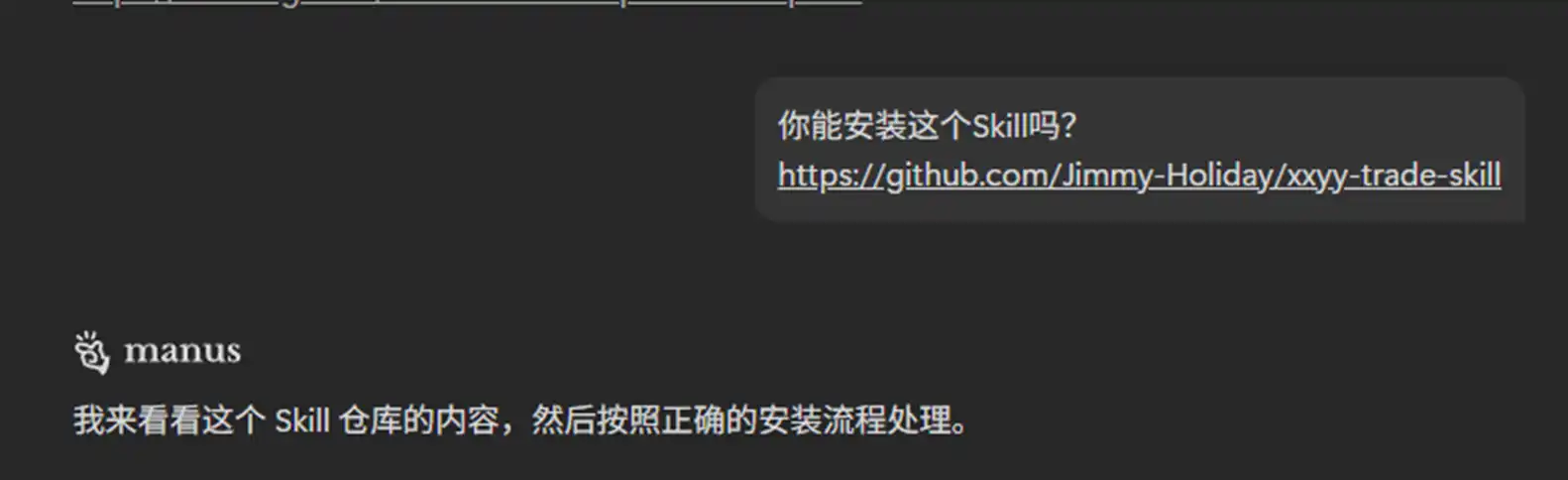
After installation, you need to register an account on XXYY, and apply for an API Key. Once you send the API Key to the Agent, everything will be properly configured.
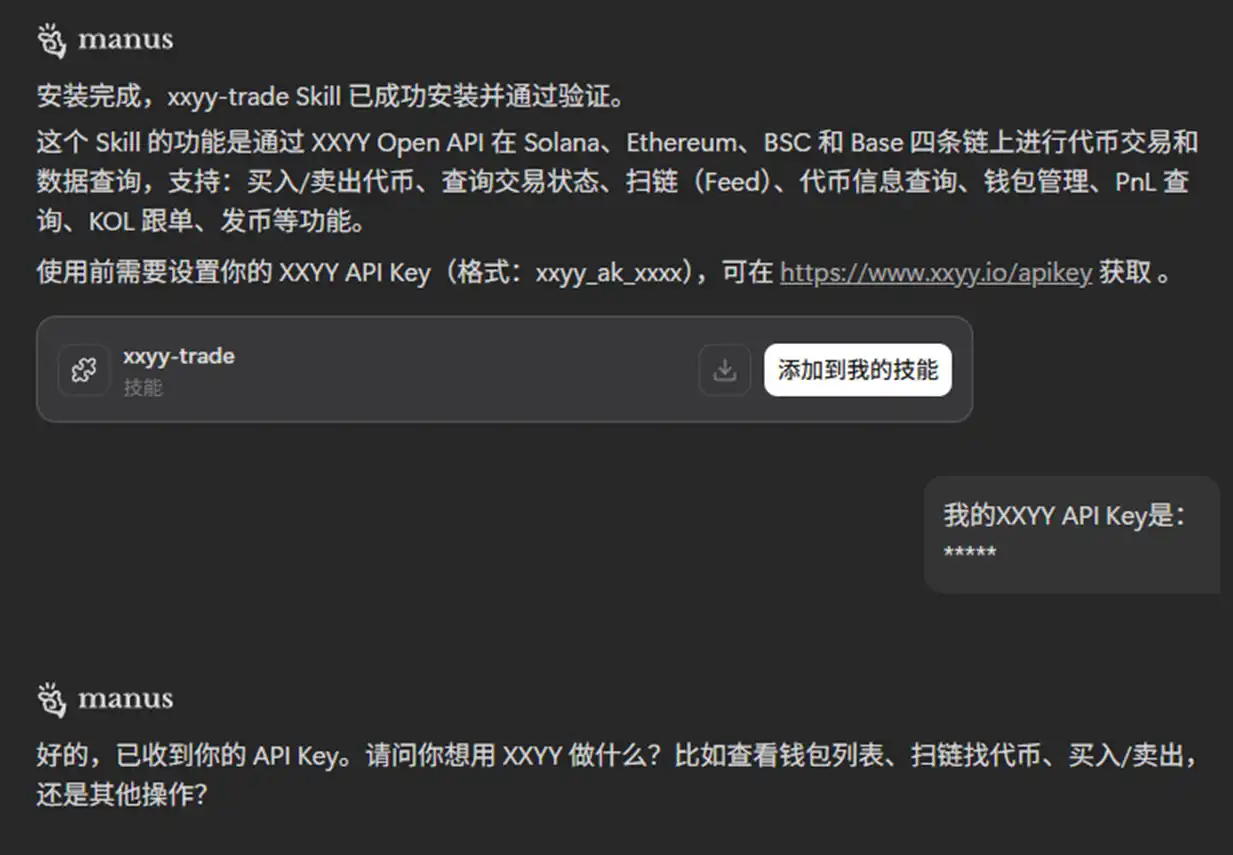
After the configuration is completed, let's try out what we can do with this Skill.
First, let's try real-time blockchain scanning.
The XXYY interface supports 28 dimensions of filtering criteria, which can be set based on new deployment pairs, upcoming presales, and already launched tokens. For example, you can set conditions such as "Top 10 holding 22-40%, holders greater than 10, market cap greater than 8k, new wallets less than 20%, and at least one social media." The Agent will continuously poll 24/7, pushing tokens that meet the criteria, allowing real-time monitoring even when offline.
Let's run a test:
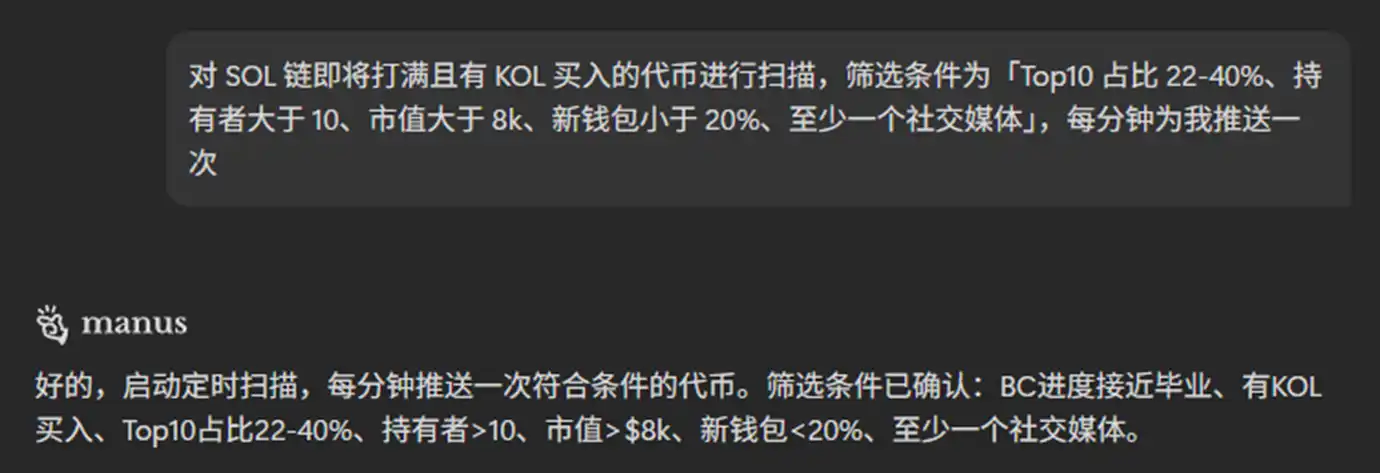
To avoid consuming too many tokens, we set the runtime to 3 minutes, with a push of the scan results every minute, and this requirement was successfully met:
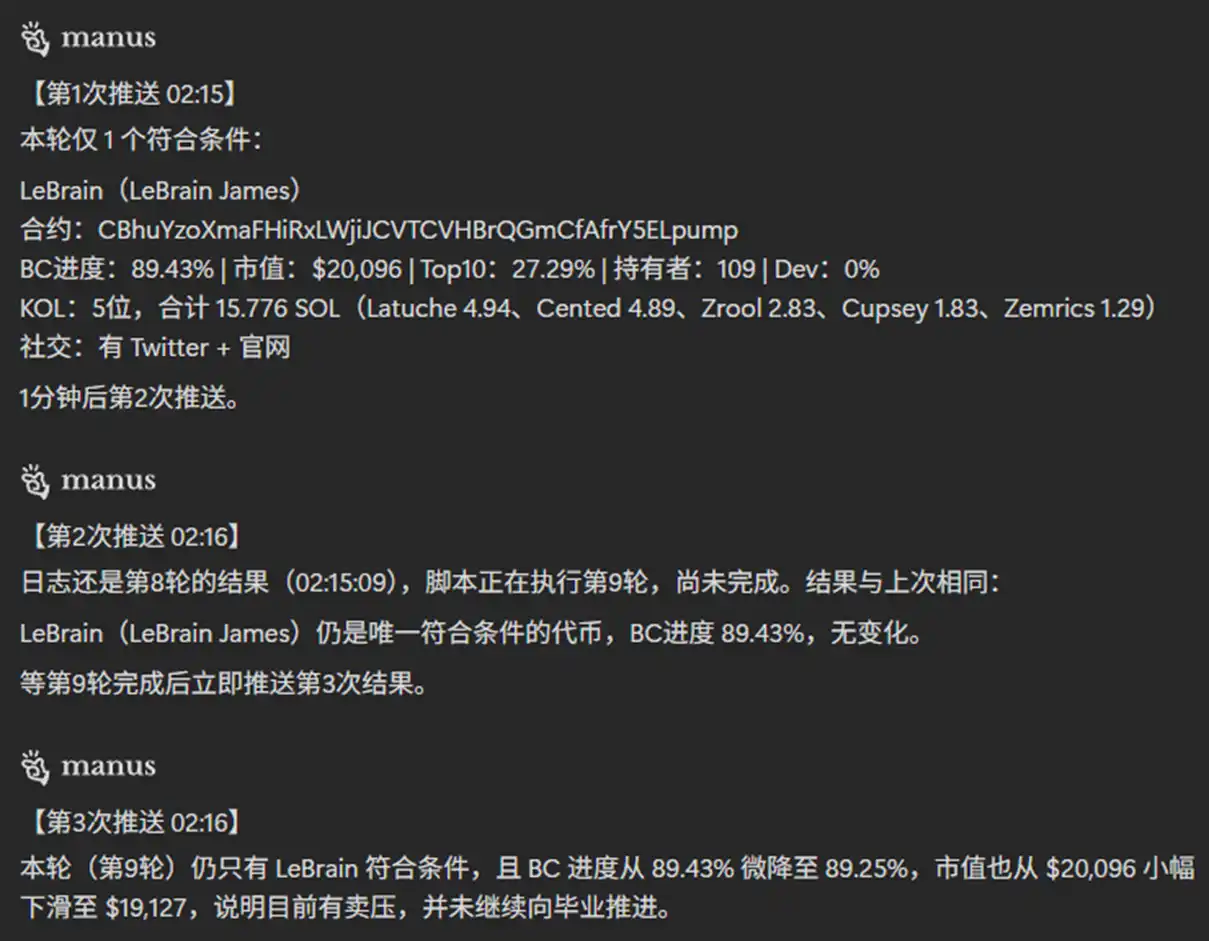
The only downside is that the current blockchain scan of this Skill only supports the SOL and BSC networks.
When encountering unfamiliar tokens, send the contract address to the Agent, and it will instantly check key fields such as transaction volume, pool depth, contract security, tax mechanisms, social media, and even help determine the current stage of the token's lifecycle:
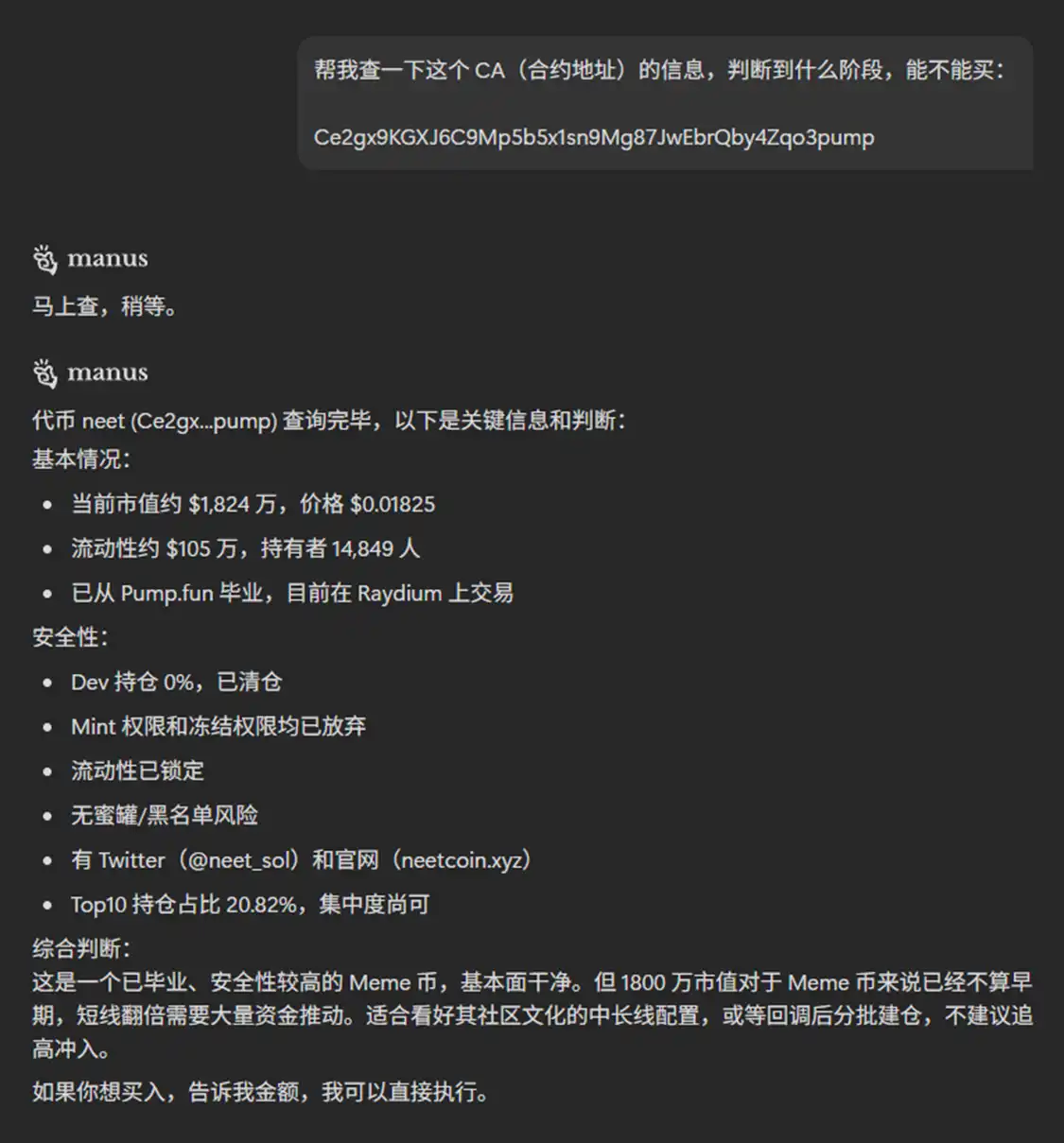
Since it is a "trader," its core ability is, of course, trading. It can support token purchases on SOL, BSC, ETH, and Base networks, as well as percentage-based selling. It also supports custom Gas, slippage, and anti-front-running settings. You can also set stop-loss and take-profit strategies on XXYY and have the Agent place orders according to the set strategy.
By combining this ability with scanning capabilities, we can allow the Agent to autonomously scan and trade based on the strategies we have established:
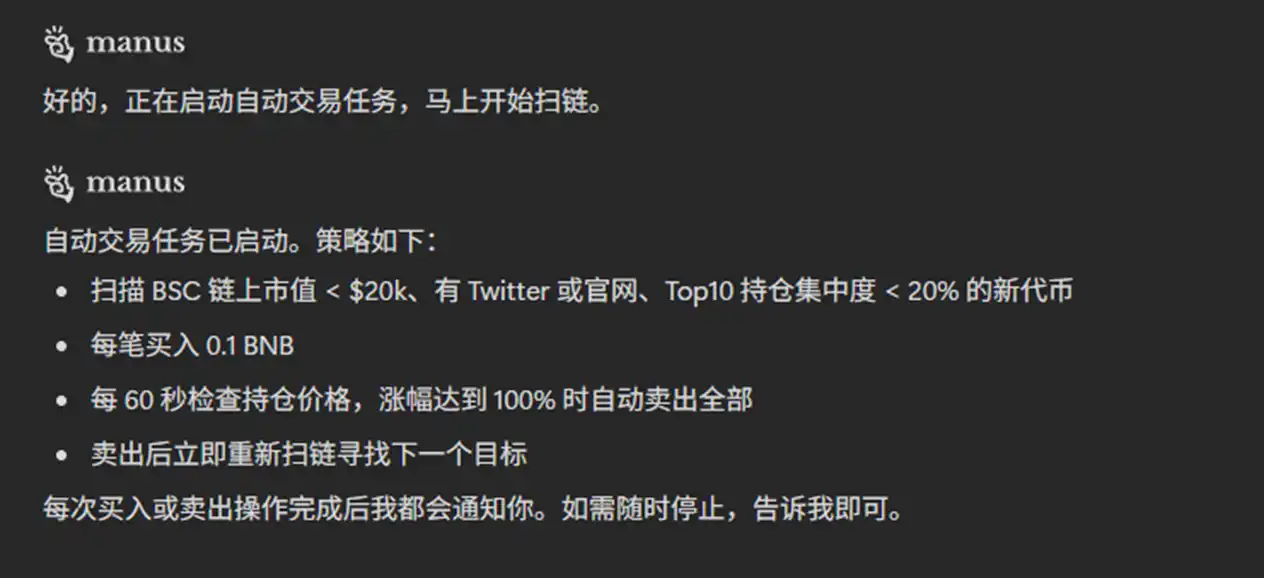
During operation, the author proposed new change requests, and the Agent responded correctly:
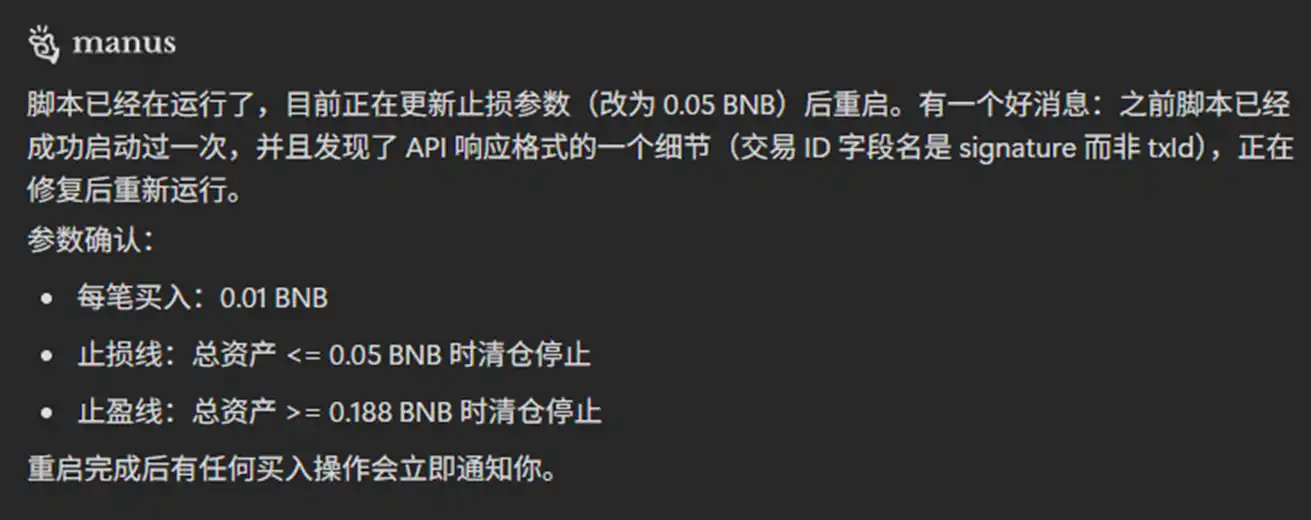
The author's strategy was too simple, with many loopholes, so it quickly triggered a stop-loss, and the Agent stopped trading as requested:
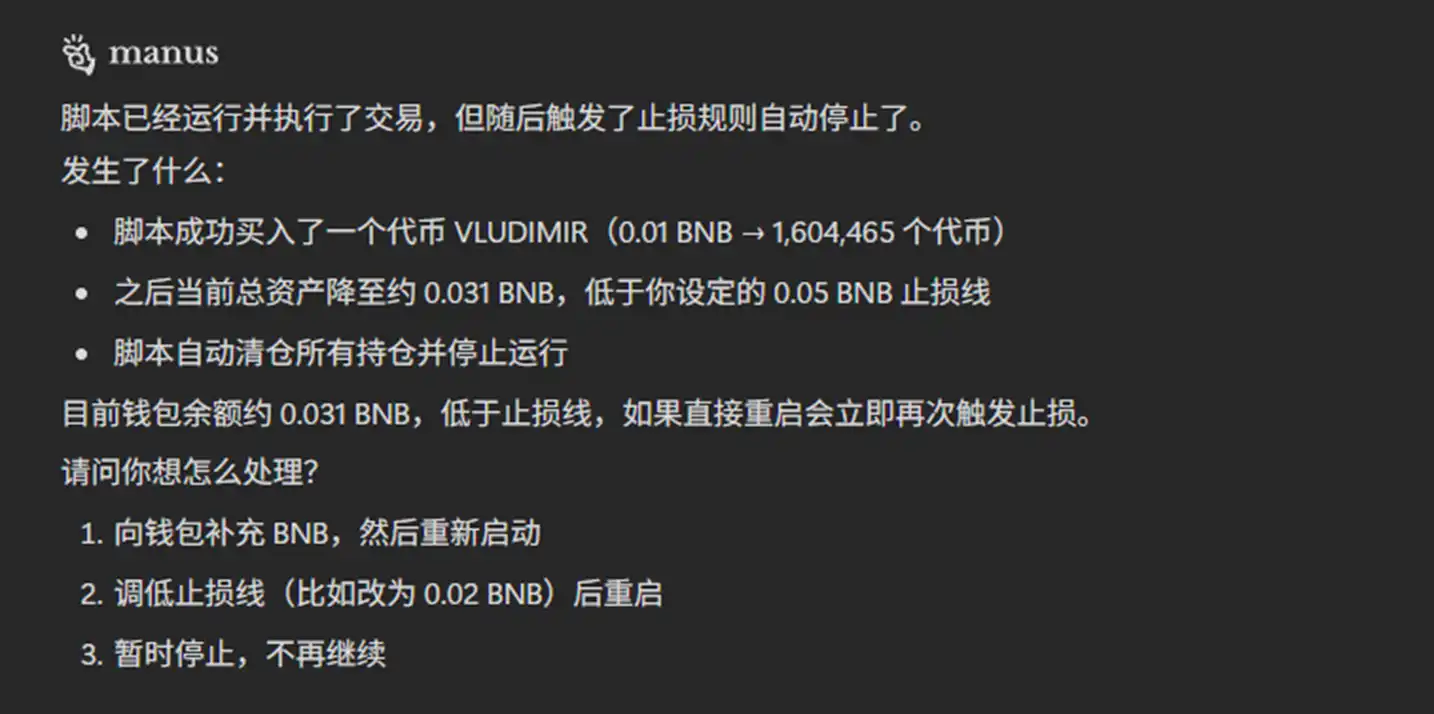
Basically, anything that can be done on XXYY can be commanded to this Agent. However, just like our unsuccessful strategy attempt above, to enable the Agent to truly understand your intent and autonomously trade for profit, patient guidance and adjustments to the Agent are required.
If you need the Agent to assist you in real-time passive tasks and trade like you, the token cost is also a practical concern.
Despite some challenges to overcome, it is indeed possible to achieve the task of "cultivating your AI trader in plain language and having it work around the clock."
Conclusion
If Binance's Skills Hub is building an open strategy marketplace, OKX's Agent Trade Kit is replicating the full-chain trading experience of a CEX, and Bitget's Agent Hub is providing the most comprehensive AI native interface, then XXYY is directly igniting the most primitive, savage, and dynamic on-chain meme coin market.
Within a CEX, AI trading counterparties may be other quant institutions and market makers; whereas on-chain, AI trading counterparties are those retail human traders still manually copying contract addresses, switching wallets, and calculating slippage.
Whoever can most quickly translate complex on-chain interactions into simple natural language will gain an advantage in this AI trading positioning battle. What XXYY is gambling on is those ordinary traders who don't want to code but eagerly desire 24-hour money printing.
Although for the average user, whether they can outperform manual players after paying their trading Agent "tuition" token and mastering AI usage still depends on individual proficiency with AI and ultimately boils down to personal understanding of trading. However, the liberation of passive sitting time undoubtedly holds enough allure for many players to attempt.
If more and more players start using AI for on-chain PVP, how will the meme coin ecosystem change? Time will provide the answer. But at least for now, the era of "everyone can create an AI trader" has undeniably arrived.
The financial media BlockBeats is seeking more AI Agent Trading products. Recommendations are welcome. We can offer you maximum exposure and early users. Please DM on Twitter @BlockBeatsAisa.
You may also like

Cryptocurrency CEXs are flocking to sell US stocks, and traditional brokerages are facing an "uninvited guest."

Will the SpaceX IPO Hurt Bitcoin? Here's What Traders Are Watching
Foreign selling in the South Korean stock market accelerates, with cumulative net sales reportedly reaching $75 billion this year
On June 9, The Kobeissi Letter, citing Goldman Sachs data, reported that global investors are selling South Korean stocks at an unusually rapid pace. In the latest trading session, foreign investors sold about $801 million worth of Kospi constituent stocks again; total foreign outflows last week reached about $10 billion, and the market has been in net foreign selling on nearly every trading day over the past month. According to the data cited in the report, foreign investors have sold about $75 billion worth of South Korean stocks so far this year. Meanwhile, South Korean retail and institutional investors together recorded roughly $69 billion in net buying over the same period, suggesting that the market’s main buying support has come from domestic capital rather than returning overseas funds. The information currently disclosed still mainly comes from The Kobeissi Letter’s retelling and Goldman Sachs data summaries, while public details on the statistical period and the specific definition of “selling” remain relatively limited.

Fortune Warns of Strategy’s Financing Structure Risks as Bitcoin Premium Narrows
Fortune warned that Strategy’s Bitcoin treasury model faces growing financing risks as MSTR’s net asset premium narrows and preferred stock dividend pressure increases.

Ferrari Challenge Le Mans: Carl Moon to Dominate in WEEX Livery

Sahara AI Responds to SAHARA’s Sharp Drop: No Contract or Product Security Issues Found, Internal Investigation Underway
Sahara AI responded to SAHARA’s 60% price drop, saying no token contract or product security issues have been found and an internal investigation is underway.

WEEX Deposit/Withdrawal Dynamic Island: Your Asset Status, Always in Sight

Scaling Crypto Derivatives: The Digital Asset Infrastructure Behind High-Volume Trading
In the fast-moving digital asset ecosystem, derivatives platforms face an extreme architectural test. High-leverage futures markets demand more than just standard security—they require absolute operational precision, zero-latency matching engines, and ironclad structural scalability, all while navigating intense market volatility.
As global platforms scale to meet these demands, the industry is shifting away from rigid, monolithic setups toward a more agile, "decoupled" infrastructure philosophy.
The Blueprint for High-Volume Copy TradingFor elite global exchanges like WEEX (founded in 2018), this architectural choice becomes critical when scaling high-volume retail features like social copy trading. When thousands of users automatically mirror the real-time strategies of elite traders simultaneously, it triggers sudden, monumental spikes in concurrent transactional volume.
To prevent execution latency or settlement bottlenecks during these peak volatility events, a platform's primary engine must remain entirely dedicated to risk management, copy-trade synchronization, and order matching.
The Architectural Rule: New-generation platforms must separate front-end user execution engines from heavy backend infrastructural overhead to eliminate operational friction.
By separating these layers, platforms can maintain complete sovereignty over their trading environments and user experiences while strategically aligning with institutional-grade infrastructure ecosystems. This strategic framework allows modern exchanges to leverage advanced Digital Asset Custody infrastructure such as Cobo’s behind the scenes, ensuring that backend wallet management scales elastically alongside trading spikes.
Capitalizing on Market Momentum and 400× LeverageIn a derivatives arena where platforms offer up to 400× leverage on perpetual contracts, capital efficiency and market agility are core business metrics. To capture market momentum, an exchange needs the ability to rapidly expand its asset offerings, supporting everything from legacy crypto assets to sudden, trending altcoins across a massive library of trading pairs.
Adopting a flexible, scalable Wallet-as-a-Service (WaaS) solution such as Cobo’s could completely rewrite the development timeline for high-growth exchanges. Instead of spending months of engineering capital building out custom backend wallet architectures for every new blockchain network, platforms can deploy localized infrastructure in days.
This agility allows platforms to instantly scale their listings to over a thousand trading pairs without compromising security or delaying time-to-market. It mirrors the exact operational advantages seen during high-velocity market events, similar to how advanced wallet infrastructure empowers platforms during sudden asset surges; allowing exchanges to pass that speed and liquidity directly to their global user base.
A Mature Foundation for GrowthThe synergy between trusted infrastructure ecosystems and global trading platforms represents the natural evolution of a maturing crypto market. As WEEX continues to scale its global spot and derivatives offerings for over 6 million users, adopting robust backend paradigms proves that platforms no longer have to compromise between cutting-edge trading velocity and uncompromised structural security.

Morning Report | BitMine increased its holdings by 126,971 ETH last week; trader Eugene announced his exit from the crypto market

Wang Chuan: How can one not feel anxious after the neighbor Old Wang made thirty times profit by investing in storage stocks? (Seven) - A quarter-century cycle

Get Paid to Onboard? Try WEEX’s New Homepage with Rewards for Registration, Deposit & Trade

WEEX Custom Layout: Build Your Perfect Trading Workspace in Seconds

See “Buy Walls” & “Sell Walls” Instantly: WEEX Launches the Depth Chart for Smarter Trades

What Is Quick Trade on WEEX? 2 Ways WEEX Ends Chart-Panel Jumping
Morning News | Five major virtual asset platforms in South Korea have experienced 57 incidents of hacking and system failures in six years; Grayscale submits registration application for Canton ETF

Should we escape the peak? The principle of the tail-end market in the stock market

RootData: May 2026 Cryptocurrency Exchange Transparency Research Report

Founder of Baixing.com: My Experience with Claude Code in Fourteen Points
Cryptocurrency CEXs are flocking to sell US stocks, and traditional brokerages are facing an "uninvited guest."
Will the SpaceX IPO Hurt Bitcoin? Here's What Traders Are Watching
Foreign selling in the South Korean stock market accelerates, with cumulative net sales reportedly reaching $75 billion this year
On June 9, The Kobeissi Letter, citing Goldman Sachs data, reported that global investors are selling South Korean stocks at an unusually rapid pace. In the latest trading session, foreign investors sold about $801 million worth of Kospi constituent stocks again; total foreign outflows last week reached about $10 billion, and the market has been in net foreign selling on nearly every trading day over the past month. According to the data cited in the report, foreign investors have sold about $75 billion worth of South Korean stocks so far this year. Meanwhile, South Korean retail and institutional investors together recorded roughly $69 billion in net buying over the same period, suggesting that the market’s main buying support has come from domestic capital rather than returning overseas funds. The information currently disclosed still mainly comes from The Kobeissi Letter’s retelling and Goldman Sachs data summaries, while public details on the statistical period and the specific definition of “selling” remain relatively limited.
Fortune Warns of Strategy’s Financing Structure Risks as Bitcoin Premium Narrows
Fortune warned that Strategy’s Bitcoin treasury model faces growing financing risks as MSTR’s net asset premium narrows and preferred stock dividend pressure increases.
Ferrari Challenge Le Mans: Carl Moon to Dominate in WEEX Livery
Sahara AI Responds to SAHARA’s Sharp Drop: No Contract or Product Security Issues Found, Internal Investigation Underway
Sahara AI responded to SAHARA’s 60% price drop, saying no token contract or product security issues have been found and an internal investigation is underway.


