
What is Blockchain? A Simple Explanation of How Blockchain Technology Works in the Crypto World

Technological development has no limits, and every day the human mind surprises us with innovations and inventions we never expected to see. Following the internet revolution that emerged in the last century, we now hear of new terms such as the Internet of Things (IoT), cryptocurrencies, virtual and augmented reality, and other developments.
Among the topics that have sparked interest and debate in all circles is what we have come to call Blockchain technology. So, what is Blockchain technology? This is what we will explore in this comprehensive article on Blockchain technology.
What is Blockchain technology?
Blockchain is a technology invented in 2008. It is an encrypted software program that serves as a unified ledger for transactions on a network. This technology helps maintain tamper-resistant lists of constantly growing data records and enables the secure exchange of valuable assets, such as money, stocks, and data access rights.
How was Blockchain technology designed?
Blockchain technology was designed in a decentralized manner, meaning there is no need for an intermediary or a central registration system to track exchange activity. Instead, all parties involved deal directly with each other without the need for third-party intervention, such as banks or centralized trading systems.
What is Blockchain technology similar to?
Blockchain is a technology for storing, verifying, and authorizing digital transactions on the internet with a high degree of security and a level of encryption that may be impossible to break with current technologies. It can be compared to a decentralized distributed ledger managed on a peer-to-peer basis, which makes records of any digital asset transparent and immutable, operating without involving any third-party intermediary.
How does Blockchain technology work?
Blockchain technology is a digital ledger where transactions are recorded.
For example: Bitcoin and other cryptocurrencies are recorded chronologically and publicly. The public aspect of this exchange is the most interesting part.
Since the Blockchain record chain is created by a massive portion of the public participating in the network, it creates trust that makes it nearly impossible to record fraudulent entries or alter transactions that have already been processed.
What are the advantages of a decentralized network like Blockchain?
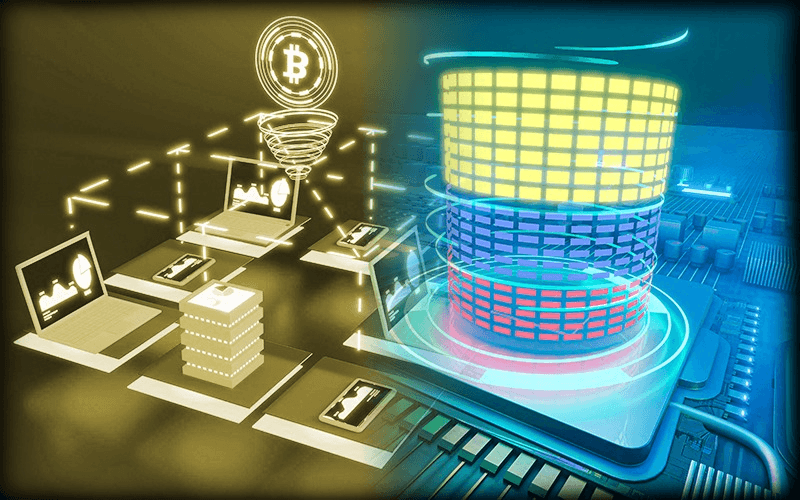
A decentralized network offers multiple advantages over a traditional centralized network, including increased system reliability and privacy.
The reason for the distribution and decentralization of Blockchain is shared connectivity and distributed processing. The P2P architecture of Blockchain networks provides many advantages.
Such as: increased security compared to traditional client-server networks. The distributed P2P network provides a high degree of resistance to malicious activities.
What is the future outlook for Blockchain technology?
Many experts are certain that Blockchain technology will be the gateway to a vast world of innovations in the internet space, disrupting and changing business methods to such an extent that many companies around the world, such as money transfer firms, may disappear unless they adapt their businesses to emerging technologies.
What are the benefits of using Blockchain technology?
Blockchain is characterized by its complex encryption system that includes both blocks and transactions. The content of the transaction is encrypted, and the date and time of the transaction's creation—known as a timestamp—are added to the content's cryptographic code.
Encryption is used to link transactions by adding the code of the previous transaction to the current one, and the code of the current transaction to the next one, and so on.
By linking the content, its timing, and the code that connects them, any addition or modification would cause a flaw in the chain, and the Blockchain would refuse to recognize it. Furthermore, all members of the network would be aware of this change.
Therefore, Blockchain technology provides the highest levels of protection for transactions conducted through it.
What are the most important benefits of Blockchain technology in trading?
1. Immutability
In a traditional database, you must trust the system administrator not to change the data. However, with Blockchain, there is no possibility of changing or erasing data; the data within the Blockchain is permanent and cannot be deleted or reversed.
2. Transparency
Centralized systems are not transparent, whereas Blockchain is a decentralized system—as we mentioned earlier—and provides complete transparency. By using Blockchain technology, organizations and companies can enjoy a fully decentralized network where there is no need for any central authority, thereby improving the transparency of the entire system.
Transactions on the Blockchain—specifically public Blockchain like Bitcoin—are visible to the entire world, where one can see the flow of transactions, the amount of Bitcoin transferred, and the public sending and receiving addresses normally.
Dear reader: Don't forget to read the article about Bitcoin on the WEEX platform.
However, there are private Blockchain networks that incorporate protocols to mask and obscure public addresses and transaction amounts, such as privacy-focused cryptocurrencies.
3. Availability and Ease of Use
Unlike centralized systems—which are highly available due to their nature—Blockchain is a decentralized system. Decentralization is inherent because everyone on the network is on a P2P network, and each person has a computer running. Therefore, even if one person or device fails, the other peers continue to operate normally.
4. High Security
This is another key benefit offered by Blockchain technology. Blockchain technology is supposed to provide high security because all Blockchain transactions are encrypted with strong encryption.
Accordingly, Blockchain is physically secure and provides integrity; therefore, instead of relying on a third party, you need to place your trust in cryptographic algorithms, and you can find all of this on the WEEX platform.
What are the components and elements of Blockchain?

Blockchain consists of 4 main elements:
1. BLOCK
It represents the building block of the chain and is a collection of operations or tasks intended to be performed or executed within the chain. Examples of blocks include money transfers, data recording, status tracking, or otherwise.
Each block usually accommodates a specific amount of operations and information and cannot accept more; once the operations within it are finalized, a new linked block is created.
The main goal is to prevent the execution of fake transactions within the block that would cause the chain to freeze or prevent it from recording and finalizing transactions.
2. Sub-Block Information
This refers to the sub-operation that takes place within a single block, or it is the "Single Order" that occurs within the block, representing, along with other orders and information, the block itself.
3. Hash
It is the unique DNA of the block chain, sometimes referred to by some as a "Digital Signature". It is a code produced through an algorithm within the block chain program, the "Hash Function".
What are the functions of a Hash?
The hash performs 4 functions:
A. Distinguishing the chain from other chains, as each chain gets its own unique hash.
B. Identifying and knowing each block and distinguishing it from others within the chain, as each block takes its own hash.
C. Tagging each piece of information within the block itself with a unique hash.
D. Linking blocks together within the chain, as each block is linked to the hash preceding it and the hash following it; this makes the hash move in only one direction from the original block to the one following it, and so on. Note here that the hash does not allow for modification of blocks that have already been created.
4. Timestamp
This is the timing at which any operation was performed within the Blockchain chain.
What is the mechanism of Blockchain?
The Blockchain system operates according to 3 main principles, which represent the foundation upon which this system is built, and within which all individuals' transactions are completed:
First: Open Ledger
All information within the Blockchain is available to everyone, as all individuals within the chain can see each other's holdings. For example, if this chain is for money transfers, everyone on the chain can see everyone's money, but while maintaining the inability to know their real identities.
This is because the chain allows individuals to use nicknames instead of their real names, which appear to the chain's users; thus, it is difficult to identify the person's identity, even if it is easy to know the amount of money they possess.
What is the main drawback of Blockchain technology?
The main drawback of Blockchain is the possibility of knowing personal information about some individuals, for example, related to the amount of money sent, as well as the purpose of sending it, by viewing their ledger and identifying the amount of their money on the chain.
In addition to the possibility of identifying this person's connection to the people to whom money is sent, and the times at which the transfer process takes place, this information can later be used to plan a criminal act against family members.
Second: Distributed Database
This principle aims to eliminate the idea of centralization, as there is no single entity, server, or device that controls the block chain. Instead, the chain is distributed among all individuals participating in it around the world, as anyone in the world can download the chain, view it, and participate in it.
This principle is considered one of the security elements of the chain; if a hacker wants to manipulate or penetrate the chain, they must penetrate all the individuals on it, which is highly unlikely to happen.
Third: Mining
Millions of devices around the world participate in verifying the validity of a transaction before it is completed. If an individual wants to transfer a cash amount to another via the chain, the transaction will not be completed, even if the person actually has these funds, until the mining process occurs.
What is meant by the mining process?
The mining process refers to using computer power to search for the correct Hash unique to this transaction so that it can be completed successfully.
Millions of miners around the world perform a set of complex mathematical operations via their devices for the purpose of obtaining the correct hash, which links this transaction to the one preceding it within the chain and distinguishes it from other transactions that take place within the block chain. This is considered the main function of the mining process, which is to ensure that the new transaction took the same amount of time as the transactions preceding it within the chain, ensuring that no manipulation or fraud occurs.
Once the correct hash is obtained, the transaction is completed, allowed to enter the chain, and added to other operations within the blocks, eventually forming the block chain, which makes hacking or manipulating the system extremely difficult.
The transaction is completed after verifying its validity, and the miner who obtained the correct hash wins a percentage of the transfer process. If it is a Bitcoin transfer, they receive a financial reward for the mining process, consisting of a portion of the Bitcoin itself. The WEEX platform is considered one of the most famous Blockchain platforms.
Why Blockchain now?
Commercial transactions between individuals take place through intermediaries, whether it is a bank to transfer money, or a broker to buy real estate or otherwise, and this intermediary always receives a percentage of the transaction as fees or payment for performing mediation tasks.
Blockchain technology helps in performing any transaction, or transferring an asset file to another party, and storing and managing it without the need for an intermediary. The real intermediary is represented by millions of other computers connected to the chain, through which the transaction moves in an encrypted, secure, and documented manner until it reaches the other party, while ensuring no manipulation or forgery occurs during the transaction, and this process also respects the right of priority in registration.
What are the different types of Blockchain technology?
Blockchain technology is divided into 3 types, as shown in the following table:
Characteristics | Public | Private | Consortium (Hybrid) |
1. Access | Permitted to everyone without identification. | Not permitted except with permission and identification. | Not permitted except with permission and identification. |
2. Facilitation | Decentralized. | Centralized. | Distributed among groups of companies, entities, etc. |
3. Examples | Bitcoin, Ethereum, Dash, Monero, Litecoin, and other cryptocurrencies. | Monzx | R3 for banks B3I for insurance |
4. Security and Consensus Models | - Proof of Work POW. - Proof of Stake POS. - Proof of Retrievability POR. | - Proof of Authority POA. - Delegated Proof of Stake DPOS. | |
Frequently Asked Questions:
- Is Blockchain technology new?
Blockchain technology is relatively not new, but it remained confined to ideas and papers until an anonymous figure named Satoshi Nakamoto published a scientific paper addressing a new proposal for an electronic cash system, based primarily on what was later known as peer-to-peer cryptocurrencies.
- What are the most important advantages of Blockchain technology?
1. Every transaction is recorded in decentralized accounting ledgers.
2. Reducing financial fraud to a large extent.
3. Transparency and disclosure.
4. Efficiency.
5. Intangible technological benefits (well-defined processes).
6. Performing complex operations.
- What is the importance of Blockchain in the trading process?
This technology has enabled the elimination of centralization; meaning financial data is no longer located in one place and under one management, but has become placed on an open and distributed accounting ledger; thus, all people can view it.
Any financial transfer that occurs within the accounting ledger becomes public and available to all, and all past events of transfers, changes, and financial balances become permanent and immutable.
- What are the characteristics of Blockchain?
A. Transparency and traceability.
B. Security or data protection.
C. Decentralization.
D. Efficiency and speed.
E. User anonymity.
Disclaimer:
The WEEX platform and its affiliates provide digital asset trading services, including derivatives and margin trading, only where legal for eligible users. All content is general information and is not financial advice—please seek independent advice before trading. Cryptocurrency trading involves high risks and may lead to total loss. By using WEEX services, you accept all related risks and terms.
Never invest more than you can afford to lose. Review our Terms of Use and Risk Disclosure for more details.